Kirjojen hintavertailu – 12 903 725 kirjaa ja 27 kauppaa

Kirjailija

Alexander Rodriguez

Kirjat ja teokset yhdessä paikassa: 493 kirjaa, julkaisuja vuosilta 2014–2019, suosituimpiin kuuluu Puzzles for Brain Tents - 200 Medium Puzzles 10x10 vol. 6. Vertaile teosten hintoja ja tarkista saatavuus suomalaisista kirjakaupoista.

493 kirjaa

Kirjojen julkaisuvuodet: 2014–2019.

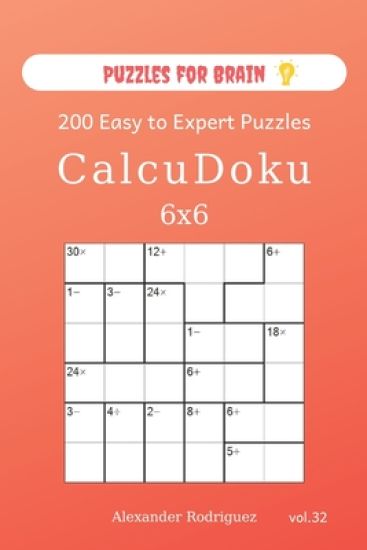
Puzzles for Brain - CalcuDoku 200 Easy to Expert Puzzles 6x6 (volume 32)
Each puzzle consists of a grid containing blocks surrounded by bold lines. The object is to fill all empty squares so that the numbers 1 to N (where N is the number of rows or columns in the grid) appear exactly once in each row and column and the numbers in each block produce the result shown in the top-left corner of the block according to the math operation appearing on the top of the grid. In CalcuDoku a number may be used more than once in the same block.
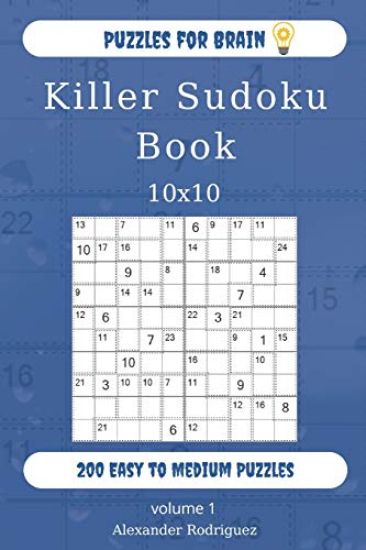
Puzzles for Brain - Killer Sudoku Book 200 Easy to Medium Puzzles 10x10 (volume 1)
Killer Sudoku is a mix of Sudoku and Kakuro. Your goal is the same as in regular sudoku: fill every row, column and 5x2 region with the numbers 1-10 once. The difference is how you arrive at those numbers. The objective is to fill the grid with numbers from 1 to 10 in a way that the following conditions are met: Each row, column, and nonet contains each number exactly once. The sum of all numbers in a cage must match the small number printed in its corner. No number appears more than once in a cage. (This is the standard rule for killer sudokus, and implies that no cage can include more than 10 cells.
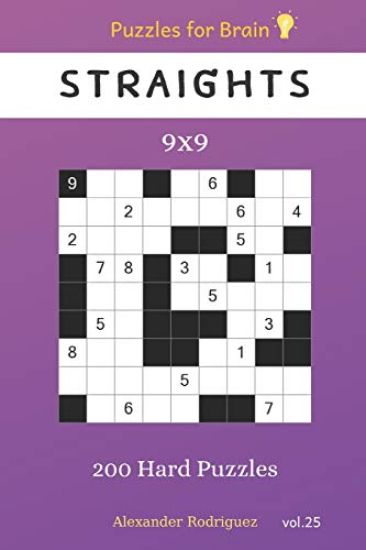
Puzzles for Brain - Straights 200 Hard Puzzles 9x9 vol.25

Puzzles for Brain - Straights 200 Hard Puzzles 9x9 vol.25

Alexander Rodriguez

Independently Published
2019
nidottu
The solver is given a 9x9 grid, partially divided by black cells into compartments. Each compartment, vertically or horizontally, must contain a straight - a set of consecutive numbers, but in any order. For example: 7, 6, 4, 5 is valid, but 1, 3, 8, 7 is not. Like sudoku, the solver must fill the remaining white cells with numbers 1 to 9 (or 1 to n in puzzles with N cells per side) such that each row and column contains unique digits. Whereas Sudoku has the additional constraint of 3x3 boxes, in Str8ts rows and columns are divided by blacks cells. Additional clues are set in some of the black cells - these numbers remove that digit as an option in the row and column. Such digits do not form part of any straight.
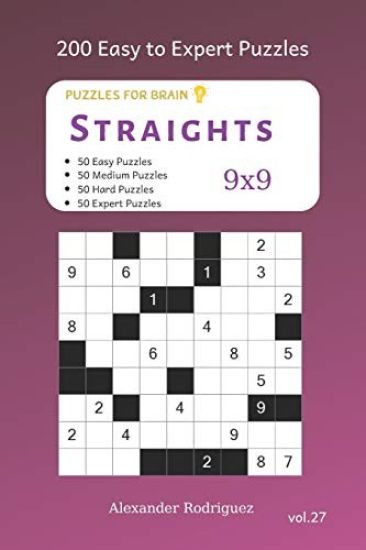
Puzzles for Brain - Straights 200 Easy to Expert Puzzles 9x9 vol.27
The solver is given a 9x9 grid, partially divided by black cells into compartments. Each compartment, vertically or horizontally, must contain a straight - a set of consecutive numbers, but in any order. For example: 7, 6, 4, 5 is valid, but 1, 3, 8, 7 is not. Like sudoku, the solver must fill the remaining white cells with numbers 1 to 9 (or 1 to n in puzzles with N cells per side) such that each row and column contains unique digits. Whereas Sudoku has the additional constraint of 3x3 boxes, in Str8ts rows and columns are divided by blacks cells. Additional clues are set in some of the black cells - these numbers remove that digit as an option in the row and column. Such digits do not form part of any straight.
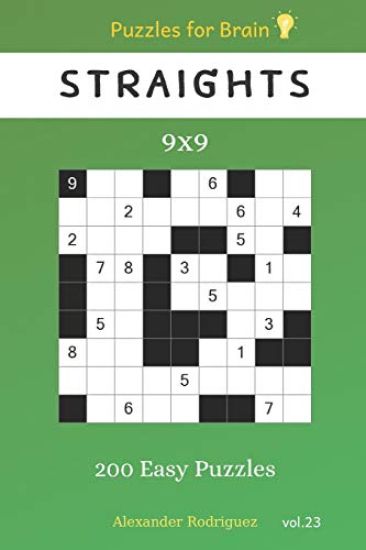
Puzzles for Brain - Straights 200 Easy Puzzles 9x9 vol.23

Puzzles for Brain - Straights 200 Easy Puzzles 9x9 vol.23

Alexander Rodriguez

Independently Published
2019
nidottu
The solver is given a 9x9 grid, partially divided by black cells into compartments. Each compartment, vertically or horizontally, must contain a straight - a set of consecutive numbers, but in any order. For example: 7, 6, 4, 5 is valid, but 1, 3, 8, 7 is not. Like sudoku, the solver must fill the remaining white cells with numbers 1 to 9 (or 1 to n in puzzles with N cells per side) such that each row and column contains unique digits. Whereas Sudoku has the additional constraint of 3x3 boxes, in Str8ts rows and columns are divided by blacks cells. Additional clues are set in some of the black cells - these numbers remove that digit as an option in the row and column. Such digits do not form part of any straight.
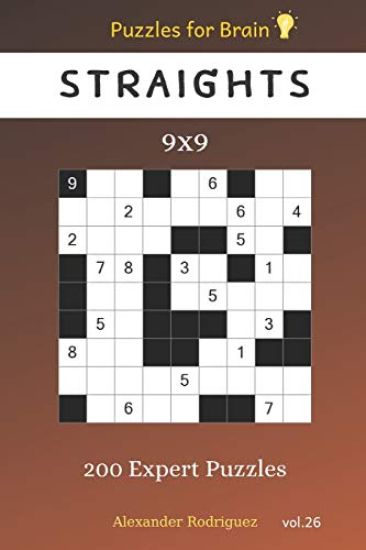
Puzzles for Brain - Straights 200 Expert Puzzles 9x9 vol.26

Puzzles for Brain - Straights 200 Expert Puzzles 9x9 vol.26

Alexander Rodriguez

Independently Published
2019
nidottu
The solver is given a 9x9 grid, partially divided by black cells into compartments. Each compartment, vertically or horizontally, must contain a straight - a set of consecutive numbers, but in any order. For example: 7, 6, 4, 5 is valid, but 1, 3, 8, 7 is not. Like sudoku, the solver must fill the remaining white cells with numbers 1 to 9 (or 1 to n in puzzles with N cells per side) such that each row and column contains unique digits. Whereas Sudoku has the additional constraint of 3x3 boxes, in Str8ts rows and columns are divided by blacks cells. Additional clues are set in some of the black cells - these numbers remove that digit as an option in the row and column. Such digits do not form part of any straight.
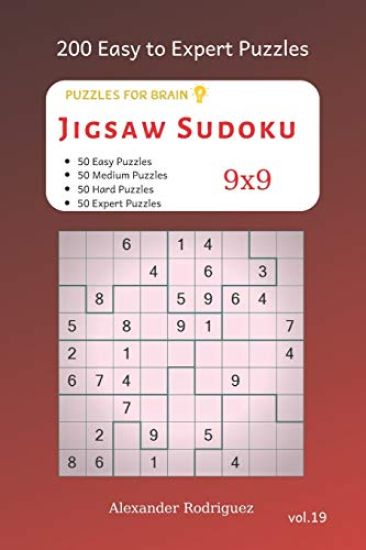
Puzzles for Brain - Jigsaw Sudoku 200 Easy to Expert Puzzles 9x9 vol.19
The rules of Jigsaw Sudoku are similar to standard Sudoku, since you must place each of the numbers 1 to 9 (or 1 to whatever the size of the puzzle is) into each of the rows and columns. However whereas standard Sudoku also has rectangular boxes that must each contain every number, in Jigsaw Sudoku these boxes are replaced by different bold-lined shapes that must each contain every number instead.
Puzzles for Brain - CalcuDoku 200 Easy to Expert Puzzles 9x9 vol.31
Each puzzle consists of a grid containing blocks surrounded by bold lines. The object is to fill all empty squares so that the numbers 1 to N (where N is the number of rows or columns in the grid) appear exactly once in each row and column and the numbers in each block produce the result shown in the top-left corner of the block according to the math operation appearing on the top of the grid. In CalcuDoku a number may be used more than once in the same block.