Kirjojen hintavertailu – 12 903 725 kirjaa ja 27 kauppaa
Kirjailija
Alexander Rodriguez
Kirjat ja teokset yhdessä paikassa: 493 kirjaa, julkaisuja vuosilta 2014–2019, suosituimpiin kuuluu Puzzles for Brain Tents - 200 Medium Puzzles 10x10 vol. 6. Vertaile teosten hintoja ja tarkista saatavuus suomalaisista kirjakaupoista.
Each cell should contain a zero or a one. No more than two similar numbers below or next to each other are allowed. Each row and each column is unique and contains as many zeros as ones.
Each cell should contain a zero or a one. No more than two similar numbers below or next to each other are allowed. Each row and each column is unique and contains as many zeros as ones.
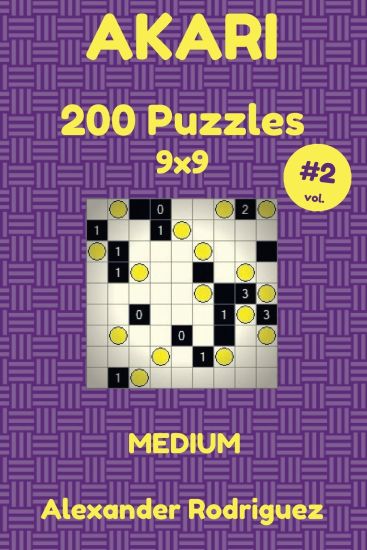
Akari (Light Up) is played on a rectangular grid of white and black cells. The player places light bulbs in white cells such that no two bulbs shine on each other, until the entire grid is lit up. A bulb sends rays of light horizontally and vertically, illuminating its entire row and column unless its light is blocked by a black cell. A black cell may have a number on it from 0 to 4, indicating how many bulbs must be placed adjacent to its four sides; for example, a cell with a 4 must have four bulbs around it, one on each side, and a cell with a 0 cannot have a bulb next to any of its sides. An unnumbered black cell may have any number of light bulbs adjacent to it, or none. Bulbs placed diagonally adjacent to a numbered cell do not contribute to the bulb count.
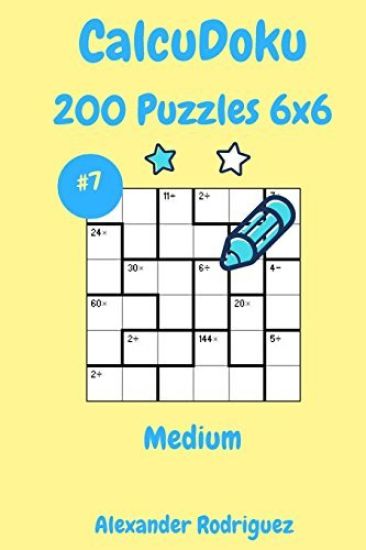
Each puzzle consists of a grid containing blocks surrounded by bold lines. The object is to fill all empty squares so that the numbers 1 to N (where N is the number of rows or columns in the grid) appear exactly once in each row and column and the numbers in each block produce the result shown in the top-left corner of the block according to the math operation appearing on the top of the grid. In CalcuDoku a number may be used more than once in the same block.
Each puzzle consists of a grid containing blocks surrounded by bold lines. The object is to fill all empty squares so that the numbers 1 to N (where N is the number of rows or columns in the grid) appear exactly once in each row and column and the numbers in each block produce the result shown in the top-left corner of the block according to the math operation appearing on the top of the grid. In CalcuDoku a number may be used more than once in the same block.
Each puzzle consists of a grid containing blocks surrounded by bold lines. The object is to fill all empty squares so that the numbers 1 to N (where N is the number of rows or columns in the grid) appear exactly once in each row and column and the numbers in each block produce the result shown in the top-left corner of the block according to the math operation appearing on the top of the grid. In CalcuDoku a number may be used more than once in the same block.
Akari (Light Up) is played on a rectangular grid of white and black cells. The player places light bulbs in white cells such that no two bulbs shine on each other, until the entire grid is lit up. A bulb sends rays of light horizontally and vertically, illuminating its entire row and column unless its light is blocked by a black cell. A black cell may have a number on it from 0 to 4, indicating how many bulbs must be placed adjacent to its four sides; for example, a cell with a 4 must have four bulbs around it, one on each side, and a cell with a 0 cannot have a bulb next to any of its sides. An unnumbered black cell may have any number of light bulbs adjacent to it, or none. Bulbs placed diagonally adjacent to a numbered cell do not contribute to the bulb count.
Akari (Light Up) is played on a rectangular grid of white and black cells. The player places light bulbs in white cells such that no two bulbs shine on each other, until the entire grid is lit up. A bulb sends rays of light horizontally and vertically, illuminating its entire row and column unless its light is blocked by a black cell. A black cell may have a number on it from 0 to 4, indicating how many bulbs must be placed adjacent to its four sides; for example, a cell with a 4 must have four bulbs around it, one on each side, and a cell with a 0 cannot have a bulb next to any of its sides. An unnumbered black cell may have any number of light bulbs adjacent to it, or none. Bulbs placed diagonally adjacent to a numbered cell do not contribute to the bulb count.
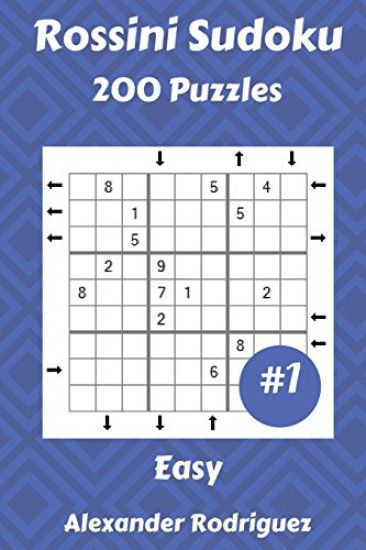
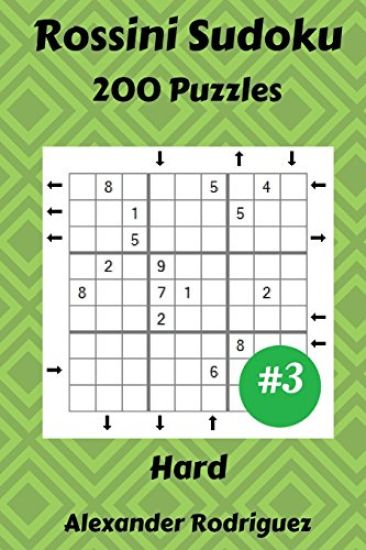
Classic Sudoku Rules apply. Additionally the arrows indicate that the nearest three digits in the row (column) are in ascending or descending order (increasing towards the direction the arrow is pointing towards). If there is no arrow outside a row/column, the nearest 3 digits therein cannot be in either ascending or descending order.
Classic Sudoku Rules apply. Additionally the arrows indicate that the nearest three digits in the row (column) are in ascending or descending order (increasing towards the direction the arrow is pointing towards). If there is no arrow outside a row/column, the nearest 3 digits therein cannot be in either ascending or descending order.
Each puzzle consists of a grid containing blocks surrounded by bold lines. The object is to fill all empty squares so that the numbers 1 to N (where N is the number of rows or columns in the grid) appear exactly once in each row and column and the numbers in each block produce the result shown in the top-left corner of the block according to the math operation appearing on the top of the grid. In CalcuDoku a number may be used more than once in the same block.
Akari (Light Up) is played on a rectangular grid of white and black cells. The player places light bulbs in white cells such that no two bulbs shine on each other, until the entire grid is lit up. A bulb sends rays of light horizontally and vertically, illuminating its entire row and column unless its light is blocked by a black cell. A black cell may have a number on it from 0 to 4, indicating how many bulbs must be placed adjacent to its four sides; for example, a cell with a 4 must have four bulbs around it, one on each side, and a cell with a 0 cannot have a bulb next to any of its sides. An unnumbered black cell may have any number of light bulbs adjacent to it, or none. Bulbs placed diagonally adjacent to a numbered cell do not contribute to the bulb count.
Shikaku is played on a rectangular grid. Some of the squares in the grid are numbered. The objective is to divide the grid into rectangular and square pieces such that each piece contains exactly one number, and that number represents the area of the rectangle.
Each puzzle consists of a grid containing blocks surrounded by bold lines. The object is to fill all empty squares so that the numbers 1 to N (where N is the number of rows or columns in the grid) appear exactly once in each row and column and the numbers in each block produce the result shown in the top-left corner of the block according to the math operation appearing on the top of the grid. In CalcuDoku a number may be used more than once in the same block.
A Consecutive Sudoku puzzle adds one extra constraint to the standard Sudoku grid - not only must you place 1 to 9 (or 1 to whatever the width of the puzzle is) in each row, column and bold-lined box, but also obey the white consecutive markers: White bars between squares indicate that the squares are consecutive - meaning that the numbers in these two squares have a numerical difference of '1'. For example: 1 and 2; or 4 and 5. If there is no white bar then the numbers are not consecutive.
The puzzle a 16 x 16 grid made up of 4 x 4 subgrids (called "regions"). Some cells already contain numbers, known as "givens". The goal is to fill in the empty cells, one number in each, so that each column, row, and region contains the numbers 1 through 16 exactly once. Each number in the solution therefore occurs only once in each of three "directions", hence the "single numbers" implied by the puzzle's name.
Kropki Sudoku puzzles add black (o) and white (o) circles to a regular Sudoku puzzle. All pairs of touching squares which contain consecutive values (such as 2 & 3 or 6 & 7) are marked with a white circle: o. Also, all pairs of touching squares which contain values where one number is exactly twice the value of the other (such as 2 & 4, or 4 & 8) are marked with a black circle: o. This applies to left/right, up/down touching only - there are no diagonal markers. All possible o and o are given, so if there is no circle between two touching squares then they are not consecutive and one is not double the value of the other.
Place a digit from 1 to 9 into each of the empty cells so that each digit appears exactly once in each row, column and 3x3 outlined box. Additionally every main/marked diagonal contains only 3 different numbers