Kirjojen hintavertailu – 12 859 828 kirjaa ja 27 kauppaa

Kirjailija

Alexander Styhre

Kirjat ja teokset yhdessä paikassa: 59 kirjaa, julkaisuja vuosilta 2007–2025, suosituimpiin kuuluu Theories and perspectives in business administration. Vertaile teosten hintoja ja tarkista saatavuus suomalaisista kirjakaupoista.

59 kirjaa

Kirjojen julkaisuvuodet: 2007–2025.

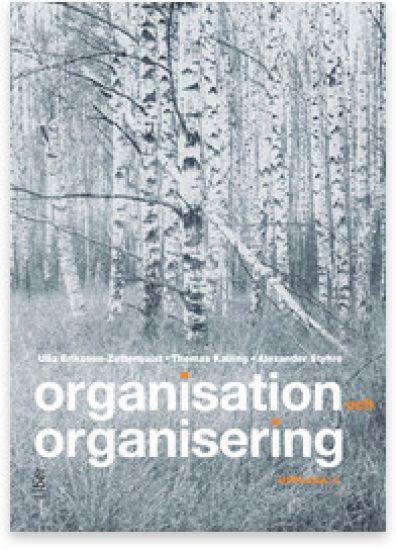
Organisation och organisering

Organisation och organisering

Ulla Eriksson-Zetterquist; Thomas Kalling; Alexander Styhre

Liber
2015
nidottu
Boken beskriver organisationsteorin från de tidigaste försöken att organisera merkantil verksamhet under antiken och medeltiden till dagens kunskapsbaserade arbete. Den presenterar teoretiska perspektiv på organisationer kronologiskt och refererar skandinavisk organisationsteori. Den illustrerar teoretiska resonemang med exempel från såväl svenska som internationella företag och organisationer. Boken är grundläggande och lämpar sig väl för introduktionskurser. Den fjärde upplagan har uppdaterats genomgående och ett flertal exempel från näringsliv och förvaltning har bytts ut och nya referenser och avsnitt har tillkommit. Organisation och organisering har publicerats i dansk översättning (2014) och i en omarbetad norsk upplaga (2014). Sagt om boken"Nu kommer fjärde upplagan av en mycket läsvärd bok som med all säkerhet kommer att få klassikerstatus. Organisationskunskap kan verkligen innehålla mycket och i detta fall gör författarna en grundlig exposé över olika organisationsteorier från antikens dagar fram till idag. Boken ger heltäckande kunskap inom området och är tänkt att användas som lärobok. Författarna är alla professorer vid Göteborgs respektive Lunds universitet. Språket blir aldrig tungrott och exemplen från olika verksamheter är mångskiftande och läsvärda. Det finns inga illustrationer annat än färgade rutor med praktikfall från arbetslivet. Dessa är uppdaterade i den nya upplagan och flera referenser har lagts till den redan digra listan. Läsningen var riktigt njutbar och gav en bra bild av människors urgamla strävan att organisera sina ansträngningar till gemensamma mål. Här finns också teorier och diskussioner av olika metoder för att uppnå önskvärda resultat. Såväl de historiska avsnitten som de dagsaktuella väcker intresse." Lena Löfgren Bjerner, lektör, BTJ-häftet nr 21, 2015. Om författarnaUlla Eriksson-Zetterquist är professor vid GRI, Handelshögskolan vid Göteborgs universitet. homas Kalling är professor och chef för Institutet för ekonomisk forskning vid Lunds universitet. Alexander Styhre är professor vid företagsekonomiska institutionen, Handelshögskolan vid Göteborgs universitet.

The Financialization of the Firm

The Financialization of the Firm

Alexander Styhre

Edward Elgar Publishing Ltd
2015
sidottu
The term 'financialization' denotes the general tendency in the advanced Western economies to allow a substantial proportion of taxable profits to accumulate in the finance industry. Alexander Styhre discusses the financialization of the firm in the period after 1980 and stresses how key managerial activities have been redefined on the basis of finance theory and free-market ideologies. This book critically examines the literature and the implications of financialization for organizations and the economy as a whole. In seven chapters, Styhre covers topics such as the causes and consequences of financialization, corporate governance and financialization, managerial control, auditing, and accountability. He aims to broaden our concept of financialization to encapsulate socio economic and cultural changes since the early 1980s and, in doing so, expand its meaning to encompass more than a technical shift in policy. Academic researchers, graduate students in management programs and organization theory courses, practicing managers and management consultants will find this to be an engaging read.
Organisasjonsteori

Organisasjonsteori

Thomas Kalling; Ulla Eriksson-Zetterquist; Alexander Styhre; Kristin Woll

Cappelen Damm akademisk
2014
nidottu
Organisasjonsteori gir en solid og oversiktlig presentasjon av faget organisasjonsteori. Den dekker emnene som tradisjonelt inngår i faget slik det undervises på universitet og høyskoler, og legger vekt på den nordiske tradisjonen i utvalget av tekster og eksempler. Boken er strukturert etter fagets historiske utvikling, fra antikken via den klassiske organisasjonsteorien og byråkratiteorien, og helt frem til de seneste utviklingstrekk, og viser sammenhengen de ulike skoler og teorier har vokst frem i. Organisasjonsteori bygger på den svenske Organisation och organisering av Ulla Eriksson-Zetterquist, Thomas Kalling og Alexander Styhre. Den norske utgaven er oversatt og bearbeidet av Kristin Woll. Woll har i tillegg formulert læringsmål for de forskjellige kapitlene og dessuten skrevet et eget kapittel om makt. Boken er utviklet for undervisningsformål av skandinaviske forfattere som både representerer akademisk tyngde, omfattende lærebokproduksjon og lang erfaring med å undervise i faget på universitet og høyskoler i Sverige og Norge. Sagt om boken:«Dette er et imponerende læreverk. Boken løfter frem de bærende teoritradisjoner og sentrale utviklingstrekk innen organisasjonsteorien, og evner å formidle faget på en oversiktlig og engasjerende måte. Nødvendige pedagogiske grep og forenklinger går aldri på bekostning av faglig presisjonsnivå. Forfatterne viser at de kjenner organisasjonsteoriens klassikere like godt som nyere utviklingstrekk i forskningsfront. Som organisasjonsteoretiker blir jeg stolt på fagets vegne når jeg leser denne boken. Organisasjonsfagets relevans fremstår med tydelighet gjennom gode eksemplifiseringer og illustrerende case. Kort sagt; dette er state of the art fra Norden.» Kjell Arne Røvik, professor ved UiT, Norges Arktiske Universitet«Endelig en innføringsbok i organisasjonsteori på norsk med skandinavisk innretning og kronologi. En spennende fortelling om organisasjonsteoriens utvikling, muligheter og mangfold. Forfatterne evner på en god måte å plassere ulike tradisjoner historisk og teoretisk, og presenterer stoffet på en måte som gjør boken egnet for studenter på innføringsnivå. Boken vil også være nyttig for viderekomne og praktikere som trenger å vite mer om bakgrunnen for de mange konsepter og teorier om organisasjon som flyter omkring i det moderne samfunnet. Boken har fått med seg mange av de viktigste skandinaviske bidragene til organisasjonsteorien og er tilrettelagt for norske forhold.» Professor Haldor Byrkjeflot, Institutt for sosiologi og samfunnsgeografi, Universitetet i Oslo«Organisation och organisering är unik till sin karaktär och ändå en bok som man har väntat länge på. Boken ger en bra översikt av organisationsteorin och på ett sätt som är stimulerande och relevant för såväl studenter och forskare som praktiker. Boken bjuder på en bild av organisationsteorihistoria, unik i sin detaljrikedom, som finns där inte bara för att hedra gamla klassiker utan även för att visa hur somliga idéer lever i ny skepnad hundra år senare. Samtidigt bjuder den på ett urval av de nyaste trenderna i organisationsstudier och försöker förutspå framtidens organisationsteori. Den rymmer mainstream såväl som avantgardet, och pekar på det skandinaviska bidraget till den internationella organisationsläran. Sist, men inte minst, har författarna lyckats hitta ett tonläge som är lätt och pedagogiskt utan att förenkla komplexa tankar och idéer.» Professor Barbara Czarniawska, GRI, Göteborgs universitet«Boken er noe så sjelden som en lettlest lærebok der klassikerne illustreres med klipp fra originaltekstene – slik at leseren gis nærkontakt med kildene. Det kronologiske plottet får frem utviklingen i faget – samtidig som det er et godt grep for å gi konkret historisk innhold til abstrakte teorier. Ved å bli guidet inn i den konteksten en organisasjonsteori har oppstått i, forstår man hvilke spørsmål den i sin tid var ment å besvare.» Kjersti Halvorsen, førsteamanuensis ved Institutt for samfunnsmedisin, Universitetet i Bergen«Författarna till Organisation och organisering har på ett utmärkt sätt klarat av att skriva en seriös presentation av organisationsteorin. En mycket läsvärd lärobok. Läsarna kan glädja sig åt närvaron av alla de många viktiga svenska och skandinaviska organisationsteoretiska bidragen och av aktuella illustrationer och fall från svenska företag och organisationer. Även om det är en grundbok och därmed främst lämplig för nybörjare i ämnet så vill jag även rekommendera den för mer avancerade studenter och forskare i ämnet.» Professor Lars Bengtsson, Blekinge Tekniska Högskola
Biomaterials Innovation

Biomaterials Innovation

Alexander Styhre

Edward Elgar Publishing Ltd
2014
sidottu
Rapid advances in the life sciences means that there is now a far more detailed understanding of biological systems on the cellular, molecular and genetic levels. Sited at the intersection between the life sciences, the engineering sciences and the design sciences, innovations in the biomaterials industry are expected to garner increasing attention and play a key role in future development. This book examines the biomaterials innovations taking place in corporations and in academic research settings today. Biomaterials Innovation offers a comprehensive overview of life science innovation and presents empirical research in the field of biomaterials innovation. Alexander Styhre examines innovation management practices in the field of biomaterials development and explains institutional changes in the biomaterials industry. The demand for accomplishing biocompatibility between the human body and the materials developed is highlighted, as is the relationship between financial markets and biomaterials companies. Finally, the author discusses the therapeutic, regulatory and managerial implications of biomaterials innovation. Biomaterials Innovation will be required reading for any researcher, policy-maker or student interested in innovation management, the life sciences and the development of health care therapies. Contents: 1. Life and Materiality, Nature and Artifice: Transgressing the Divide 2. Bios, Materiality, and Biomateriality 3. Innovation Management and Innovation in the Life Sciences 4. Shifting Institutional Logics in Biomaterial Companies 5. The Epistemology of Biomaterials: How Biomaterials Become Embodied 6. Financing Biomaterials Innovation: Selling Science in Venture Capital Markets 7. Biomaterials Innovation: Re-creating the Human Body Appendix: Methodology of the Studies Bibliography Index
Management and Neoliberalism

Management and Neoliberalism

Alexander Styhre

Routledge
2014
sidottu
After the financial collapse of 2008 and the bailing out of banks in the US and the UK, the long-term viability of the neoliberal doctrine has come under new scrutiny. The elimination of regulatory control, the financialization of the economy including the growth of increasingly complex financial innovations, and the dominance of a rentier class have all been subject to thorough criticism. Despite the unexpected meltdown of the financial system and the substantial costs for restoring the finance industry, critics contend that the same decision-makers remain in place and few substantial changes to regulatory control have been made. Even though neoliberal thinking strongly stresses the role of the market and market-based transactions, the organization theory and management literature has been marginally concerned with neoliberalism as a political agenda and economic policy. This book examines the consequences of neoliberalism for management thinking and management practice. Managerial practices in organizations are fundamentally affected by a political agenda emphasizing competition and innovation. Concepts such as auditing, corporate social responsibility, shareholder value, and boundariless careers are some examples of managerial terms and frameworks that are inextricably entangled with the neoliberal agenda. This book introduces the literature on neoliberalism, its history and controversies, and demonstrates where neoliberal thinking has served to rearticulate managerial practice, including in the areas of corporate governance, human resource management, and regulatory control of organizations.
Organisation og organisering

Organisation og organisering

Alexander Styhre; Thomas Kalling; Ulrika Eriksson-Zetterquist

Lindhardt og Ringhof
2014
nidottu
Organisation og organisering Er en gennemgang af organisationsteori fra de tidligste forsøg på at organisere merkantile virksomheder i antikken til nutidens IT-intensive arbejde i organisationer. Denne grundbog til videregående uddannelser introducerer på fin og pædagogisk vis centrale ideer indenfor organisationsfeltet. "Organisation og organisering giver en god oversigt over organisationsteorien på en måde, som er stimulerende og relevant for både studerende, forskere og praktikere. Bogen byder på en oversigt over organisationsteorihistorien, som er enestående i sin detaljerigdom, og som ikke blot er med for at hædre gamle klassikere, men også for at vise, hvordan nogle idéer lever videre i nye sammenhænge hundrede år senere. Samtidig byder den på et udvalg af de nyeste tendenser i organisationsstudier og forsøger at give et bud på fremtidens organisationsteori. Bogen rummer mainstream såvel som avantgarde og peger på det skandinaviske bidrag til den internationale viden om organisation. Sidst, men ikke mindst, er det lykkedes forfatterne at formidle stoffet let og pædagogisk uden at forenkle komplekse tanker og ideer." Professor Barbara Czarniawska, GRI, Göteborgs universitet
Reproductive Medicine and the Life Sciences in the Contemporary Economy
In Reproductive Medicine and the Life Sciences in the Contemporary Economy, Alexander Styhre and Rebecka Arman illuminate issues that have given rise to terms such as 'the bioeconomy' and 'the baby business'. The life sciences play an increasing role in providing services and commodities consumed by businesses and the public. Based on an in-depth study of clinics offering assisted fertilization in Sweden, this book is the first to examine the commercialization and commodification of know-how derived from the life sciences, from the point of view of organization theory. In the field of reproductive medicine there has been significant growth of both public and private clinical work. Clinics are places where individual interests and concerns and social and institutional arrangements intersect. With a front office where patients encounter various professional groups and a back office comprising the laboratories wherein human reproductive materials are handled and stored, they are more than just places in which medicine is applied in a clinical setting. Clinicians in this field actively influence policy-making and the regulatory frameworks that monitor and set the boundaries for their work. These are places where social and cultural interests and concerns are translated into policies and practice. The clinics are open social systems, responding to and influencing discussions. This book combines organization theory, sociological theory, gender theory, science and technology studies, and philosophy. It emphasises the critical importance of a sociomaterial perspective on organization, stressing how material and social resources are always of necessity folded into each other in day-to-day organizing.
Social Theory of Innovation

Social Theory of Innovation

Alexander Styhre

Copenhagen Business School Press
2013
nidottu
The contemporary economy is primarily understood through the rationalist and formalist lenses of economic theory and its accompanying (mainstream) theories of organisation and management. In this corpus of work, the economy is commonly portrayed as emerging on the basis of the calculated and instrumental use of heterogeneous resources. Innovation, the capacity to produce new goods and services, being of key importance in a competitive capitalist economic regime, is a joint, collaborative process embedded in social action (ie: through forms of agency). In contrast to individualist, calculative, and utilitarian images of economic agency, sociologists, historians, anthropologists, and others have demonstrated that economic agency is determined in many cases by social and cultural conditions that extend beyond the narrow sphere of instrumental economic behaviour. A social theory of innovation makes a connection between innovation, economic agency and three complementary perspectives (ie: those of playfulness, reciprocity, and squandering (the conspicuous and symbolic waste of excess resources), in terms of being three principles that underlie innovative and creative work. Rather than postulating the homo-economicus model of economic agency, prescribed by neo-classical economic theory, as the only possible and legitimate image of economic agency, alternative models exist which in various ways contribute to our understanding of how and why innovation is produced in contemporary society. A social theory of innovation draws on a diverse corpus of literature from management studies, economics, economic sociology, and the humanities to provide a less confined and narrow image of innovation and economic agency. This book is intended for undergraduate, graduate and post-graduate business school curricula in both economic sociology and other educational programs addressing the organisation of the economy and society at large.
Visual Culture in Organizations

Visual Culture in Organizations

Alexander Styhre

Routledge
2012
nidottu
Vision and visuality are two concepts widely discussed and debated in philosophy and social science literature. Some authors even suggest that the entire Western intellectual tradition is strongly shaped by the paradigm of vision; the inspection and analysis of specimens collected from social reality are regarded as the only legitimate source of truth. However, in organizations, a variety of visual practices are employed in for instance science-based innovation in for instance the pharmaceutical industry and in architect work. Such visual practices include the use of various technoscientific machinery and tools to more mundane uses of full-scale models and photos in architect work. In comparison to the various linguistic perspectives on organizations, vision and visuality remain surprisingly little theorized and examined in the organization literature. Visual Culture in Organizations offers an introduction to the literature on vision and visuality that is relevant to organizational theory (comparing and contrasting it to the well-documented area of linguistic theory in organizations), proposes a theoretical framework for visual culture in organizations, and provides empirical illustrations to the theoretical framework. The book shows that visual practices are a central procedure in the day-to-day routines of organizations and are long overdue for close examination.
Organizations and the Bioeconomy

Organizations and the Bioeconomy

Alexander Styhre

Routledge
2012
sidottu
The advancement of the life sciences and the technosciences has enhanced the longevity of citizens in the Western world, and half of the generation born in the first decade of the new millennium is now expected to live to the age of one hundred years. In a society with such longevity and affluence, consumption of health-related goods and services such as pharmaceuticals and scanning procedures may be seen as a sustainable source of income for the industries that promote it. Though the healthcare sector has traditionally been organized in the public sector in Europe and in the private sector in the US, the recent advancement of new therapies and direct-to-consumer marketing have opened up new streams of consumption and revenue for health care goods and services around the globe. This book examines the so-called ‘bioeconomy’ as a new economic and commercial field that emphasizes the management of individual life, including the regulation and control of weight and food consumption and other issues pertaining to individual well-being. In addition, the bioeconomy includes a variety of practices based on commercial interests such as organ donations, reproductive medicine and technologies, and what has been referred to as the tissue economy – the various forms of trade with human tissues. Author Alexander Styhre provides a thorough introduction to the bioeconomy, exploring this new and unique intersection of the life sciences and the technosciences with more traditional consumer markets.
The Innovative Bureaucracy

The Innovative Bureaucracy

Alexander Styhre

Routledge
2012
nidottu
Highly original and based on unique empirical research in the fields of organization theory and organization behaviour, this work makes an invaluable contribution to the literature on bureaucracy and innovation. Focusing on a study of two major companies working with innovation and new product development Styhre's critical analysis pushes the boundaries of bureaucracy studies beyond its current entrenched position. Departing from the traditional view that bureaucratic organizations are inefficient, incapable of responding to external changes, unable to orchestrate innovative work and provide meaningful jobs for its co-workers, this empirical study underlines the merits of a functional organization, the presence of specialist and expertise groups and hierarchical structures. Analyzing the literature of bureaucracy, the new forms of post-bureaucratic organizations and drawing on the philosophy of Henri Bergson, the author offers a model of bureaucracy, capable of both apprehending its functional organization and its continuous and ongoing modifications and changes to adapt to external conditions. Innovative and compelling, this book is an excellent text for advanced students of organization and management theory and managerial strategists and decision-makers across the globe.
Knowledge Sharing in Professions

Knowledge Sharing in Professions

Alexander Styhre

Ashgate Publishing Limited
2011
sidottu
No professional is an island. Despite their capacity to monopolize and erect entry barriers in terms of either formal credentials or membership of certain organizations, professionalism is inextricably bound up with collective accomplishments on a day-to-day basis and the capacity to share all the resources that constitute the professional domain of expertise. Knowledge Sharing in Professions looks at professionalism as a form of systematic and institutionalized knowledge sharing. It analyses professionalism through the everyday practices in professional communities and the organizations where they work. Three empirical studies, of pharmaceutical clinical trials researchers, management consultants, and architects, are presented, serving to illustrate the relational nature of these and other professions, and how members of professional communities are constantly exchanging data, information, and know-how in their everyday work. Alexander Styhre seeks to understand the role of professions and other forms of experts in contemporary society on the basis of complementary perspectives, that is to say, the communal and collegial nature of professional work. This book represents a valuable contribution both to the sociological literature on professions and the business orientated literature on knowledge management and should promote further new research on professionalism.
Organization Theory

Organization Theory

Ulla Eriksson-Zetterquist; Tomas Müllern; Alexander Styhre

Oxford University Press
2011
nidottu
This textbook presents organization theory in an exciting new way, moving away from a traditional linear historical narrative approach, to present students with an approach that offers both relevancy and appeal. The authors take a practice-based approach, identifying questions, problems and issues that are perceived as pertinent by practitioners, and using these as the starting point to identify the relevant theories. This means that students will find it easier to engage with the material and more attention is paid to issues such as boundary spanning, leadership, quality management, strategic change, and development psychology/organizational learning; areas that are not always covered in other textbooks. Online Resource Centre: For students: Multiple choice questions Further Reading and Research: Comprising of web links and web link updates linking to organization and company websites, plus additional readings and articles. "What happened next": as appropriate, cases from within the textbook will continue to be updated on the Online Resource Centre. For lecturers: Test bank PowerPoint slides Seminar exercises
Organizing technologies

Organizing technologies

Alexander Styhre; Thomas Kalling; Ulla Eriksson-Zetterquist

Universitetsforlaget
2011
nidottu
Organizing Technologies presents theories about technology and its recursive ability to both shape its users and to be shaped by its very use. Organization theory and management studies tend to underrate the importance of technological resources in accomplishing organized activities. In organizations, a wide variety of technologies are mobilized on a day-to-day basis to accomplish organized activities. Some of these technologies are subject to continuous discussions and controversies while others are taken for granted or simply ignored. Organizing Technologies presents theories about technology and its recursive ability to both shape its users and to be shaped by its very use, outlining an analytical model where technologies serve three broad functions within organizations: to produce goods and services, to enhance administrative work, and to connect and co-align organizations within networks, supply chains, or distribution systems. "The authors have pulled together a rich review and commentary on much written about technology over the last 200 years, providing us with an invaluable resource and a guiding hand. They recapture the often-forgotten distinction between productive and administrative technologies to help us view recent changes in the global workplace. This book is a God-send for those like teachers, politicians, journalists and managers who find themselves obliged to comment on today's technology-shaped events but lack the background to achieve their own balance." J. C. Spender, professor at ESADE, Barcelona
Visual Culture in Organizations

Visual Culture in Organizations

Alexander Styhre

Routledge
2010
sidottu
Vision and visuality are two concepts widely discussed and debated in philosophy and social science literature. Some authors even suggest that the entire Western intellectual tradition is strongly shaped by the paradigm of vision; the inspection and analysis of specimens collected from social reality are regarded as the only legitimate source of truth. However, in organizations, a variety of visual practices are employed in for instance science-based innovation in for instance the pharmaceutical industry and in architect work. Such visual practices include the use of various technoscientific machinery and tools to more mundane uses of full-scale models and photos in architect work. In comparison to the various linguistic perspectives on organizations, vision and visuality remain surprisingly little theorized and examined in the organization literature. Visual Culture in Organizations offers an introduction to the literature on vision and visuality that is relevant to organizational theory (comparing and contrasting it to the well-documented area of linguistic theory in organizations), proposes a theoretical framework for visual culture in organizations, and provides empirical illustrations to the theoretical framework. The book shows that visual practices are a central procedure in the day-to-day routines of organizations and are long overdue for close examination.
Byråkrati

Byråkrati

Alexander Styhre

Liber
2009
nidottu
Byråkratin är den vanligaste organisationsformen i vårt samhälle. Det är också den kanske mest kritiserade. Byråkratier framställs ofta som stelbenta miljöer med ineffektiva handläggare. Med denna bok vill författaren ge en mer balanserad och rättvisande bild av den roll byråkratimodellen har haft och alltjämt har i dagens samhälle. Polemiken mellan byråkratins kritiker och försvarare är en viktig utgångspunkt i diskussionen. I boken visas också hur byråkratin har gett upphov till nya organisationsformer. Inom organisationsteorin har man på senare år börjat tala om ”postbyråkratiska organisationer”. I det avslutande kapitlet behandlas framtidsutsikterna för byråkratibegreppet. Byråkrati – teoretiker, kritiker och försvarare kan ses som en allmän introduktion till begreppet byråkrati, men även till organisationsteorifältet. Sagt om boken”Det här är en intressant bok om ett aktuellt och högst relevant men i hög grad missförstått ämne. På ett tankeväckande sätt lyckas Alexander Styhre fånga den komplexa karaktären hos begreppet byråkrati och gör en kvalificerad och kritisk granskning av både negativa och positiva perspektiv som förts fram i annan litteratur. Det är en användbar bok, både som kurslitteratur och som stimuli för intellektet.” Jannis Kallinikos, professor, London School of EconomicsOm författarnaAlexander Styhre är professor i företagsekonomi, inriktning organisation och management, Handelshögskolan vid Göteborgs universitet.
Managing Knowledge in the Construction Industry
Knowledge management presents a new way of understanding organizations and companies, and is especially suited to sophisticated and highly technical firms and operations such as those in the construction industry. This new book draws on hard data from three separate research programs in Sweden and shows how the concept of knowledge can make sense in the construction industry, an industry which can be viewed in essence as being engaged in the material transformation of "nature into buildings". In particular it explores and examines three different businesses: a medium sized construction firm; Wingårdh Architecture, Sweden’s most prestigious architecture firm; and BESAB, a specialist concrete injection firm working on underground construction. An emerging theme is the situational and context-bound nature of knowledge in the construction industry, thus showing "knowledge" to be a remarkably heterogeneous concept. A range of readers should find the book useful, from students and construction managers through to researchers.
The Innovative Bureaucracy

The Innovative Bureaucracy

Alexander Styhre

Routledge
2007
sidottu
Highly original and based on unique empirical research in the fields of organization theory and organization behaviour, this work makes an invaluable contribution to the literature on bureaucracy and innovation. Focusing on a study of two major companies working with innovation and new product development Styhre's critical analysis pushes the boundaries of bureaucracy studies beyond its current entrenched position. Departing from the traditional view that bureaucratic organizations are inefficient, incapable of responding to external changes, unable to orchestrate innovative work and provide meaningful jobs for its co-workers, this empirical study underlines the merits of a functional organization, the presence of specialist and expertise groups and hierarchical structures. Analyzing the literature of bureaucracy, the new forms of post-bureaucratic organizations and drawing on the philosophy of Henri Bergson, the author offers a model of bureaucracy, capable of both apprehending its functional organization and its continuous and ongoing modifications and changes to adapt to external conditions. Innovative and compelling, this book is an excellent text for advanced students of organization and management theory and managerial strategists and decision-makers across the globe.
Organisering och intersektionalitet

Organisering och intersektionalitet

Ulla Eriksson-Zetterquist; Alexander Styhre

Liber
2007
nidottu
Varför är en person underordnad andra personer? Svaren blir olika beroende på vilka teorier forskare använder. Denna bok visar hur intersektionalitet kan tillämpas inom organisationsteorin. Genom att skifta fokus och alternera mellan teorier om kön, klass, etnicitet och sexualitet kan man få en större insikt om en persons arbete och livssituation, hur ett företag är organiserat eller hur en arbetsgrupp fungerar. Om författarnaUlla Eriksson-Zetterquist är professor och verksam vid GRI, Handelshögskolan, Göteborgs universitet. Alexander Styhre är professor i företagsekonomi, Handelshögskolan vid Göteborgs universitet.