Kirjojen hintavertailu – 12 903 725 kirjaa ja 27 kauppaa

Kirjailija

Alexander Yakobson

Kirjat ja teokset yhdessä paikassa: 4 kirjaa, julkaisuja vuosilta 2008–2014, suosituimpiin kuuluu Nation State and Religion. Vertaile teosten hintoja ja tarkista saatavuus suomalaisista kirjakaupoista.

4 kirjaa

Kirjojen julkaisuvuodet: 2008–2014.

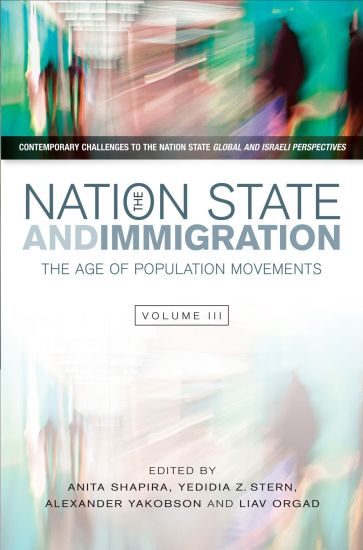
Nation State and Immigration

Nation State and Immigration

Anita Shapira; Yedidia Z. Stern; Alexander Yakobson

LIVERPOOL UNIVERSITY PRESS
2014
sidottu
For the last two centuries, the nation state has posed a formidable challenge to multinational empires. It has served as a base for modernisation, secularisation and democratisation -- and also for the formation of totalitarian regimes. Today, the nation state faces challenges from multiple directions. National minorities demand self-determination while religious forces challenge secular governments, and global migration movements undermine the cultural uniformity once considered essential for the formation and preservation of nation states. This is the third of a three-volume set (detailed below) which addresses key challenges facing the contemporary nation state from a global perspective but with special emphasis on the Middle East and Israel. Publication reflects research conducted under the auspices of The Israel Democracy Institute's "Nation State Project", which analyses Israel's complex reality in which a Jewish majority contends with an Arab minority, ultra-Orthodox religious forces reject the authority of the nation state, and an immigrant society exhibits substantial cultural and ethnic variance. Volume III explores the cultural, social and political effects of immigration on the contemporary nation state -- its character, cohesion, and possible future, as well as on contemporary liberal democracy. Contributions deal with such issues as different liberal approaches to the issue of immigration and immigrant integration, nation-building narratives and their implications for immigrants and minorities, citizenship tests and integration policy in the United States and in Europe, as well as Israel's Law of Return and the debate about it and other aspects of immigration policy.
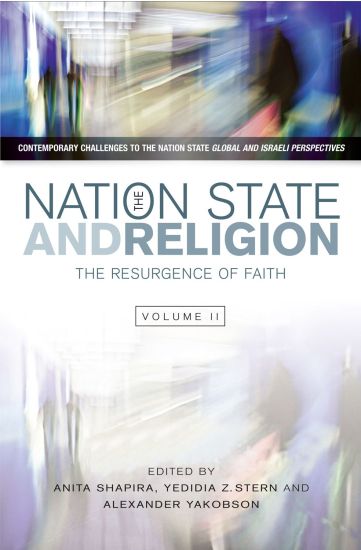
Nation State and Religion

Nation State and Religion

Anita Shapira; Yedidia Z. Stern; Alexander Yakobson

LIVERPOOL UNIVERSITY PRESS
2013
sidottu
For the last two centuries, the nation state has posed a formidable challenge to multinational empires. It has served as a base for modernisation, secularisation and democratisation -- and also for the formation of totalitarian regimes. Today, the nation state faces challenges from multiple directions. National minorities demand self-determination while religious forces challenge secular governments, and global migration movements destroy the cultural uniformity once considered essential for the formation and preservation of nation states. The Nation State and Religion: The Resurgence of Faith is the second of a three-volume set which addresses key challenges facing the contemporary nation state from a global perspective but with special emphasis on the Middle East and Israel. Publication reflects research conducted under the auspices of The Israel Democracy Institute's "Nation State Project", which analyses Israel's complex reality in which a Jewish majority contends with an Arab minority, ultra-Orthodox religious forces reject the authority of the nation state, and an immigrant society exhibits substantial cultural and ethnic variance. Volume II examines the role of religion in the nation state and the tension between nationality and religion as it is expressed today in society, politics, law and culture. The book offers a broad-based and in-depth comparative look at this issue in relation to different religions (Christianity, Islam and Judaism) and relative to varied nation states (the United States, France, Canada, Pakistan, Turkey, Syria, and the Palestinian Authority). Special emphasis is given to the Jewish nation state of Israel, where there is an ongoing struggle about the role of religion in the public sphere.
Israel and the Family of Nations

Israel and the Family of Nations

Alexander Yakobson; Amnon Rubinstein

Routledge
2010
nidottu
Can Israel be both Jewish and truly democratic? How can a nation–state, which incorporates a large national minority with a distinct identity of its own be a state of all its citizens? Written by two eminent Israeli scholars, a professor of constitutional law and a historian, Alexander Yakobson and Amnon Rubinstein are the first to treat Zionism and Israeli experience in light of other states’ experiences and in particular of newly established states that have undergone constitutional changes and wrestled with issues of minorities. Citing various European, constitutions and laws, the authors explore concept of a Jewish State and its various meanings in the light of international law, and the current norms of Human Rights as applied to other democratic societies compatible with liberal democratic norms and conclude that international reality does not accord with the concept which regards a modern, liberal democracy as a culturally "neutral" and a nationally colourless entity. In light of the new political map in Israel and the prospect of future disengagement from the West Bank, Israel and the Family of Nations is essential reading for all those who wish to understand Israel’s future challenges.
Israel and the Family of Nations

Israel and the Family of Nations

Alexander Yakobson; Amnon Rubinstein

Routledge
2008
sidottu
Can Israel be both Jewish and truly democratic? How can a nation–state, which incorporates a large national minority with a distinct identity of its own be a state of all its citizens? Written by two eminent Israeli scholars, a professor of constitutional law and a historian, Alexander Yakobson and Amnon Rubinstein are the first to treat Zionism and Israeli experience in light of other states’ experiences and in particular of newly established states that have undergone constitutional changes and wrestled with issues of minorities. Citing various European, constitutions and laws, the authors explore concept of a Jewish State and its various meanings in the light of international law, and the current norms of Human Rights as applied to other democratic societies compatible with liberal democratic norms and conclude that international reality does not accord with the concept which regards a modern, liberal democracy as a culturally "neutral" and a nationally colourless entity. In light of the new political map in Israel and the prospect of future disengagement from the West Bank, Israel and the Family of Nations is essential reading for all those who wish to understand Israel’s future challenges.