Kirjojen hintavertailu – 12 859 819 kirjaa ja 27 kauppaa

Kirjailija

Alexandra Jaffe

Kirjat ja teokset yhdessä paikassa: 4 kirjaa, julkaisuja vuosilta 1999–2016, suosituimpiin kuuluu Sociolinguistics from the Periphery. Vertaile teosten hintoja ja tarkista saatavuus suomalaisista kirjakaupoista.

4 kirjaa

Kirjojen julkaisuvuodet: 1999–2016.

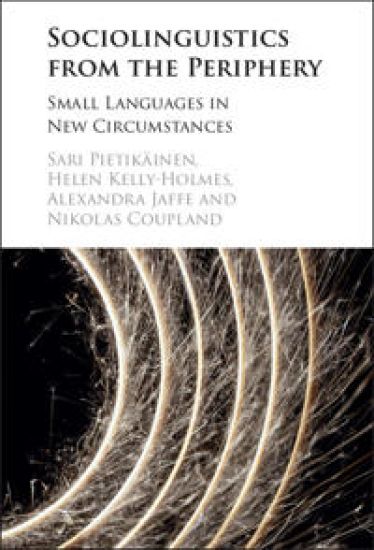
Sociolinguistics from the Periphery

Sociolinguistics from the Periphery

Sari Pietikäinen; Alexandra Jaffe; Helen Kelly-Holmes; Nikolas Coupland

Cambridge University Press
2016
sidottu
This leading team of scholars presents a fascinating book about change: shifting political, economic and cultural conditions; ephemeral, sometimes even seasonal, multilingualism; and altered imaginaries for minority and indigenous languages and their users. The authors refer to this network of interlinked changes as the new conditions surrounding small languages (Sámi, Corsican, Irish and Welsh) in peripheral sites. Starting from the conviction that peripheral sites can and should inform the sociolinguistics of globalisation, the book explores how new modes of reflexivity, more transactional frames for authenticity, commodification of peripheral resources, and boundary-transgression with humour, all carry forward change. These types of change articulate a blurring of binary oppositions between centre and periphery, old and new, and standard and non-standard. Such research is particularly urgent in multilingual small language contexts, where different conceptualisations of language(s), boundaries, and speakers impact on individuals' social, cultural, and economic capital, and opportunities.

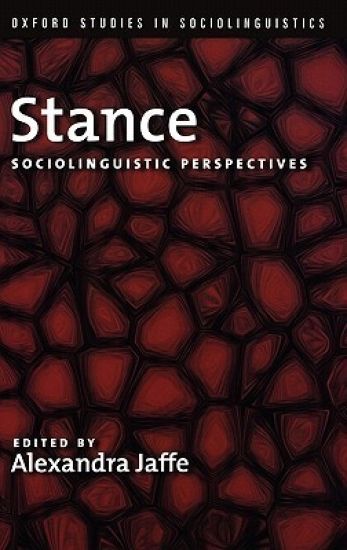
Stance

Stance

Alexandra Jaffe

Oxford University Press Inc
2012
nidottu
All communication involves acts of stance, in which speakers take up positions vis-a-vis the expressive, referential, interactional and social implications of their speech. This book brings together contributions in a new and dynamic current of academic explorations of stancetaking as a sociolinguistic phenomenon. Drawing on data from such diverse contexts as advertising, tourism, historical texts, naturally occurring conversation, classroom interaction and interviews, leading authors in the field of sociolinguistics in this volume explore how linguistic stancetaking is implicated in the representation of self, personal style and acts of stylization, and self- and other-positioning. The analyses also focus on how speakers deploy and take up stances vis-a-vis sociolinguistic variables and the critical role of stance in the processes of indexicalization: how linguistic forms come to be associated with social categories and meanings. In doing so, many of the authors address critical issues of power and social reproduction, examining how stance is implicated in the production, reproduction and potential change of social and linguistic hierarchies and ideologies. This volume maps out the terrain of existing sociolinguistic and linguistic anthropological research on stance, synthesizes how it relates to existing theoretical orientations, and identifies a framework for future research.
Stance

Stance

Alexandra Jaffe

Oxford University Press Inc
2009
sidottu
All communication involves acts of stance, in which speakers take up positions vis-à-vis the expressive, referential, interactional and social implications of their speech. This book brings together contributions in a new and dynamic current of academic explorations of stancetaking as a sociolinguistic phenomenon. Drawing on data from such diverse contexts as advertising, tourism, historical texts, naturally occurring conversation, classroom interaction and interviews, leading authors in the field of sociolinguistics in this volume explore how linguistic stancetaking is implicated in the representation of self, personal style and acts of stylization, and self- and other-positioning. The analyses also focus on how speakers deploy and take up stances vis-a-vis sociolinguistic variables and the critical role of stance in the processes of indexicalization: how linguistic forms come to be associated with social categories and meanings. In doing so, many of the authors address critical issues of power and social reproduction, examining how stance is implicated in the production, reproduction and potential change of social and linguistic hierarchies and ideologies. This volume maps out the terrain of existing sociolinguistic and linguistic anthropological research on stance, synthesizes how it relates to existing theoretical orientations, and identifies a framework for future research.
Ideologies in Action

Ideologies in Action

Alexandra Jaffe

De Gruyter Mouton
1999
sidottu
In Corsica, spelling contests, road signs, bilingual education bills and Corsican language newscasts leave language planners and ordinary speakers deeply divided over how to define what "counts" as Corsican and how it is connected with cultural identity. In Ideologies in Action Alexandra Jaffe explores the complex interrelationship between linguistic ideologies and practices on the French island of Corsica. This detailed exploration of the ideological and political underpinnings of three decades of language planning raises fundamental questions about what it means to "save" a minority language, and the way in which specific cultural, political and ideological contexts shape the "successes" and "failures" of linguistic engineering efforts. Jaffe's ethnography focuses both on the way dominant language ideologies are inscribed in the everyday experience of ordinary people, as well as how they shape the evolving strategies of language planners trying to revitalize the Corsican language. While Jaffe's analysis demonstrates the pervasive influence of dominant language ideologies on minority language speakers and language planners, she also draws on case studies from everyday discourse, educational practice and public and mediatized debates over language issues to develop an ethnographically-grounded perspective on levels of resistance. In the final part of the book she explores the emergence (and the limits) of "radical" genres of resistance found in forms of Corsican language activism and in examples of codeswitching and language mixing in bilingual radio practice. This book contributes to a growing literature on language ideology, and will be of interest to anthropologists, political scientists and linguists interested in the practical and theoretical dimensions of language contact, minority language literacy, bilingual education, and language shift.