Kirjojen hintavertailu – 12 903 725 kirjaa ja 27 kauppaa

Kirjailija

Alexei Myasnikov

Kirjat ja teokset yhdessä paikassa: 4 kirjaa, julkaisuja vuosilta 2008–2026, suosituimpiin kuuluu Combinatorial Group Theory. Vertaile teosten hintoja ja tarkista saatavuus suomalaisista kirjakaupoista.

4 kirjaa

Kirjojen julkaisuvuodet: 2008–2026.

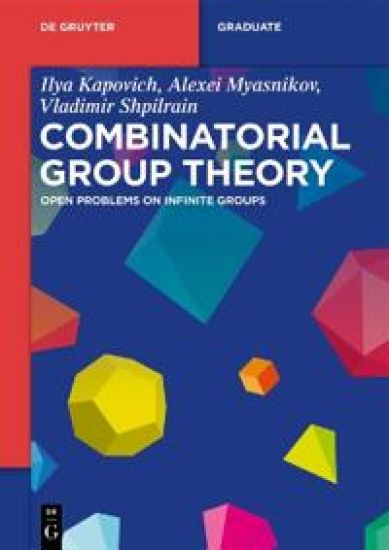
Combinatorial Group Theory

Combinatorial Group Theory

Ilya Kapovich; Alexei Myasnikov; Vladimir Shpilrain

De Gruyter
2026
isokokoinen pokkari
This is an annotated collection of over 200 open problems in combinatorial group theory. One can say that most of the problems are closer in spirit to the "purely combinatorial" group theory. However, the authors included several problems with geometric flavor where they felt this was natural. Approximately 20 years ago, a new direction in group theory began to emerge at the interface with theoretical computer science. In recognition of this, the given collection includes problems that are not only significant in combinatorial group theory but also have direct relevance to this emerging area, such as the Post correspondence problem for groups, which is gaining momentum in contemporary research. The “flagship” section includes problems about free groups; these have been at the center of combinatorial group theory for over a century, and they are getting ever more popular due to newly discovered connections with the theoretical computer science mentioned above. Other classes of groups that the authors cover include hyperbolic groups, solvable groups, groups of matrices, and others. The target audience of the book is very broad: from PhD students to senior researchers.

The Elementary Theory of Groups

The Elementary Theory of Groups

Benjamin Fine; Anthony Gaglione; Alexei Myasnikov; Gerhard Rosenberger; Dennis Spellman

De Gruyter
2014
sidottu
After being an open question for sixty years the Tarski conjecture was answered in the affirmative by Olga Kharlampovich and Alexei Myasnikov and independently by Zlil Sela. Both proofs involve long and complicated applications of algebraic geometry over free groups as well as an extension of methods to solve equations in free groups originally developed by Razborov. This book is an examination of the material on the general elementary theory of groups that is necessary to begin to understand the proofs. This material includes a complete exposition of the theory of fully residually free groups or limit groups as well a complete description of the algebraic geometry of free groups. Also included are introductory material on combinatorial and geometric group theory and first-order logic. There is then a short outline of the proof of the Tarski conjectures in the manner of Kharlampovich and Myasnikov.
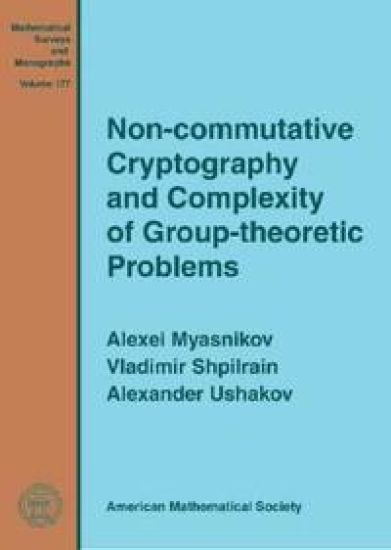
Non-commutative Cryptography and Complexity of Group-theoretic Problems

Non-commutative Cryptography and Complexity of Group-theoretic Problems

Alexei Myasnikov; Vladimir Shpilrain; Alexander Ushakov

American Mathematical Society
2011
sidottu
This book is about relations between three different areas of mathematics and theoretical computer science: combinatorial group theory, cryptography, and complexity theory. It explores how non-commutative (infinite) groups, which are typically studied in combinatorial group theory, can be used in public key cryptography. It also shows that there is remarkable feedback from cryptography to combinatorial group theory because some of the problems motivated by cryptography appear to be new to group theory, and they open many interesting research avenues within group theory. In particular, a lot of emphasis in the book is put on studying search problems, as compared to decision problems traditionally studied in combinatorial group theory. Then, complexity theory, notably generic-case complexity of algorithms, is employed for cryptanalysis of various cryptographic protocols based on infinite groups, and the ideas and machinery from the theory of generic-case complexity are used to study asymptotically dominant properties of some infinite groups that have been applied in public key cryptography so far. This book also describes new interesting developments in the algorithmic theory of solvable groups and another spectacular new development related to complexity of group-theoretic problems, which is based on the ideas of compressed words and straight-line programs coming from computer science.
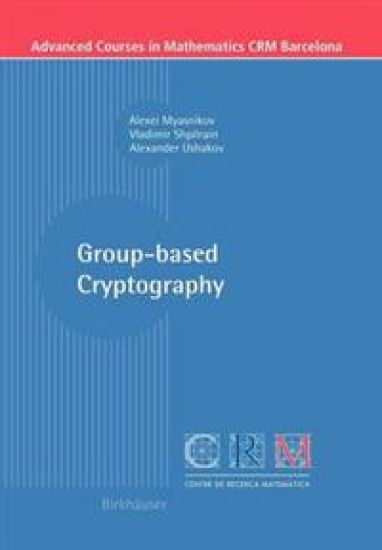
Group-based Cryptography

Group-based Cryptography

Alexei Myasnikov; Vladimir Shpilrain; Alexander Ushakov

Birkhauser Verlag AG
2008
nidottu
This book is about relations between three di?erent areas of mathematics and theoreticalcomputer science: combinatorialgroup theory, cryptography,and c- plexity theory. We explorehownon-commutative(in?nite) groups,which arety- callystudiedincombinatorialgrouptheory,canbeusedinpublickeycryptography. We also show that there is a remarkable feedback from cryptography to com- natorial group theory because some of the problems motivated by cryptography appear to be new to group theory, and they open many interesting research - enues within group theory. Then, we employ complexity theory, notably generic case complexity of algorithms,for cryptanalysisof various cryptographicprotocols based on in?nite groups. We also use the ideas and machinery from the theory of generic case complexity to study asymptotically dominant properties of some in?nite groups that have been used in public key cryptography so far. It turns out that for a relevant cryptographic scheme to be secure, it is essential that keys are selected from a "very small" (relative to the whole group, say) subset rather than from the whole group. Detecting these subsets ("black holes") for a part- ular cryptographic scheme is usually a very challenging problem, but it holds the keyto creatingsecurecryptographicprimitives basedonin?nite non-commutative groups. The book isbased onlecture notesfor the Advanced Courseon Group-Based CryptographyheldattheCRM,BarcelonainMay2007. Itisagreatpleasureforus to thank Manuel Castellet, the HonoraryDirector of the CRM, for supporting the idea of this Advanced Course. We are also grateful to the current CRM Director, JoaquimBruna,and to the friendly CRM sta?,especially Mrs. N. PortetandMrs. N. Hern' andez, for their help in running the Advanced Course and in preparing the lecture notes.