Kirjojen hintavertailu – 12 903 724 kirjaa ja 27 kauppaa

Kirjailija

Alf Hornborg

Kirjat ja teokset yhdessä paikassa: 16 kirjaa, julkaisuja vuosilta 2001–2026, suosituimpiin kuuluu Historiens hemvist I : den historiska tidens former. Vertaile teosten hintoja ja tarkista saatavuus suomalaisista kirjakaupoista.

16 kirjaa

Kirjojen julkaisuvuodet: 2001–2026.

Historiens hemvist I : den historiska tidens former

Historiens hemvist I : den historiska tidens former

Jens Bartelson; Henrik Berggren; Staffan Carlshamre; Marcia Sá Cavalcante Schuback; Kristina Fjelkestam; Torbjörn Gustafsson Chorell; Stefan Helgesson; Alf Hornborg; Peter Jackson; Helge Jordheim; Dan Karlholm; Claudia Lindén; Hanna Meretoja; Jerry Määttä; Anders Olsson; Johan Redin; Hans Ruin; Fredrika Spindler; Jayne Svenungsson

Makadam förlag
2016
nidottu
Vi lever alla omgivna av ett förflutet som på olika sätt påverkar nuet. Men hur ska vi förstå det förflutnas fortsatta verkan och närvaro i samtiden? Inom historieteori diskuterades länge frågan om vi kan veta något med säkerhet om det förflutna. Men under senare decennier har intresset snarare riktats mot de olika sätt på vilka det förflutna finns kvar och formar de efterkommande. En dåtidsorienterad historieskrivning har fått ge plats åt en som rör sig i relationer mellan olika tidsliga dimensioner. I takt med att den historiska tiden historiseras väcks nya frågor: Är det meningsfullt att tala om en sammanhängande fortskridande tid eller bör vi snarare tänka oss flera parallella, multipla och korsande tider? Hur ska vi förstå historisk tid efter att framstegstanken själv alltmer kommit att framstå som en konstruktion? Frågor om vår egen plats i ett historiskt landskap öppnar för nya sätt att tänka det historiska och att historisera, där genealogiska, arkeologiska, dekonstruktiva, konstellativa och andra former av motläsningar tycks öppna nya och olikartade dörrar till det förflutna, i dess skilda gestalter och verkligheter. "Den historiska tidens former" är den första fristående delen i trebandsverket "Historiens hemvist". Den samlar nitton forskare inom skilda ämnen som behandlar frågor om historiens slut, hemsökelser och gengångare, döda och odöda, postapokalyps och messianism, exil, narrativitet och genealogi, polytemporalitet, anakronism och tidens mångfaldigande. Sammantaget bidrar den till att ge nya kartor över det samtida historiska medvetandet i dess struktur och förvandling. Volymen är redigerad av Victoria Fareld, forskare i idéhistoria vid Stockholms universitet, och Hans Ruin, professor i filosofi vid Södertörns högskola, båda knutna till forskningsprogrammet "Tid, minne, representation".
Liquidate: How Money is Dissolving the World

Liquidate: How Money is Dissolving the World

Alf Hornborg

TAYLOR FRANCIS LTD
2026
nidottu
Liquidate: How Money is Dissolving the World examines the emergence of money and its social and ecological repercussions. It views money as a new phenomenon in the evolution of life that has fundamentally transformed ecosystems and human social relations. The appearance of coined money around 600 BCE coincided with the first abstract philosophies and religions. This book shows how changes in human–environmental relations have reflected changes in social relations generated by money. The detached modern view of nature mirrors the socially detached modern individual. However, the abandonment of animism has not diminished the human propensity for fetishism – the perception of artefacts such as money tokens as indexes of what they represent. Market prices obscure the asymmetric global resource transfers that make increasingly advanced technologies possible where there is enough money. Our fetishised understandings of money and technologies cannot deal with the escalating production of entropy underlying climate change. They also drive the dramatic reduction of biological and cultural diversity under globalisation. Given these problems, many people reassess premodern and indigenous societies in search of more sustainable ideas on how to organise exchange. Liquidate: How Money is Dissolving the World will be of interest to scholars working in anthropology, sociology, economics, history, semiotics, comparative religions, and indigenous studies.
Liquidate: How Money is Dissolving the World

Liquidate: How Money is Dissolving the World

Alf Hornborg

TAYLOR FRANCIS LTD
2024
sidottu
Liquidate: How Money is Dissolving the World examines the emergence of money and its social and ecological repercussions. It views money as a new phenomenon in the evolution of life that has fundamentally transformed ecosystems and human social relations. The appearance of coined money around 600 BCE coincided with the first abstract philosophies and religions. This book shows how changes in human–environmental relations have reflected changes in social relations generated by money. The detached modern view of nature mirrors the socially detached modern individual. However, the abandonment of animism has not diminished the human propensity for fetishism – the perception of artefacts such as money tokens as indexes of what they represent. Market prices obscure the asymmetric global resource transfers that make increasingly advanced technologies possible where there is enough money. Our fetishised understandings of money and technologies cannot deal with the escalating production of entropy underlying climate change. They also drive the dramatic reduction of biological and cultural diversity under globalisation. Given these problems, many people reassess premodern and indigenous societies in search of more sustainable ideas on how to organise exchange. Liquidate: How Money is Dissolving the World will be of interest to scholars working in anthropology, sociology, economics, history, semiotics, comparative religions, and indigenous studies.
The Magic of Technology

The Magic of Technology

Alf Hornborg

TAYLOR FRANCIS LTD
2024
nidottu
This book examines our understanding of technology and suggests that machines are counterfeit organisms that seem to replace human bodies but are ultimately means of displacing workloads and environmental loads beyond our horizon. It emphasises that technology is not the politically neutral revelation of natural principles that we tend to think, but largely a means of accumulating, through physically asymmetric exchange, the material means of harnessing natural forces to reinforce social relations of power. Alf Hornborg reflects on how our cultural illusions about technology appeared in history and how they continue to stand in the way of visions for an equal and sustainable world. He argues for a critical reconceptualisation of modern technology as an institution for redistributing human time, resources, and risks in world society. The book highlights a need to think of world trade in other terms than money and raises fundamental questions about the role of human-artifact relations in organising human societies. It will be of interest to a range of scholars working in anthropology, sociology, economics, development studies, and the philosophy of technology.*CHOICE Outstanding Academic Title for 2023*
The Magic of Technology

The Magic of Technology

Alf Hornborg

TAYLOR FRANCIS LTD
2022
sidottu
This book examines our understanding of technology and suggests that machines are counterfeit organisms that seem to replace human bodies but are ultimately means of displacing workloads and environmental loads beyond our horizon. It emphasises that technology is not the politically neutral revelation of natural principles that we tend to think, but largely a means of accumulating, through physically asymmetric exchange, the material means of harnessing natural forces to reinforce social relations of power. Alf Hornborg reflects on how our cultural illusions about technology appeared in history and how they continue to stand in the way of visions for an equal and sustainable world. He argues for a critical reconceptualisation of modern technology as an institution for redistributing human time, resources, and risks in world society. The book highlights a need to think of world trade in other terms than money and raises fundamental questions about the role of human-artifact relations in organising human societies. It will be of interest to a range of scholars working in anthropology, sociology, economics, development studies, and the philosophy of technology.*CHOICE Outstanding Academic Title for 2023*
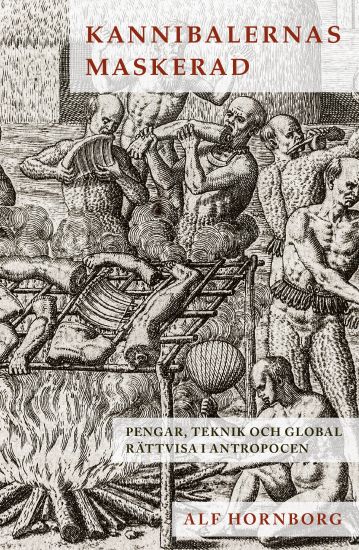
Kannibalernas maskerad : pengar, teknik och global rättvisa i antropocen
Solpaneler och elbilar framställs ofta som av­görande faktorer i omställningen till ett klimat­anpassat samhälle, som om omställningen bara skulle vara en fråga om att byta teknik. Det är lätt att glömma att det faktiskt är priserna på arbete och resurser i olika delar av världen som gör solpanelerna och elbilarna möjliga till att börja med. Vi är kort sagt lika förblindade av vår teknik som av våra konsumtionsvaror. Vi ser föremålen men inte hur mycket lågavlönat arbete och skövlad natur som de står för. När vi konsumerar – alltså metaforiskt äter – varorna förtär vi andra människors livsenergi. I "Kannibalernas maskerad" anlägger human­ekologen Alf Hornborg ett antropologiskt perspektiv på hela resurs- och omställnings­problematiken och visar hur pengar och teknik i själva verket fungerar som raffinerade metoder för att tillägna sig andra människors tid och naturresurser. Både ekonomer och ingenjörer lever med den moderna synvillan att ekonomin kan bortse ifrån naturen medan tekniken handlar om fysiska ting som inget har med världssamhället att göra. Denna synvilla utmanas alltmer av antropocen – den nya tidsålder då människors verksamhet påverkar hela jordklotet. Kan vi tygla vår rovdrift på varandra och planeten genom att utforma våra pengar på nya sätt? Kan vi föreställa oss en ekonomi som tar hänsyn till människor och miljö bortom vår horisont? Kan vi genomskåda vår tids magi? Alf Hornborg är antropolog och professor i humanekologi vid Lunds universitet. Han har publicerat en rad böcker på engelska. På Daidalos har han tidigare givit ut "Myten om maskinen" (2010) och "Nollsummespelet" (2015).
Nature, Society, and Justice in the Anthropocene

Nature, Society, and Justice in the Anthropocene

Alf Hornborg

Cambridge University Press
2021
pokkari

Halvin toimitettuna 43,70 €

Are money and technology the core illusions of our time? In this book, Alf Hornborg offers a fresh assessment of the inequalities and environmental degradation of the world. He shows how both mainstream and radical economists are limited by a particular worldview and, as a result, do not grasp that conventional money is at the root of many of the problems that are threatening societies, not to mention planet Earth itself. Hornborg demonstrates how market prices obscure asymmetric exchanges of resources - human labor, land, energy, materials - under a veil of fictive reciprocity. Such unequal exchange, he claims, underpins the phenomenon of technological development, which is, fundamentally, a redistribution of time and space - human labor and land - in world society. Hornborg deftly illustrates how money and technology have shaped our thinking and our social and ecological relations, with disturbing consequences. He also offers solutions for their redesign in ways that will promote justice and sustainability.
Nature, Society, and Justice in the Anthropocene

Nature, Society, and Justice in the Anthropocene

Alf Hornborg

Cambridge University Press
2019
sidottu
Are money and technology the core illusions of our time? In this book, Alf Hornborg offers a fresh assessment of the inequalities and environmental degradation of the world. He shows how both mainstream and radical economists are limited by a particular worldview and, as a result, do not grasp that conventional money is at the root of many of the problems that are threatening societies, not to mention planet Earth itself. Hornborg demonstrates how market prices obscure asymmetric exchanges of resources - human labor, land, energy, materials - under a veil of fictive reciprocity. Such unequal exchange, he claims, underpins the phenomenon of technological development, which is, fundamentally, a redistribution of time and space - human labor and land - in world society. Hornborg deftly illustrates how money and technology have shaped our thinking and our social and ecological relations, with disturbing consequences. He also offers solutions for their redesign in ways that will promote justice and sustainability.
Global Magic

Global Magic

Alf Hornborg

Palgrave Macmillan
2017
nidottu
Modern thought on economics and technology is no less magical than the world views of non-modern peoples. This book reveals how our ideas about growth and progress ignore how money and machines throughout history have been used to exploit less affluent parts of world society. The argument critically explores a middle ground between Marxist political ecology and Actor-Network Theory.
Global Magic

Global Magic

Alf Hornborg

Palgrave Macmillan
2016
sidottu
Modern thought on economics and technology is no less magical than the world views of non-modern peoples. This book reveals how our ideas about growth and progress ignore how money and machines throughout history have been used to exploit less affluent parts of world society. The argument critically explores a middle ground between Marxist political ecology and Actor-Network Theory.
Nollsummespelet : teknikfetischism och global miljörättvisa
Om vi menar allvar med retoriken om global hållbarhet och rättvisa måste vi vara beredda att ompröva våra mest grundläggande föreställningar om tekniska och ekonomiska framsteg. Det vi har uppfattat som utveckling och framsteg har genom historien i stor utsträckning varit en fråga om att förskjuta arbets- och miljöbelastning till människor med mindre köpkraft. Ofta har den ena gruppens framgångar genom ojämnt utbyte varit knutna till den andras förluster. Detta drag av nollsummespel blir särskilt tydligt om vi granskar den industriella revolutionen och den roll de fossila bränslena spelat i världshistorien, men det kan spåras genom flera årtusenden. Alf Hornborg visar i denna bok att vår moderna bild av teknisk utveckling bygger på ett lokalt perspektiv ? världen betraktad ifrån 1800-talets Europa ? och på magiska föreställningar om teknikens väsen, som en i föremålen inneboende kraft snarare än något som möjliggörs av globala skillnader i priserna på arbete och naturresurser. Ett vidgat, globalt perspektiv ger oss anledning att betrakta teknik och inte minst pengar med nya ögon. Det är själva idén om pengar som ligger till grund för ojämnt utbyte. "Nollsummespelet" vidareutvecklar resonemangen i Alf Hornborgs tidigare bok "Myten om maskinen" på flera sätt, bland annat genom att erbjuda en konkret vision för en hållbar ekonomi.
Myten om maskinen : essäer om makt, modernitet och miljö
Den moderna människan sätter sin tilltro till tekniken. Men är själva föreställningen om "teknik" en kulturell illusion? I Myten om maskinen utmanar Alf Hornborg, professor i humanekologi vid Lunds universitet, idén att mänskligheten är förenad i en gemensam utveckling mot allt effektivare teknik. Istället hävdar han att modern teknik förutsätter ett slags globalt nollsummespel med ojämna resursflöden, som gör det möjligt för rikare delar av världssamhället att vinna tid och rum på bekostnad av de fattigare delarnas människor och miljö. Vi föreställer oss maskinens funktioner som frikopplade från de samhälleliga utbytesrelationer som gör den ekonomiskt och fysiskt möjlig. Men även den ångmaskin som blev kärnan i den industriella revolutionen var oupplösligt förbunden med slavarbete och jordförstöring på avlägsna bomullsplantager. Vår retorik om "hållbar utveckling" avslöjar de paradoxer som omger myten om maskinen. Hit hör de motstridiga signaler vi får om globalisering, tillväxt, konsumtion, återvinning, oljetoppen, biobränslen och klimatkrisen. Ytterst bottnar problemen i vår modernitet - de förändrade relationer till naturen, medmänniskor, självet och livsmening som alstras av pengar och antagandet om alltings utbytbarhet.
Global Ecology and Unequal Exchange
In modern society, we tend to have faith in technology. But is our concept of ‘technology’ itself a cultural illusion? This book challenges the idea that humanity as a whole is united in a common development toward increasingly efficient technologies. Instead it argues that modern technology implies a kind of global ‘zero-sum game’ involving uneven resource flows, which make it possible for wealthier parts of global society to save time and space at the expense of humans and environments in the poorer parts. We tend to think of the functioning of machines as if it was detached from the social relations of exchange which make machines economically and physically possible (in some areas). But even the steam engine that was the core of the Industrial Revolution in England was indissolubly linked to slave labour and soil erosion in distant cotton plantations. And even as seemingly benign a technology as railways have historically saved time (and accessed space) primarily for those who can afford them, but at the expense of labour time and natural space lost for other social groups with less purchasing power. The existence of technology, in other words, is not a cornucopia signifying general human progress, but the unevenly distributed result of unequal resource transfers that the science of economics is not equipped to perceive. Technology is not simply a relation between humans and their natural environment, but more fundamentally a way of organizing global human society. From the very start it has been a global phenomenon, which has intertwined political, economic and environmental histories in complex and inequitable ways. This book unravels these complex connections and rejects the widespread notion that technology will make the world sustainable. Instead it suggests a radical reform of money, which would be as useful for achieving sustainability as for avoiding financial breakdown. It brings together various perspectives from environmental and economic anthropology, ecological economics, political ecology, world-system analysis, fetishism theory, semiotics, environmental and economic history, and development theory. Its main contribution is a new understanding of technological development and concerns about global sustainability as questions of power and uneven distribution, ultimately deriving from the inherent logic of general-purpose money. It should be of interest to students and professionals with a background or current engagement in anthropology, sustainability studies, environmental history, economic history, or development studies.
Global Ecology and Unequal Exchange
In modern society, we tend to have faith in technology. But is our concept of ‘technology’ itself a cultural illusion? This book challenges the idea that humanity as a whole is united in a common development toward increasingly efficient technologies. Instead it argues that modern technology implies a kind of global ‘zero-sum game’ involving uneven resource flows, which make it possible for wealthier parts of global society to save time and space at the expense of humans and environments in the poorer parts. We tend to think of the functioning of machines as if it were detached from the social relations of exchange which make machines economically and physically possible (in some areas). But even the steam engine that was the core of the Industrial Revolution in England was indissolubly linked to slave labour and soil erosion in distant cotton plantations. And even as seemingly benign a technology as railways have historically saved time (and accessed space) primarily for those who can afford them, but at the expense of labour time and natural space lost for other social groups with less purchasing power. The existence of technology, in other words, is not a cornucopia signifying general human progress, but the unevenly distributed result of unequal resource transfers that the science of economics is not equipped to perceive. Technology is not simply a relation between humans and their natural environment, but more fundamentally a way of organizing global human society. From the very start it has been a global phenomenon, which has intertwined political, economic and environmental histories in complex and inequitable ways. This book unravels these complex connections and rejects the widespread notion that technology will make the world sustainable. Instead it suggests a radical reform of money, which would be as useful for achieving sustainability as for avoiding financial breakdown. It brings together various perspectives from environmental and economic anthropology, ecological economics, political ecology, world-system analysis, fetishism theory, semiotics, environmental and economic history, and development theory. Its main contribution is a new understanding of technological development and concerns about global sustainability as questions of power and uneven distribution, ultimately deriving from the inherent logic of general-purpose money. It should be of interest to students and professionals with a background or current engagement in anthropology, sustainability studies, environmental history, economic history, or development studies.
Political Ecology Across Spaces, Scales, and Social Groups

Political Ecology Across Spaces, Scales, and Social Groups

Susan Paulson; Lisa L. Gezon; Arturo Escobar; Andrew Gardner; Mette Brodgen; James Greenberg; Hanne Svarstad; Michael Dove; Alf Hornborg; Charles Stevens; Josiah Heyman; Fiona Mackenzie; Anne Ferguson; William Derman

Rutgers University Press
2004
nidottu
Environmental issues have become increasingly prominent in local struggles, national debates, and international policies. In response, scholars are paying more attention to conventional politics and to more broadly defined relations of power and difference in the interactions between human groups and their biophysical environments. Such issues are at the heart of the relatively new interdisciplinary field of political ecology, forged at the intersection of political economy and cultural ecology. This volume provides a toolkit of vital concepts and a set of research models and analytic frameworks for researchers at all levels. The two opening chapters trace rich traditions of thought and practice that inform current approaches to political ecology. They point to the entangled relationship between humans, politics, economies, and environments at the dawn of the twenty-first century and address challenges that scholars face in navigating the blurring boundaries among relevant fields of enquiry. The twelve case studies that follow demonstrate ways that culture and politics serve to mediate human-environmental relationships in specific ecological and geographical contexts. Taken together, they describe uses of and conflicts over resources including land, water, soil, trees, biodiversity, money, knowledge, and information; they exemplify wide-ranging ecological settings including deserts, coasts, rainforests, high mountains, and modern cities; and they explore sites located around the world, from Canada to Tonga and cyberspace.
The Power of the Machine

The Power of the Machine

Alf Hornborg

AltaMira Press,U.S.
2001
nidottu

Halvin toimitettuna 67,00 €

Hornborg argues that we are caught in a collective illusion about the nature of modern technology that prevents us from imagining solutions to our economic and environmental crises other than technocratic fixes. He demonstrates how the power of the machine generates increasingly asymmetrical exchanges and distribution of resources and risks between distant populations and ecosystems, and thus an increasingly polarized world order. The author challenges us to reconceptualize the machine—"industrial technomass"—as a species of power and a problem of culture. He shows how economic anthropology has the tools to deconstruct the concepts of production, money capital, and market exchange, and to analyze capital accumulation as a problem at the very interface of the natural and social sciences. His analysis provides an alternative understanding of economic growth and technological development. Hornborg's work is essential for researchers in anthropology, human ecology, economics, political economy, world-systems theory, environmental justice, and science and technology studies. Find out more about the author at the Lund University, Sweden web site.