Kirjojen hintavertailu – 12 903 735 kirjaa ja 27 kauppaa

Kirjailija

Alfred Gray

Kirjat ja teokset yhdessä paikassa: 5 kirjaa, julkaisuja vuosilta 1998–2013, suosituimpiin kuuluu Introduction to Ordinary Differential Equations with Mathematica. Vertaile teosten hintoja ja tarkista saatavuus suomalaisista kirjakaupoista.

5 kirjaa

Kirjojen julkaisuvuodet: 1998–2013.

Introduction to Ordinary Differential Equations with Mathematica

Introduction to Ordinary Differential Equations with Mathematica

Alfred Gray; Michael Mezzino; Mark A. Pinsky

Springer-Verlag New York Inc.
2013
nidottu
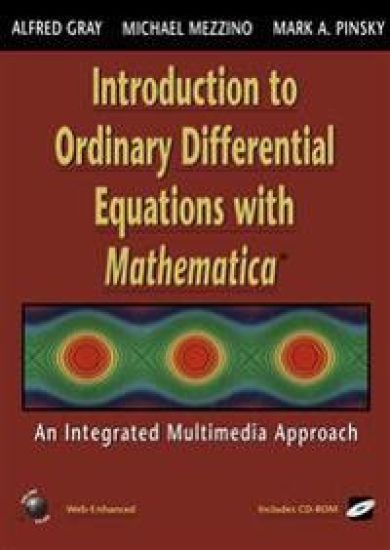
These materials, which have been developed and thoroughly class tested over a period of several years by the authors, are intended for use in courses in differential equations taught at the sophomore/junior level in American colleges and universities. Prerequisites for using these materials is the calculus of one variable, although calculus of several variables, and linear algrbra, are recommended. The text covers the standard topics in first and second order equations, power series solutions, first order systems, Laplace transforms, numerical methods and stability of non-linear systems. For historical completeness, the authors have also included the solution methods of Bernoulli, Clariaut, and Lagrange, if instructors wish to cover them. Liberal use is made of programs in Mathemtica, both for symbolic computations and graphical displays. The programs are described in separate sections, as well as in the accompanying Mathematica notebooks. The book has been designed so that it can be read with or without Mathematica and no pre-requisite knowledge of Mathematica is required to use the book, not to deal with the Mathematica programs contained in ODE.m, the special Mathematica software package residing on the CD-ROM accompanying the text. ODE.m enables students to solve differential equations, much as a calculator would. The CD-ROM, in addition to containing ODE.m, also contains the Mathematica solution of worked examples, the Mathematica solution of exercises, a protrait gallery of some 48 mathematicians who have contributed to the field of differential equations, a selction of various Mathematica noteboosk, Mathematica movies and sample labs for students. Mathematica programs and additional problem/example files will be made available online through the TELOS Web site (www.telospub.com) and the author's dedicated web site:
Introduction to Ordinary Differential Equations with Mathematica®

Introduction to Ordinary Differential Equations with Mathematica®

Alfred Gray; Mike Mezzino; Mark Pinsky

Springer-Verlag New York Inc.
1998
nidottu
The purpose of this companion volume to our text is to provide instructors (and eventu­ ally students) with some additional information to ease the learning process while further documenting the implementations of Mathematica and ODE. In an ideal world this volume would not be necessary, since we have systematically worked to make the text unambiguous and directly useful, by providing in the text worked examples of every technique which is discussed at the theoretical level. However, in our teaching we have found that it is helpful to have further documentation of the various solution techniques introduced in the text. The subject of differential equations is particularly well-suited to self-study, since one can always verify by hand calculation whether or not a given proposed solution is a bona­ fide solution of the differential equation and initial conditions. Accordingly, we have not reproduced the steps of the verification process in every case, rather content with the illustration of some basic cases of verification in the text. As we state there, students are strongly encouraged to verify that the proposed solution indeed satisfies the requisite equation and supplementary conditions.
Tubes

Tubes

Alfred Gray

Springer Basel
2012
nidottu
In July 1998, I received an e-mail from Alfred Gray, telling me: " . . . I am in Bilbao and working on the second edition of Tubes . . . Tentatively, the new features of the book are: 1. Footnotes containing biographical information and portraits 2. A new chapter on mean-value theorems 3. A new appendix on plotting tubes " That September he spent a week in Valencia, participating in a workshop on Differential Geometry and its Applications. Here he gave me a copy of the last version of Tubes. It could be considered a final version. There was only one point that we thought needed to be considered again, namely the possible completion of the material in Section 8. 8 on comparison theorems of surfaces with the now well-known results in arbitrary dimensions. But only one month later the sad and shocking news arrived from Bilbao: Alfred had passed away. I was subsequently charged with the task of preparing the final revision of the book for the publishers, although some special circumstances prevented me from finishing the task earlier. The book appears essentially as Alred Gray left it in September 1998. The only changes I carried out were the addition of Section 8. 9 (representing the discus­ sion we had), the inclusion of some new results on harmonic spaces, the structure of Hopf hypersurfaces in complex projective spaces and the conjecture about the volume of geodesic balls.
Modern Differential Geometry of Curves and Surfaces with Mathematica

Modern Differential Geometry of Curves and Surfaces with Mathematica

Elsa Abbena; Simon Salamon; Alfred Gray

Chapman Hall/CRC
2006
sidottu
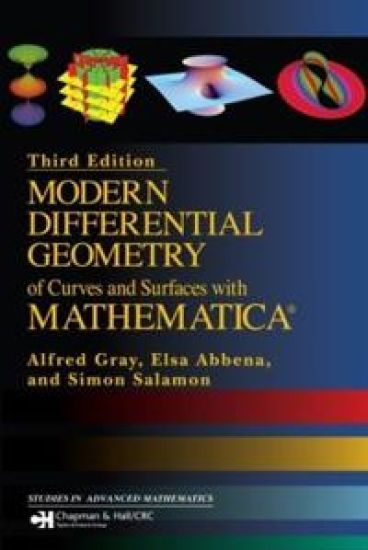
Presenting theory while using Mathematica in a complementary way, Modern Differential Geometry of Curves and Surfaces with Mathematica, the third edition of Alfred Gray’s famous textbook, covers how to define and compute standard geometric functions using Mathematica for constructing new curves and surfaces from existing ones. Since Gray’s death, authors Abbena and Salamon have stepped in to bring the book up to date. While maintaining Gray's intuitive approach, they reorganized the material to provide a clearer division between the text and the Mathematica code and added a Mathematica notebook as an appendix to each chapter. They also address important new topics, such as quaternions. The approach of this book is at times more computational than is usual for a book on the subject. For example, Brioshi’s formula for the Gaussian curvature in terms of the first fundamental form can be too complicated for use in hand calculations, but Mathematica handles it easily, either through computations or through graphing curvature. Another part of Mathematica that can be used effectively in differential geometry is its special function library, where nonstandard spaces of constant curvature can be defined in terms of elliptic functions and then plotted. Using the techniques described in this book, readers will understand concepts geometrically, plotting curves and surfaces on a monitor and then printing them. Containing more than 300 illustrations, the book demonstrates how to use Mathematica to plot many interesting curves and surfaces. Including as many topics of the classical differential geometry and surfaces as possible, it highlights important theorems with many examples. It includes 300 miniprograms for computing and plotting various geometric objects, alleviating the drudgery of computing things such as the curvature and torsion of a curve in space.
Tubes

Tubes

Alfred Gray

Birkhauser Verlag AG
2003
sidottu
In July 1998, I received an e-mail from Alfred Gray, telling me: " . . . I am in Bilbao and working on the second edition of Tubes . . . Tentatively, the new features of the book are: 1. Footnotes containing biographical information and portraits 2. A new chapter on mean-value theorems 3. A new appendix on plotting tubes " That September he spent a week in Valencia, participating in a workshop on Differential Geometry and its Applications. Here he gave me a copy of the last version of Tubes. It could be considered a final version. There was only one point that we thought needed to be considered again, namely the possible completion of the material in Section 8. 8 on comparison theorems of surfaces with the now well-known results in arbitrary dimensions. But only one month later the sad and shocking news arrived from Bilbao: Alfred had passed away. I was subsequently charged with the task of preparing the final revision of the book for the publishers, although some special circumstances prevented me from finishing the task earlier. The book appears essentially as Alred Gray left it in September 1998. The only changes I carried out were the addition of Section 8. 9 (representing the discus­ sion we had), the inclusion of some new results on harmonic spaces, the structure of Hopf hypersurfaces in complex projective spaces and the conjecture about the volume of geodesic balls.