
Kirjojen hintavertailu – 12 903 725 kirjaa ja 27 kauppaa

Kirjailija

Alice Mathers

Kirjat ja teokset yhdessä paikassa: 2 kirjaa, julkaisuja vuodelta 2013, suosituimpiin kuuluu Socially Restorative Urbanism. Vertaile teosten hintoja ja tarkista saatavuus suomalaisista kirjakaupoista.

2 kirjaa

Socially Restorative Urbanism

Socially Restorative Urbanism

Kevin Thwaites; Alice Mathers; Ian Simkins

Routledge
2013
sidottu
The need for a human-orientated approach to urbanism is well understood, and yet all too often this dimension remains lacking in urban design. In this book the authors argue for and develop socially restorative urbanism – a new conceptual framework laying the foundations for innovative ways of thinking about the relationship between the urban spatial structure and social processes to re-introduce a more explicit people-centred element into urban place-making and its adaptation. Focusing on this interplay between humans and the built environment, two new concepts are developed: the transitional edge – a socio-spatial concept of the urban realm; and Experiemics – a participative process that acts to redress imbalances in territorial relationships, defined in terms of the awareness of mine, theirs, ours and yours (MTOY). In this way, Socially Restorative Urbanism shows how professional practice and community understanding can be brought together in a mutually interdependent and practical way. Its theoretical and practical principles are applicable across a wide range of contexts concerning human benefit through urban environmental change and experience, and it will be of interest to readers in the social sciences and environmental psychology, as well as the spatial planning and design disciplines.
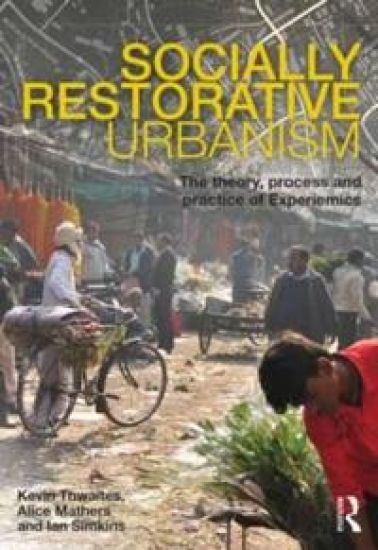
Socially Restorative Urbanism

Socially Restorative Urbanism

Kevin Thwaites; Alice Mathers; Ian Simkins

Routledge
2013
nidottu
The need for a human-orientated approach to urbanism is well understood, and yet all too often this dimension remains lacking in urban design. In this book the authors argue for and develop socially restorative urbanism – a new conceptual framework laying the foundations for innovative ways of thinking about the relationship between the urban spatial structure and social processes to re-introduce a more explicit people-centred element into urban place-making and its adaptation. Focusing on this interplay between humans and the built environment, two new concepts are developed: the transitional edge – a socio-spatial concept of the urban realm; and Experiemics – a participative process that acts to redress imbalances in territorial relationships, defined in terms of the awareness of mine, theirs, ours and yours (MTOY). In this way, Socially Restorative Urbanism shows how professional practice and community understanding can be brought together in a mutually interdependent and practical way. Its theoretical and practical principles are applicable across a wide range of contexts concerning human benefit through urban environmental change and experience, and it will be of interest to readers in the social sciences and environmental psychology, as well as the spatial planning and design disciplines.