Kirjojen hintavertailu – 12 903 725 kirjaa ja 27 kauppaa
Kirjailija
Alison Cook-Sather
Kirjat ja teokset yhdessä paikassa: 8 kirjaa, julkaisuja vuosilta 2010–2026, suosituimpiin kuuluu Promoting Equity and Justice Through Pedagogical Partnership. Vertaile teosten hintoja ja tarkista saatavuus suomalaisista kirjakaupoista.
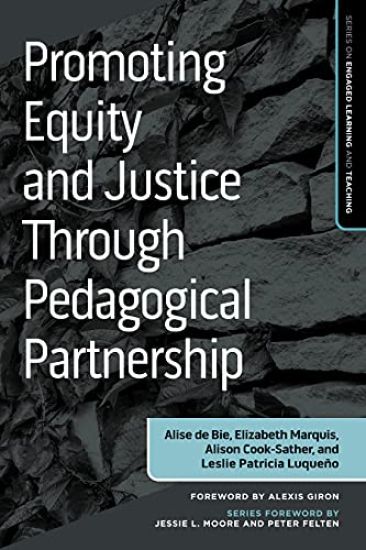
Faculty and staff in higher education are looking for ways to address the deep inequity and systemic racism that pervade our colleges and universities. Pedagogical partnership can be a powerful tool to enhance equity, inclusion, and justice in our classrooms and curricula. These partnerships create opportunities for students from underrepresented and equity-seeking groups to collaborate with faculty and staff to revise and reinvent pedagogies, assessments, and course designs, positioning equity and justice as core educational aims. When students have a seat at the table, previously unheard voices are amplified, and diversity and difference introduce essential perspectives that are too often overlooked. In particular, the book contributes to the literature on pedagogical partnership and equity in education by integrating theory, synthesizing research, and providing concrete examples of the ways partnership can contribute to more equitable educational systems. At the same time, the authors acknowledge that partnership can only realize its full potential to redress harms and promote equity and justice when thoughtfully enacted. This book is a resource that will inspire and challenge a wide variety of higher education faculty and staff and contribute to advancing both practice and research on the potential of student-faculty pedagogical partnerships. Presenting a conceptual framework for understanding the various epistemological, affective, and ontological harms that face students from equity-seeking groups in postsecondary education, Promoting Equity and Justice Through Pedagogical Partnership applies this conceptual framework to current literature in partnerships, highlighting the promise of partnership as the way to redress these harms. The authors ground both the conceptual framework and the literature review by offering two case studies of pedagogical partnership in practice. They then explore the complexities raised by their framework, including the conditions under which partnerships themselves may risk reproducing epistemic, affective, or ontological harms. Applying the framework in this way allows them to propose strategies that make it more likely for these mediations to be successful. Finally, the authors focus on the future of pedagogical partnership and share their perspectives on new directions for inquiry and practice. After summarizing the overarching themes developed throughout the book, the authors leave the reader with a set of questions and recommendations for further inquiry and discussion. A Series on Engaged Learning and Teaching Book. Visit the books’ companion website, hosted by the Center for Engaged Learning, for book resources.
Parlor Press and the Center for Engaged Learning Open Access Book Series Series Editors: Jessie L Moore and Peter Felten Pedagogical Partnerships and its accompanying resources provide step-by-step guidance to support the conceptualization, development, launch, and sustainability of pedagogical partnership programs in the classroom and curriculum. This definitive guide is written for faculty, students, and academic developers who seek to leverage pedagogical partnerships to increase engaged learning, create more equitable and inclusive educational experiences, and reframe the traditionally hierarchical structure of teacher-student relationships. Filled with practical advice, Pedagogical Partnerships provides extensive materials so readers don't have to reinvent the wheel but can adapt time-tested strategies and techniques to their own unique contexts and goals. "We see this book not only as a valuable window into the day-to-day functioning and processes of one highly successful partnership program, but also as a call to develop a wide range of partnership practices that respond to and work within diverse institutional and cultural contexts." -Beth Marquis, Mick Healey, and Kelly E. Matthews Alison Cook-Sather is a professor of education at Bryn Mawr College and director of Students as Learners and Teachers (SaLT), the signature program of the Teaching and Learning Institute (TLI) at Bryn Mawr and Haverford Colleges. In addition, she has served as a consultant at institutions across the United States and around the world as others develop pedagogical partnership programs. Finally, Alison has engaged in extensive research on pedagogical partnership and is founding editor and founding co-editor, respectively, of two journals focused on pedagogical partnership: Teaching and Learning Together in Higher Education and International Journal for Students as Partners. Melanie Bahti is a former student partner in SaLT who graduated from Bryn Mawr College in 2016 with a degree in linguistics. In addition to co-authoring an article on partnership with Alison and another former student partner (Cook-Sather, Des-Ogugua, and Bahti, 2018), she has presented at conferences and consulted on partnership, and she serves as a reviewer for the International Journal for Students as Partners. She recently completed a Master's degree in higher education at the University of Pennsylvania and now works in the Center for Teaching & Learning at Thomas Jefferson University. Anita Ntem graduated from Bryn Mawr College in 2018 with a degree in psychology. As a student partner in SaLT she worked in partnership with faculty in four different departments. In addition, she has engaged in research as a Fellow of the Teaching and Learning Institute. Anita has presented her research on partnership at conferences (Ntem 2017), co-authored articles on pedagogical partnership (Cook-Sather, Ntem, and Felten in preparation; Ntem and Cook-Sather 2018), served as a facilitator of the International Summer Institute for Students as Partners at McMaster University in Canada, and is co-editor of the International Journal for Students as Partners.
Co-Creating Equitable Teaching and Learning invites readers to help forge a more inclusive and accessible college education by incorporating student voices via pedagogical partnerships. Alison Cook-Sather, a pioneer of this co-creative approach, draws on more than twenty years of experience developing student–teacher partnerships in higher education to offer a wise and generous work that speaks to both students and educators. As her research underscores, a co-creative learning environment, in which relationships and communication between students and teachers are prioritized, benefits the educational experience on many levels. Cook-Sather demonstrates how pedagogical partnerships give students the tools to advocate for their own learning while giving educators the feedback they need to improve classroom experiences. She shows how the co-creative model helps to bring about inclusive spaces and equitable teaching practices that better foster student success, especially among underrepresented and minority student populations. Offering actionable guidance, Cook-Sather advocates enacting the following four principles to structure student voice into higher education: embracing a commitment to equity and justice; providing structure rather than prescriptions for engagement; making rather than taking up space; and developing a partnership mindset. She grounds these principles in examples of practices drawn from an undergraduate education course; a faculty development program; and cross-disciplinary, cross-constituency institutional dialogues. This work calls for readers to reimagine the higher education structure and to cultivate an environment in which all stakeholders can work together to advance inclusivity, accessibility, and equity. As the author argues, co-creation can be a catalyst for change throughout the system.
Faculty and staff in higher education are looking for ways to address the deep inequity and systemic racism that pervade our colleges and universities. Pedagogical partnership can be a powerful tool to enhance equity, inclusion, and justice in our classrooms and curricula. These partnerships create opportunities for students from underrepresented and equity-seeking groups to collaborate with faculty and staff to revise and reinvent pedagogies, assessments, and course designs, positioning equity and justice as core educational aims. When students have a seat at the table, previously unheard voices are amplified, and diversity and difference introduce essential perspectives that are too often overlooked. In particular, the book contributes to the literature on pedagogical partnership and equity in education by integrating theory, synthesizing research, and providing concrete examples of the ways partnership can contribute to more equitable educational systems. At the same time, the authors acknowledge that partnership can only realize its full potential to redress harms and promote equity and justice when thoughtfully enacted. This book is a resource that will inspire and challenge a wide variety of higher education faculty and staff and contribute to advancing both practice and research on the potential of student-faculty pedagogical partnerships. Presenting a conceptual framework for understanding the various epistemological, affective, and ontological harms that face students from equity-seeking groups in postsecondary education, Promoting Equity and Justice Through Pedagogical Partnership applies this conceptual framework to current literature in partnerships, highlighting the promise of partnership as the way to redress these harms. The authors ground both the conceptual framework and the literature review by offering two case studies of pedagogical partnership in practice. They then explore the complexities raised by their framework, including the conditions under which partnerships themselves may risk reproducing epistemic, affective, or ontological harms. Applying the framework in this way allows them to propose strategies that make it more likely for these mediations to be successful. Finally, the authors focus on the future of pedagogical partnership and share their perspectives on new directions for inquiry and practice. After summarizing the overarching themes developed throughout the book, the authors leave the reader with a set of questions and recommendations for further inquiry and discussion. A Series on Engaged Learning and Teaching Book. Visit the books’ companion website, hosted by the Center for Engaged Learning, for book resources.
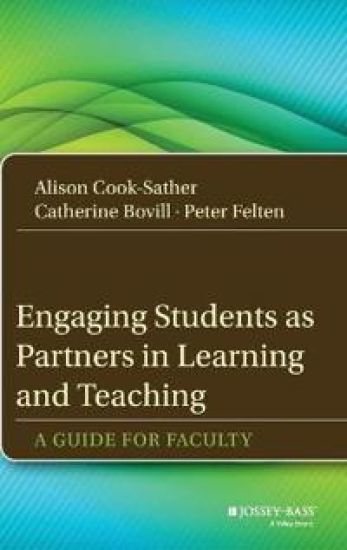
A guide to developing productive student-faculty partnerships in higher education Student-faculty partnerships is an innovation that is gaining traction on campuses across the country. There are few established models in this new endeavor, however. Engaging Students as Partners in Learning and Teaching: A Guide for Faculty offers administrators, faculty, and students both the theoretical grounding and practical guidelines needed to develop student-faculty partnerships that affirm and improve teaching and learning in higher education. Provides theory and evidence to support new efforts in student-faculty partnershipsDescribes various models for creating and supporting such partnershipsHelps faculty overcome some of the perceived barriers to student-faculty partnershipsSuggests a range of possible levels of partnership that might be appropriate in different circumstancesIncludes helpful responses to a range of questions as well as advice from faculty, students, and administrators who have hands-on experience with partnership programs Balancing theory, step-by-step guidelines, expert advice, and practitioner experience, this book is a comprehensive why- and how-to handbook for developing a successful student-faculty partnership program.
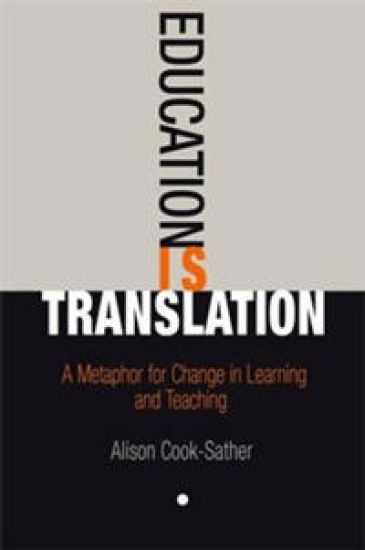
Education Is Translation offers a radical redefinition of the promises and possibilities of teaching and learning. Through an unusual weaving of not only disciplinary but also personal and academic, poetic, and analytical perspectives, Alison Cook-Sather argues that education can be understood as a process of translation through which every learner is both the translator and the subject of her own translation. Drawing on the fields of anthropology, literary theory, psychology, translation studies, and educational theory, she presents in-depth explorations of various educational experiences and provides the insights necessary for the development of rewarding life-long strategies for becoming a more effective teacher and a better learner. Her analysis reveals how teaching and learning are intimately linked, how technology can transform learning, and how teachers and learners must reposition themselves in order to achieve the most transformative education. This is not a how-to book; rather, it presents in a serious and inviting way the metaphor of translation to anyone who wants to understand more deeply and support more constructively the ways humans interact, learn, and change.
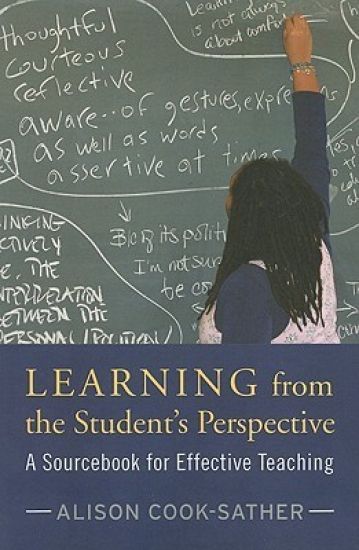
Much has been written about how to engage students in their learning, but very little of it has issued from students themselves. Compiled by one of the leading scholars in the field of student voice, this sourcebook draws on the perspectives of secondary students in the United States, England, Canada, and Australia as well as on the work of teachers, researchers, and teacher educators who have collaborated with a wide variety of students. Highlighting student voices, it features five chapters focused on student perspectives, articulated in their own words, regarding specific approaches to creating and maintaining a positive classroom environment and designing engaging lessons and on more general issues of respect and responsibility in the classroom. To support educators in developing strategies for accessing and responding to student voices in their own classrooms, the book provides detailed guidelines created by educational researchers for gathering and acting upon student perspectives. To illustrate how these approaches work in practice, the book includes stories of how pre-service and in-service teachers, school leaders, and teacher educators have made student voices and participation central to their classroom and school practices. And finally, addressing both practical and theoretical questions, the book includes a chapter that outlines action steps for high school teachers, school leaders, and teacher educators and a chapter that offers a conceptual framework for thinking about and engaging in this work. Bringing together in a single text student perspectives, descriptions of successful efforts to access them in secondary education contexts, concrete advice for practitioners, and a theoretical framework for further exploration, this sourcebook can be used to guide practice and support re-imagining education in secondary schools of all kinds, and the principles can be adapted for other educational contexts.