Kirjojen hintavertailu – 12 903 725 kirjaa ja 27 kauppaa

Kirjailija

Alistair Barclay

Kirjat ja teokset yhdessä paikassa: 7 kirjaa, julkaisuja vuosilta 2003–2023, suosituimpiin kuuluu Imperial College Sports Grounds and RMC Land, Harlington. Vertaile teosten hintoja ja tarkista saatavuus suomalaisista kirjakaupoista.

7 kirjaa

Kirjojen julkaisuvuodet: 2003–2023.

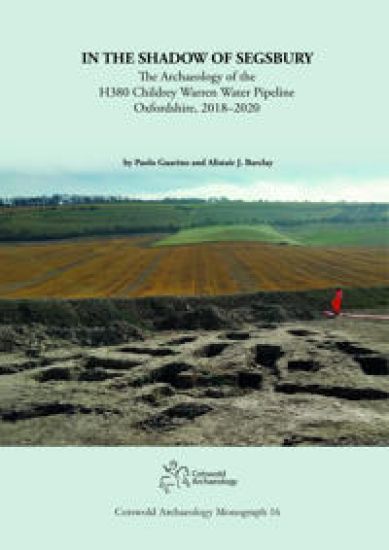
In the Shadow of Segsbury

In the Shadow of Segsbury

Paolo Guarino; Alistair Barclay

Cotswold Archaeology
2023
nidottu
Extensively illustrated report on an excavation in Oxfordshire near the Iron Age hillfort at Segsbury. Ephemeral traces of Mesolithic and Neolithic activity, including a possible Neolithic timber structure, were found. The remains of a probable Late Bronze Age pit alignment were also found. Small Iron Age settlements comprising round houses, pits and other structures, and burials were revealed. One particular burial in a pit had been subjected to unusual treatment that included the removal of the individual’s feet after death. Small Roman and post-Roman cemeteries also were identified. The small Late Roman cemetery included males, females and neonates. This cemetery is typical for the period and the burials were accompanied by a range of artefacts including coins, brooches, a bracelet and rings as well as an unusual fragmentary double-sided bone or antler comb with a horse motif and ring-and-dot decoration. A small undated cemetery was originally believed to be either of Roman or less likely post-Roman date. However, radiocarbon dating revealed the unaccompanied burials to be of late 7th or early 8th century AD date. Innovative scientific techniques including radiocarbon dating and Bayesian modelling, aDNA and isotope analysis have revealed some important details such as familial relationships and dating that would not otherwise have been known. Small assemblages of finds included worked flint and prehistoric pottery, Roman and later pottery, worked bone, glass and metalwork.
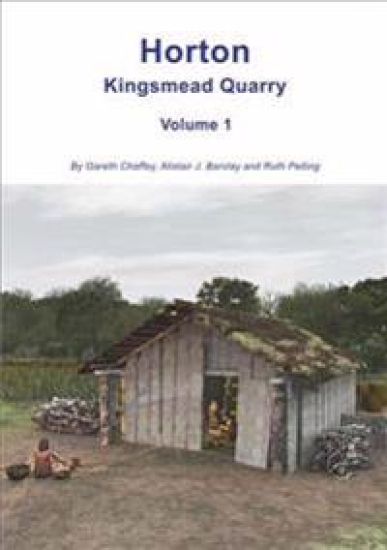
Horton Kingsmead Quarry Volume 1

Horton Kingsmead Quarry Volume 1

Gareth Chaffey; Alistair Barclay; Ruth Pelling

Trust for Wessex Archaeology Ltd
2022
sidottu
Excavations at Kingsmead Quarry, Horton, Berkshire, have provided an opportunity to investigate a large multi-period site with occupation dating back over 12,000 years. The immediate landscape was one of braided river channels for much of later prehistory, whilst a substantial channel at the southern edge of the quarry is thought to be a former course of the Thames. The investigations at Horton have revealed evidence for a rare Early Neolithic house, indicating permanent occupation on the site from about 3800 BC. A number of contemporary pits are suggestive of a house void . During the Bronze Age the landscape was dramatically transformed from an open area to an enclosed and subdivided agricultural landscape comprising field systems and two substantial farmsteads. Each farm was associated with burials, domestic refuse and metalwork. The Iron Age and Romano-British periods saw continued development and re-organisation of the landscape, with associated settlements of a much smaller scale. This is the first of three volumes and covers the results from 2003 2009. A range of structural evidence, augmented by considerable quantities of artefactual and environmental information, show Horton to have been a suitable and significant place for episodic settlement from the start of the Neolithic. A detailed account of the site is given in this volume, whilst its position in the wider archaeological landscape of the Middle Thames Valley is discussed.
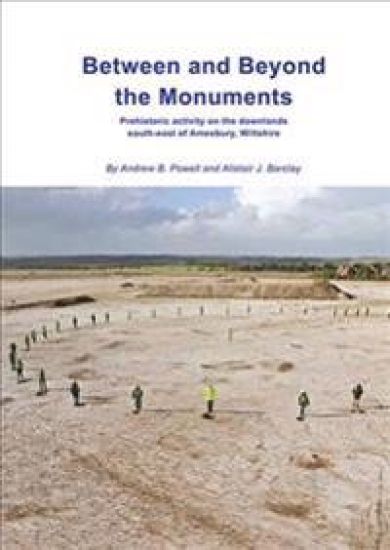
Between and Beyond the Monuments

Between and Beyond the Monuments

Andrew Powell; Alistair Barclay

Trust for Wessex Archaeology Ltd
2022
sidottu
This book reports on the prehistoric archaeology revealed by investigations of a large area of Chalk downland south-east of Amesbury, Wiltshire. Excavations on the site between 1993 and 2015 revealed Neolithic monumental features, a significant number of Beaker and other Early and Middle Bronze Age burials and funerary deposits, numerous prehistoric pits, and evidence for Iron Age and Romano-British settlement, landscape organization and burial. The present volume covers the wider prehistoric remains from the site, describing all features of Mesolithic, Neolithic, Bronze Age and Iron Age date. The prehistoric monuments, pits and extensive sequence of burials are placed in their wider landscape context, and the development, chronology and variability of prehistoric ritual and mortuary practices is explored, along with the evidence for late prehistoric settlement. Individually, some of the discoveries are of national significance. Collectively, they reveal the development and transformation of a landscape rich in ritual, mortuary and settlement features during an almost continuous period of over 3000 years, the significance of which is enhanced by the site's position immediately east of the Stonehenge World Heritage Site.
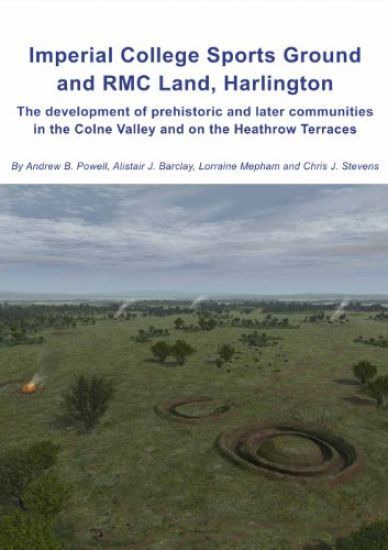
Imperial College Sports Grounds and RMC Land, Harlington

Imperial College Sports Grounds and RMC Land, Harlington

Andrew B. Powell; Alistair Barclay; Lorraine Mepham; Chris J. Stevens

Trust for Wessex Archaeology Ltd
2015
sidottu
This volume brings together the results from the excavations at the former Imperial College Sports Ground, RMC Land and Land East of Wall Garden Farm, near the villages of Harlington and Sipson in the London Borough of Hillingdon. The excavations revealed parts of an archaeological landscape with a rich history of development from before 4000 BC to the post-medieval period. The opportunity to investigate two large areas of this landscape provided evidence for possible settlement continuity and shift over a period of 6000 years. Early to Middle Neolithic occupation was represented by a rectangular ditched mortuary enclosure and a large spread of pits, many containing deposits of Peterborough Ware pottery, flint and charred plant remains. A possible dispersed monument complex of three hengiform enclosures was associated with the rare remains of cremation burials radiocarbon dated to the Middle Neolithic. Limited Late Neolithic and Early Bronze Age activity was identified, which is in stark contrast to the Middle to Late Bronze Age when a formalised landscape of extensive rectangular fields, enclosures, wells and pits was established. This major reorganised land division can be traced across the two sites and over large parts of the adjacent Heathrow terraces. A small, Iron Age and Romano-British nucleated settlement was constructed, with associated enclosures flanking a trackway. There were wayside inhumations, cremation burials and middens and more widely dispersed wells and quarries. Two possible sunken-featured buildings of early Saxon date were found. There was also a small cemetery. Subsequently, a middle Saxon and medieval field system of small enclosures and wells was established.
Lines in the Landscape

Lines in the Landscape

Alistair Barclay; George Lambrick; John Moore; Mark Robinson

Oxford University School of Archaeology
2003
sidottu
The Upper Thames Valley is an important area for prehistoric monuments and has one of the highest concentrations of cursuses, distinctive linear or elongated earthworks, in Britain. In the 1980s the Oxford Archaeological Unit along with the Abingdon Area Archaeological and Historical Society had the opportunity to extensively investigate one of these sites at Drayton. This site has produced many significant results for our present understanding of the date, construction and use of cursus monuments on the lowland river gravels of Britain. This volume reports on the excavations at Drayton, and includes an account of small-scale excavations undertaken at the Lechlade cursus by OAU and Lance and Faith Vatcher. It also provides a gazetteer of known cursus monuments in the Upper Thames Valley.