
Kirjojen hintavertailu – 12 859 828 kirjaa ja 27 kauppaa

Kirjailija

Alistair Black

Kirjat ja teokset yhdessä paikassa: 8 kirjaa, julkaisuja vuosilta 1997–2019, suosituimpiin kuuluu Libraries of Light. Vertaile teosten hintoja ja tarkista saatavuus suomalaisista kirjakaupoista.

8 kirjaa

Kirjojen julkaisuvuodet: 1997–2019.

Libraries of Light

Libraries of Light

Alistair Black

Routledge
2019
nidottu
For the first hundred years or so of their history, public libraries in Britain were built in an array of revivalist architectural styles. This backward-looking tradition was decisively broken in the 1960s as many new libraries were erected up and down the country. In this new Routledge book, Alistair Black argues that the architectural modernism of the post-war years was symptomatic of the age’s spirit of renewal. In the 1960s, public libraries truly became ‘libraries of light’, and Black further explains how this phrase not only describes the shining new library designs – with their open-plan, decluttered, Scandinavian-inspired designs – but also serves as a metaphor for the public library’s role as a beacon of social egalitarianism and cultural universalism. A sequel to Books, Buildings and Social Engineering (2009), Black's new book takes his fascinating story of the design of British public libraries into the era of architectural modernism.

Books, Buildings and Social Engineering

Books, Buildings and Social Engineering

Alistair Black; Simon Pepper; Kaye Bagshaw

CRC Press Inc
2017
nidottu
Public libraries have strangely never been the subject of an extensive design history. Consequently, this important and comprehensive book represents a ground-breaking socio-architectural study of pre-1939 public library buildings. A surprisingly high proportion of these urban civic buildings remain intact and present an increasingly difficult architectural problem for many communities. The book thus includes a study of what is happening to these historic libraries now and proposes that knowledge of their origins and early development can help build an understanding of how best to handle their future.
Understanding Community Librarianship

Understanding Community Librarianship

Alistair Black; David Muddiman

Routledge
2017
nidottu
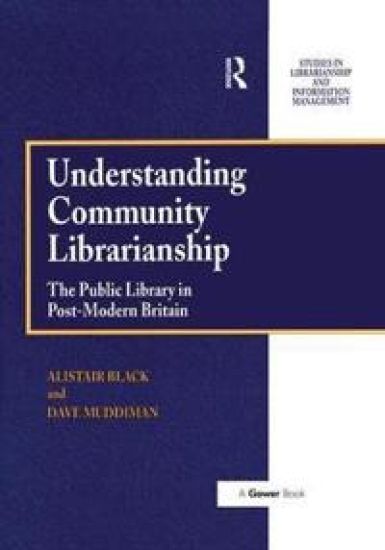
In the information society, is the community focused library a real possibility? This book reappraises the relationship between the library and its communities through an examination of the rise and decline of ’community’ librarianship over the last three decades. The authors consider key models of community based library service and argue that bland assertions of community prevalence mask a complex and problematic relationship between a highly traditional public service bureaucracy and its users. The resulting uncertainty of purpose, they claim, explains much of the current ’crisis’ of the public library movement. Drawing on recent social science theory and empirical work in the field, this book offers a new and critical perspective on the current public library debate. It is essential reading for librarians, students of information and library science and all who have a stake in the future of the public library. As a case study of community, public service and the local state it should also be of value to those with an interest in community development, cultural policy and local government.
The Early Information Society

The Early Information Society

Alistair Black; Dave Muddiman

Routledge
2016
nidottu
Whether termed the 'network society', the 'knowledge society' or the 'information society', it is widely accepted that a new age has dawned, unveiled by powerful computer and communication technologies. Yet for millennia humans have been recording knowledge and culture, engaging in the dissemination and preservation of information. In `The Early Information Society', the authors argue for an earlier incarnation of the information age, focusing upon the period 1900-1960. In support of this they examine the history and traditions in Britain of two separate but related information-rich occupations - information management and information science - repositioning their origins before the age of the computer and identifying the forces driving their early development. `The Early Information Society' offers an historical account which questions the novelty of the current information society. It will be essential reading for students, researchers and practitioners in the library and information science field, and for sociologists and historians interested in the information society.
Libraries of Light

Libraries of Light

Alistair Black

Routledge
2016
sidottu
For the first hundred years or so of their history, public libraries in Britain were built in an array of revivalist architectural styles. This backward-looking tradition was decisively broken in the 1960s as many new libraries were erected up and down the country. In this new Routledge book, Alistair Black argues that the architectural modernism of the post-war years was symptomatic of the age’s spirit of renewal. In the 1960s, public libraries truly became ‘libraries of light’, and Black further explains how this phrase not only describes the shining new library designs – with their open-plan, decluttered, Scandinavian-inspired designs – but also serves as a metaphor for the public library’s role as a beacon of social egalitarianism and cultural universalism. A sequel to Books, Buildings and Social Engineering (2009), Black's new book takes his fascinating story of the design of British public libraries into the era of architectural modernism.
Books, Buildings and Social Engineering

Books, Buildings and Social Engineering

Alistair Black; Simon Pepper; Kaye Bagshaw

Ashgate Publishing Limited
2009
sidottu
Public libraries have strangely never been the subject of an extensive design history. Consequently, this important and comprehensive book represents a ground-breaking socio-architectural study of pre-1939 public library buildings. A surprisingly high proportion of these urban civic buildings remain intact and present an increasingly difficult architectural problem for many communities. The book thus includes a study of what is happening to these historic libraries now and proposes that knowledge of their origins and early development can help build an understanding of how best to handle their future.
The Early Information Society

The Early Information Society

Alistair Black; Dave Muddiman

Ashgate Publishing Limited
2007
sidottu
Whether termed the 'network society', the 'knowledge society' or the 'information society', it is widely accepted that a new age has dawned, unveiled by powerful computer and communication technologies. Yet for millennia humans have been recording knowledge and culture, engaging in the dissemination and preservation of information. In `The Early Information Society', the authors argue for an earlier incarnation of the information age, focusing upon the period 1900-1960. In support of this they examine the history and traditions in Britain of two separate but related information-rich occupations - information management and information science - repositioning their origins before the age of the computer and identifying the forces driving their early development. `The Early Information Society' offers an historical account which questions the novelty of the current information society. It will be essential reading for students, researchers and practitioners in the library and information science field, and for sociologists and historians interested in the information society.
Understanding Community Librarianship

Understanding Community Librarianship

Alistair Black; David Muddiman

Ashgate Publishing Limited
1997
sidottu
In the information society, is the community focused library a real possibility? This book reappraises the relationship between the library and its communities through an examination of the rise and decline of ’community’ librarianship over the last three decades. The authors consider key models of community based library service and argue that bland assertions of community prevalence mask a complex and problematic relationship between a highly traditional public service bureaucracy and its users. The resulting uncertainty of purpose, they claim, explains much of the current ’crisis’ of the public library movement. Drawing on recent social science theory and empirical work in the field, this book offers a new and critical perspective on the current public library debate. It is essential reading for librarians, students of information and library science and all who have a stake in the future of the public library. As a case study of community, public service and the local state it should also be of value to those with an interest in community development, cultural policy and local government.