Kirjojen hintavertailu – 12 903 725 kirjaa ja 27 kauppaa

Kirjailija

Allan C. Carlson

Kirjat ja teokset yhdessä paikassa: 22 kirjaa, julkaisuja vuosilta 1990–2024, suosituimpiin kuuluu Godly Seed. Vertaile teosten hintoja ja tarkista saatavuus suomalaisista kirjakaupoista.

Nimi esiintyy myös muodoissa: Allan C Carlson

22 kirjaa

Kirjojen julkaisuvuodet: 1990–2024.

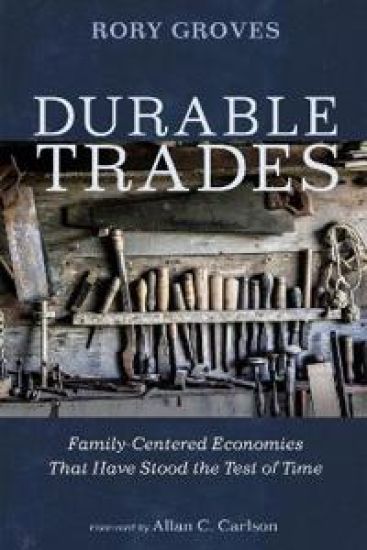
Durable Trades

Durable Trades

Rory Groves; Allan C Carlson

Front Porch Republic Books
2020
sidottu
With over thirty thousand occupations currently in existence, workers today face a bewildering array of careers from which to choose, and upon which to center their lives. But there is more at stake than just a paycheck. For too long, work has driven a wedge between families, dividing husband from wife, father from son, mother from daughter, and family from home. Building something that will last requires a radically different approach than is common or encouraged today. In Durable Trades, Groves uncovers family-centered professions that have endured the worst upheavals in history--including the Industrial Revolution--and continue to thrive today. Through careful research and thoughtful commentary, Groves offers another way forward to those looking for a more durable future.
Durable Trades

Durable Trades

Rory Groves; Allan C Carlson

Front Porch Republic Books
2020
pokkari
With over thirty thousand occupations currently in existence, workers today face a bewildering array of careers from which to choose, and upon which to center their lives. But there is more at stake than just a paycheck. For too long, work has driven a wedge between families, dividing husband from wife, father from son, mother from daughter, and family from home. Building something that will last requires a radically different approach than is common or encouraged today. In Durable Trades, Groves uncovers family-centered professions that have endured the worst upheavals in history--including the Industrial Revolution--and continue to thrive today. Through careful research and thoughtful commentary, Groves offers another way forward to those looking for a more durable future.
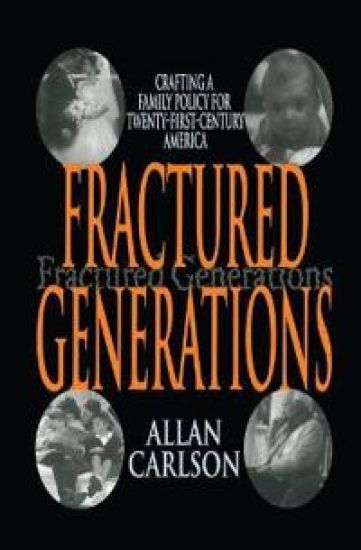
Fractured Generations

Fractured Generations

Allan C. Carlson

Routledge
2018
nidottu
Fifty years ago, the phrase "family policy" was rarely heard in America. Individual states maintained laws governing marriage, divorce, education, inheritance, and child protection, which regulated the formation, childrearing practices, and dissolution of families. However, these scattered policy issues were not seen as closely related. Until the 1960s, the nuclear family was an institution that was part of the natural life-course expected of most adults. Family meant marriage, children, the establishment of a home, care of the elderly, but perhaps most of all, bonding of the generations. As early as the 1840s, certain elements of states' policies hinted at a weakening family structure, but not until the 1960s was the family openly attacked. Feminists objected to a male-oriented home economy, demographers encouraged negative population growth, the sexual revolution was on the rise, and religiously grounded morality in public life was challenged in the federal courts. Married couples with children had to shoulder a larger tax burden, further discouraging people from building and maintaining families. Perhaps because family was so central to the founders' lives they found no need to mention it in the Constitution. But today, generational bonds have fractured, while family policy is a paramount public concern. As Allan Carlson makes clear no nation can progress, or even survive, without a durable family system. Contemporary family policy represents an attempt to counter the negative forces of the last four decades so as to restore the natural family to its necessary place in American life. Fractured Generations' chapters follow the life-course of the human family--marriage; the birth of children; infant and toddler care; schooling; building a home; crafting a durable family economy; and elder care. This is a passionate and well-reasoned appeal for a return to the institution that is the last best hope for America's future: the family.

The Natural Family

The Natural Family

Allan C. Carlson

Routledge
2017
sidottu
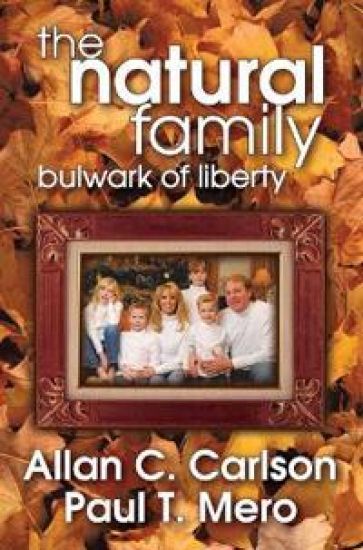
Sixty years ago, the UN declared the family to be the "natural and fundamental" unit of society. Today, many people are unsure as to what the word "family" even means. In response to this confusion, The Natural Family: Bulwark of Liberty defines the family based on universal human experience. Insisting, without apology, on the reality of the "natural family," the manifesto issues a personal call to men and women to rediscover this fundamental source of life, joy, and freedom. Carlson and Mero frankly admit that those who should have defended marriage were asleep when the full-scale assault on the family began in the 1960s. Even more seriously, most of them joined the assault by eventually adopting the very assumptions--philosophical, social, and economic--which almost extinguished the family's traditional legal and social privileges. "Family values" is now an empty slogan for those with some nostalgic attachment to the family, but who have no idea what the family really is. Carlson and Mero examine why the family is in crisis, the ways in which the natural family is the source of culture and freedom, and what families can do to preserve the most fundamental and wholesome relationship on earth. Assured that human nature is on their side, Carlson and Mero can be both realistic about the family's plight and relentlessly optimistic about the future. The Natural Family is a road map, especially for the young, for rebuilding a culture of freedom, joy, and love. "Perhaps the most succinct, thorough, and impressive pro-family argument yet made." BOOKLIST
The New Agrarian Mind

The New Agrarian Mind

Allan C. Carlson

Routledge
2017
sidottu
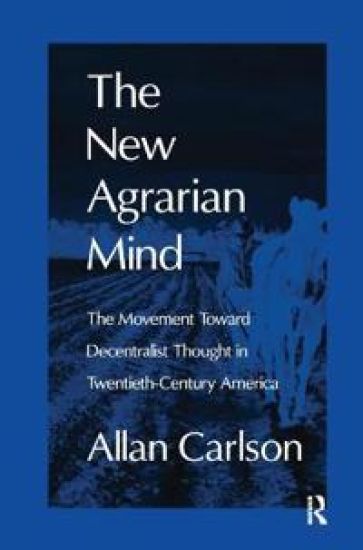
The self-sufficiency and regional outlook of farm life characterized the United States until the Civil War period. With the triumph of the industrial North over the rural South, the expansion of urbanism, and the closing of the frontier, the agrarian sector became an economic and cultural minority. The social benefits of rural life--a sense of independence, commitment to democracy, an abundance of children, stable community life--were threatened. This volume examines the rise of a distinctive agrarian intellectual movement to combat these trends. The New Agrarian Mind, now in paperback, synthesizes the thought of twentieth-century agrarian writers. It weaves together discussions of major representative figures, such as Liberty Hyde Bailey, Carle Zimmerman, and Wendell Berry, with myth-shattering analyses of the movement's cultural diversity, intellectual influence, and ideological complexity. Collectively labeled the New Agrarians to distinguish them from the simpler Jeffersonianism of the nineteenth century, they shared a coherent set of goals that were at once socially conservative and economically radical.
The Family in America

The Family in America

Allan C. Carlson

Routledge
2017
sidottu
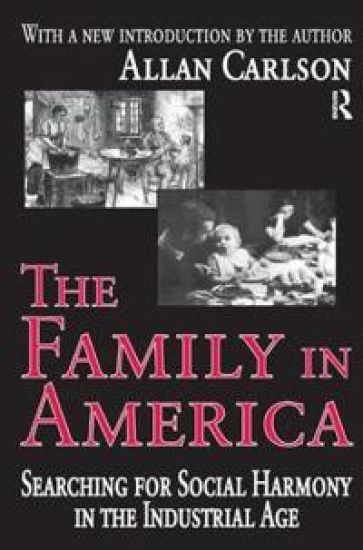
The Family in America offers a fresh interpretation of American social history, emphasizing the vital role of the family and household autonomy and threats to both imposed by industrial organization and the state. Allan Carlson shows that the United States, rather than being "born modern" as a progressive consumerist society, was in fact founded as an agrarian society composed of independent households rooted in land, lineage, and hierarchy. Carlson argues that family survival continues to be of paramount importance today. He critically examines five distinct strategies to restore a foundation for family life in industrial society, drawing on the insights of Frederic LePlay, Carle Zimmerman, and G. K. Chesterton. Carlson shows that family survival depends on the creation of meaningful, "pre-modern" household economies. This new edition includes an introduction by Allan Carlson, detailing the continued press of the industrial process onto the American family structure since initial publication of the book in 1993.
Godly Seed

Godly Seed

Allan C. Carlson

Routledge
2017
nidottu
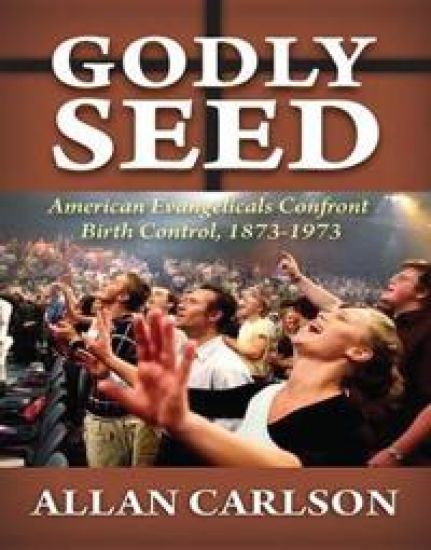
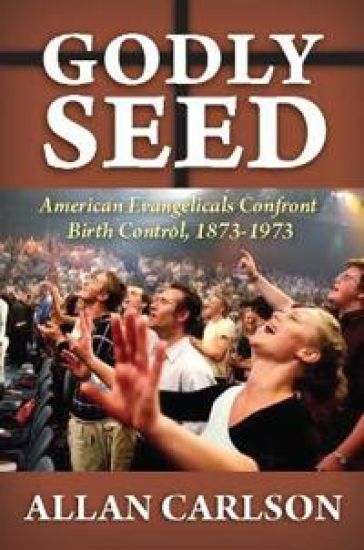
Interview with Allan Carlson In an ironic twist, American evangelical leaders are joining mainstream acceptance of contraception. Godly Seed: American Evangelicals Confront Birth Control, 1873-1973, examines how mid-twentieth-century evangelical leaders eventually followed the mainstream into a quiet embrace of contraception, complemented by a brief acceptance of abortion. It places this change within the context of historic Christian teaching regarding birth control, including its origins in the early church and the shift in arguments made by the Reformers of the sixteenth century. The book explores the demographic effects of this transition and asks: did the delay by American evangelicals leaders in accepting birth control have consequences? At the same time, many American evangelicals are rethinking their acceptance of birth control even as a majority of the nation's Roman Catholics are rejecting their church's teaching on the practice. Raised within a religious movement that has almost uniformly condemned abortion, many young evangelicals have begun to ask whether abortion can be neatly isolated from the issue of contraception. A significant number of evangelical families have, over the last several decades, rejected the use of birth control and returned decisions regarding family size to God. Given the growth of the evangelical movement, this pioneering work will have a large-scale impact.
Man of the House

Man of the House

C R Wiley; Leon J Podles; Allan C Carlson

Resource Publications (CA)
2017
sidottu
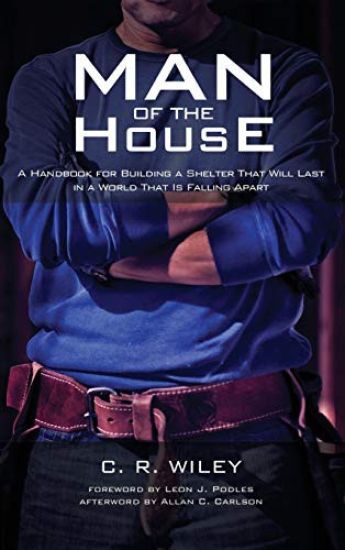
What is your plan for the end of the world as we know it? How will you protect the people you love? What will you leave to them when you are gone? The good news is this is not the first time the world has ended. What's more, men were made for times like these. And the men of the past--the good ones, anyway--have left us a plan to follow. They built houses to last--houses that could weather a storm. This book contains their plan. "With wit and flair and a manly willingness to face the facts of life, Wiley shows us how to have a real household ​rather than a chilly wayside inn, and how to help build again the real local communities that require such households for their existence. Without a recovery of manhood, it is not going to happen. Pastors, this book is for you, too." --Anthony Esolen, Providence College; author of Out of the Ashes: Reclaiming American Culture, and Real Music: The Timeless Hymns of the Church C. R. Wiley is the Senior Pastor of the Presbyterian Church of Manchester in Manchester, Connecticut. He has written for Touchstone Magazine, Modern Reformation, Sacred Architecture, The Imaginative Conservative, and Front Porch Republic. He blogs for Patheos on the Evangelical Channel. His short fiction has appeared in The Mythic Circle (published by the Mythopoeic Society) and he has published young adult fiction. He has been a commercial real estate investor and a building contractor. And he has even taught philosophy to undergraduates.
Family Cycles

Family Cycles

Allan C. Carlson

AldineTransaction
2016
sidottu
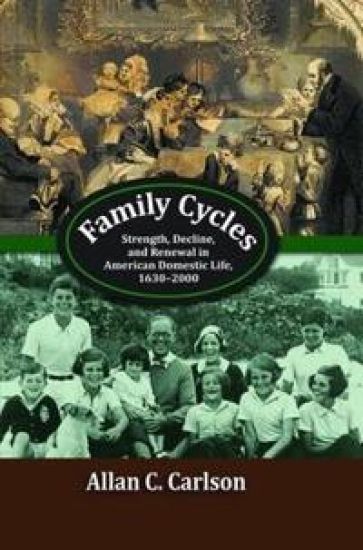
In this paradigm-shifting volume, Allan C. Carlson identifies and examines four distinct cycles of strength or weakness of American family systems. This distinctly American family model includes early and nearly universal marriage, high fertility, close attention to parental responsibilities, complementary gender roles, meaningful intergenerational bonds, and relative stability. Notably, such traits distinguish the "strong" American family system from the "weak" European model (evident since 1700), which involves late marriage, a high proportion of the adult population never married, significantly lower fertility, and more divorces. The author shows that these cycles of strength and weakness have occurred, until recently, in remarkably consistent fifty-year swings in the United States since colonial times. The book's chapters are organized around these 50-year time frames. There have been four family cycles of strength and decline since 1630, each one lasting about one hundred years. The author argues that fluctuations within this cyclical model derive from intellectual, economic, cultural, and religious influences, which he explores in detail, and supports with considerable evidence.
Family Cycles

Family Cycles

Allan C. Carlson

AldineTransaction
2016
nidottu
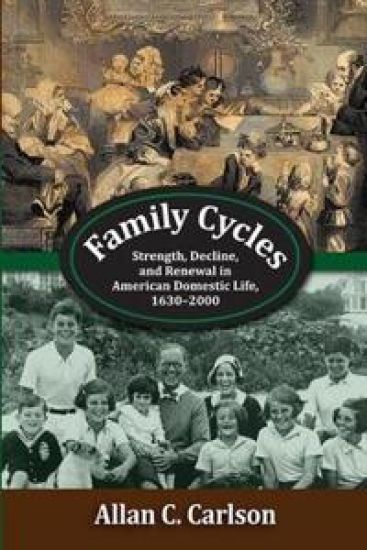
In this paradigm-shifting volume, Allan C. Carlson identifies and examines four distinct cycles of strength or weakness of American family systems. This distinctly American family model includes early and nearly universal marriage, high fertility, close attention to parental responsibilities, complementary gender roles, meaningful intergenerational bonds, and relative stability. Notably, such traits distinguish the "strong" American family system from the "weak" European model (evident since 1700), which involves late marriage, a high proportion of the adult population never married, significantly lower fertility, and more divorces. The author shows that these cycles of strength and weakness have occurred, until recently, in remarkably consistent fifty-year swings in the United States since colonial times. The book's chapters are organized around these 50-year time frames. There have been four family cycles of strength and decline since 1630, each one lasting about one hundred years. The author argues that fluctuations within this cyclical model derive from intellectual, economic, cultural, and religious influences, which he explores in detail, and supports with considerable evidence.
The Natural Family Where it Belongs

The Natural Family Where it Belongs

Allan C. Carlson

AldineTransaction
2015
nidottu
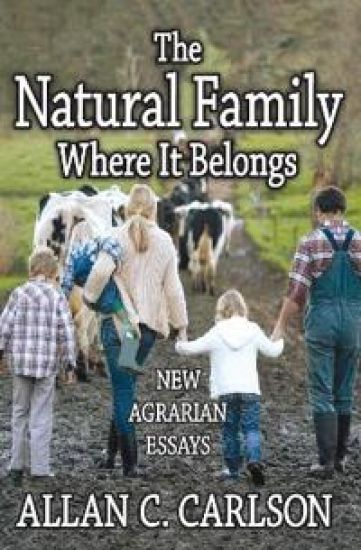
The Natural Family Where It Belongs emphasizes the vital bond of the natural family to an agrarian-like household, where the "sexual" merges with the "economic" through marriage and child-rearing and where the family is defined by its material efforts. This agrarianism is alive and well in twenty-first century America and Europe. Allan C. Carlson argues that recreating a family-centered economy portends renewal of the true democracy dreamed of by Washington, Adams, and Jefferson. Critically well received, this paperback edition makes The Natural Family Where It Belongs available to teachers and students of twentieth century American social history and the American family system. It will also be welcomed by practitioners involved with the "new agrarian" revival of the last twenty-five years. As Carlson demonstrates, agrarian households represent the touchstones of a sustainable human future. Written by one of the most prestigious and respected scholars in the field, The Natural Family Where It Belongs will influence how today's family life is viewed in America and abroad. This volume is the latest in Transaction's Marriage and Family Studies series.
The Natural Family Where it Belongs

The Natural Family Where it Belongs

Allan C. Carlson

AldineTransaction
2014
sidottu
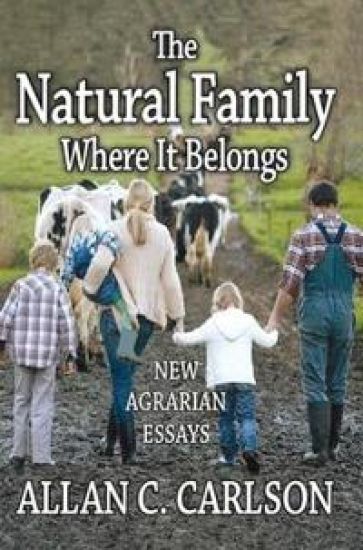
The Natural Family Where It Belongs emphasizes the vital bond of the natural family to an agrarian-like household, where the "sexual" merges with the "economic" through marriage and child-rearing and where the family is defined by its material efforts. This agrarianism is alive and well in twenty-first century America and Europe. Allan C. Carlson argues that recreating a family-cantered economy portends renewal of the true democracy dreamed of by Washington, Adams, and Jefferson. Critically well received, this paperback edition makes The Natural Family Where It Belongs available to teachers and students of twentieth century American social history and the American family system. It will also be welcomed by practitioners involved with the "new agrarian" revival of the last twenty-five years. As Carlson demonstrates, agrarian households represent the touchstones of a sustainable human future. Written by one of the most prestigious and respected scholars in the field, The Natural Family Where It Belongs will influence how today's family life is viewed in America and abroad. This volume is the latest in Transaction's Marriage and Family Studies series.
Godly Seed

Godly Seed

Allan C. Carlson

AldineTransaction
2011
sidottu
Interview with Allan Carlson In an ironic twist, American evangelical leaders are joining mainstream acceptance of contraception. Godly Seed: American Evangelicals Confront Birth Control, 1873-1973, examines how mid-twentieth-century evangelical leaders eventually followed the mainstream into a quiet embrace of contraception, complemented by a brief acceptance of abortion. It places this change within the context of historic Christian teaching regarding birth control, including its origins in the early church and the shift in arguments made by the Reformers of the sixteenth century. The book explores the demographic effects of this transition and asks: did the delay by American evangelicals leaders in accepting birth control have consequences? At the same time, many American evangelicals are rethinking their acceptance of birth control even as a majority of the nation's Roman Catholics are rejecting their church's teaching on the practice. Raised within a religious movement that has almost uniformly condemned abortion, many young evangelicals have begun to ask whether abortion can be neatly isolated from the issue of contraception. A significant number of evangelical families have, over the last several decades, rejected the use of birth control and returned decisions regarding family size to God. Given the growth of the evangelical movement, this pioneering work will have a large-scale impact.
The Natural Family

The Natural Family

Allan C. Carlson

AldineTransaction
2008
nidottu
Sixty years ago, the UN declared the family to be the "natural and fundamental" unit of society. Today, many people are unsure as to what the word "family" even means. In response to this confusion, The Natural Family: Bulwark of Liberty defines the family based on universal human experience. Insisting, without apology, on the reality of the "natural family," the manifesto issues a personal call to men and women to rediscover this fundamental source of life, joy, and freedom. Carlson and Mero frankly admit that those who should have defended marriage were asleep when the full-scale assault on the family began in the 1960s. Even more seriously, most of them joined the assault by eventually adopting the very assumptions--philosophical, social, and economic--which almost extinguished the family's traditional legal and social privileges. "Family values" is now an empty slogan for those with some nostalgic attachment to the family, but who have no idea what the family really is. Carlson and Mero examine why the family is in crisis, the ways in which the natural family is the source of culture and freedom, and what families can do to preserve the most fundamental and wholesome relationship on earth. Assured that human nature is on their side, Carlson and Mero can be both realistic about the family's plight and relentlessly optimistic about the future. The Natural Family is a road map, especially for the young, for rebuilding a culture of freedom, joy, and love. "Perhaps the most succinct, thorough, and impressive pro-family argument yet made." —BOOKLIST
Conjugal America

Conjugal America

Allan C. Carlson

AldineTransaction
2008
nidottu
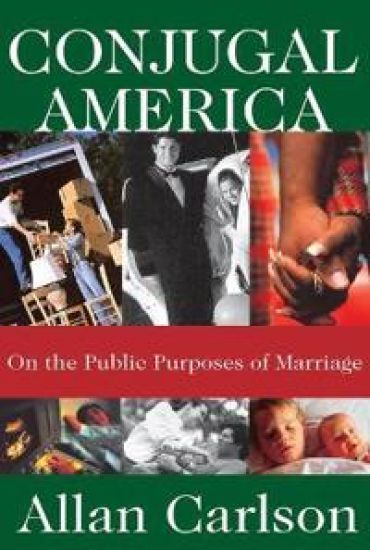
The institution of marriage has become perilously weak in America. Changes in the law over the past three decades, such as the spread of no-fault divorce and broad acquiescence to cultures of divorce and intentional childlessness, have stripped traditional marriage of important legal supports. Half of all marriages end in divorce and just as many are childless. Conjugal America seeks to recapture the real purposes of marriage and the unchanging nature of this most vital and fundamental human institution. Confronting contemporary issues and drawing heavily on the natural and social sciences, each chapter also reaches into the past to find truths grounded in human experience. Carlson reexamines the basic bond of marriage to procreation, showing that this tie has been no less than the foundation of the unwritten sexual constitution of Western civilization. He also shows how the Gnostic heresy, which despises procreation, posed a stark danger to the early Christian movement and to "the sexual constitution" of our own time as well. He then dissects claims regarding the "evolution of marriage," showing that true marriage always represents the vital connection of the sexual with the economic. Carlson explores the political nature of marriage showing, why every ambitious totalitarian government seeks above all to destroy marriage, and why the true marital bond actually stands for liberty. He concludes by arguing for the necessity of marriage policy. Because both the nature of the centralizing state and the pressures of modernity have altered family circumstances, new protections and encouragements to marriage are now imperative. Conjugal America will be central to the new debate on marriage and its purposes. This book sees the current moment as an opportunity to revitalize a necessary institution that has recently been abused and neglected and reinstate it as the primary source of commitment and care in the modern world.
Conjugal America: On the Public Purposes of Marriage
The institution of marriage has become perilously weak in America. Changes in the law over the past three decades, such as the spread of no-fault divorce and broad acquiescence to cultures of divorce and intentional childlessness, have stripped traditional marriage of important legal supports. Half of all marriages end in divorce and just as many are childless. Conjugal America seeks to recapture the real purposes of marriage and the unchanging nature of this most vital and fundamental human institution. Confronting contemporary issues and drawing heavily on the natural and social sciences, each chapter also reaches into the past to find truths grounded in human experience. Carlson reexamines the basic bond of marriage to procreation, showing that this tie has been no less than the foundation of the unwritten sexual constitution of Western civilization. He also shows how the Gnostic heresy, which despises procreation, posed a stark danger to the early Christian movement and to "the sexual constitution" of our own time as well. He then dissects claims regarding the "evolution of marriage," showing that true marriage always represents the vital connection of the sexual with the economic. Carlson explores the political nature of marriage showing, why every ambitious totalitarian government seeks above all to destroy marriage, and why the true marital bond actually stands for liberty. He concludes by arguing for the necessity of marriage policy. Because both the nature of the centralizing state and the pressures of modernity have altered family circumstances, new protections and encouragements to marriage are now imperative. Conjugal America will be central to the new debate on marriage and its purposes. This book sees the current moment as an opportunity to revitalize a necessary institution that has recently been abused and neglected and reinstate it as the primary source of commitment and care in the modern world.
Fractured Generations

Fractured Generations

Allan C. Carlson

Transaction Publishers
2005
sidottu
Fifty years ago, the phrase "family policy" was rarely heard in America. Individual states maintained laws governing marriage, divorce, education, inheritance, and child protection, which regulated the formation, childrearing practices, and dissolution of families. However, these scattered policy issues were not seen as closely related. Until the 1960s, the nuclear family was an institution that was part of the natural life-course expected of most adults. Family meant marriage, children, the establishment of a home, care of the elderly, but perhaps most of all, bonding of the generations. As early as the 1840s, certain elements of states' policies hinted at a weakening family structure, but not until the 1960s was the family openly attacked. Feminists objected to a male-oriented home economy, demographers encouraged negative population growth, the sexual revolution was on the rise, and religiously grounded morality in public life was challenged in the federal courts. Married couples with children had to shoulder a larger tax burden, further discouraging people from building and maintaining families. Perhaps because family was so central to the founders' lives they found no need to mention it in the Constitution. But today, generational bonds have fractured, while family policy is a paramount public concern. As Allan Carlson makes clear no nation can progress, or even survive, without a durable family system. Contemporary family policy represents an attempt to counter the negative forces of the last four decades so as to restore the natural family to its necessary place in American life. Fractured Generations' chapters follow the life-course of the human family--marriage; the birth of children; infant and toddler care; schooling; building a home; crafting a durable family economy; and elder care. This is a passionate and well-reasoned appeal for a return to the institution that is the last best hope for America's future: the family.
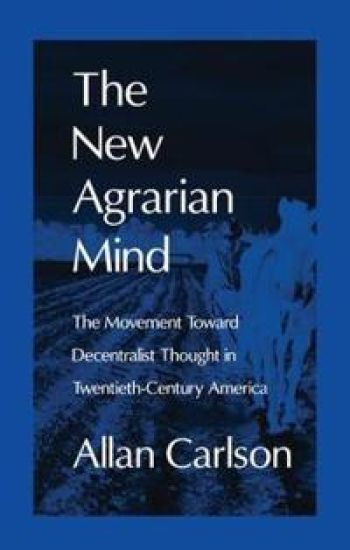
The New Agrarian Mind

The New Agrarian Mind

Allan C. Carlson

Transaction Publishers
2004
nidottu
The self-sufficiency and regional outlook of farm life characterized the United States until the Civil War period. With the triumph of the industrial North over the rural South, the expansion of urbanism, and the closing of the frontier, the agrarian sector became an economic and cultural minority. The social benefits of rural life--a sense of independence, commitment to democracy, an abundance of children, stable community life--were threatened. This volume examines the rise of a distinctive agrarian intellectual movement to combat these trends. The New Agrarian Mind, now in paperback, synthesizes the thought of twentieth-century agrarian writers. It weaves together discussions of major representative figures, such as Liberty Hyde Bailey, Carle Zimmerman, and Wendell Berry, with myth-shattering analyses of the movement's cultural diversity, intellectual influence, and ideological complexity. Collectively labeled the New Agrarians to distinguish them from the simpler Jeffersonianism of the nineteenth century, they shared a coherent set of goals that were at once socially conservative and economically radical.