Kirjojen hintavertailu – 12 859 818 kirjaa ja 27 kauppaa

Kirjailija

Allan Janik

Kirjat ja teokset yhdessä paikassa: 10 kirjaa, julkaisuja vuosilta 1996–2024, suosituimpiin kuuluu Empty Sleeve. Vertaile teosten hintoja ja tarkista saatavuus suomalaisista kirjakaupoista.

10 kirjaa

Kirjojen julkaisuvuodet: 1996–2024.

The first 10 years

The first 10 years

Anders Hammarlund; Devin E. Naar; Amos Elon; Adam Gopnik; Eddy Portnoy; Jody Rosen; Stefanie Halpern; Eric Kandel; Christian Witt-Dörring; Fredric Bedoire; Allan Janik; Steven Beller; Per Svensson

Judisk Kultur i Sverige
2024
sidottu
The First Ten Years är en ambitiös sammanställning av de många uppmärksammade symposier, konferenser, konserter, litterära samtal, teatergästspel, samtal, läsningar, utställningar, böcker och mycket mera som kulturinstitutionen Judisk Kultur i Sverige har initierat och genomfört under de första tio åren. Boken innehåller texter från de internationella symposier som genomförts kring "Jewish Cities", som Berlin, New York, Wien och Thessaloniki. Därtill kommer en generös sammanställning av bilder från alla möten under åren, de många internationella gästerna som kommit till Sverige. Dessa inkluderar världsledande musiker, kompositörer och dirigenter. Nobelprisförfattare, framstående intellektuella och filmskapare. Därtill komiker, skådespelare, sångare, poeter och artister. Boken är redigerad av Lizzie Oved Scheja och Daniel Pedersen. Bland författarna återfinns Steven Beller, Allan Janik, Fredric Bedoire, Christian Witt-Dörring, Eric Kandel, Stefanie Halpern, Jody Rosen, Eddy Portnoy, Annie Polland, Daniel Soyer, David Denby, Adam Gopnik, Letty Cottin Pogrebin, Sandee Brawarsky, Tony Michels, Jackie Jakubowski, Amos Elon, Graeme Gilloch, Jay Howard Geller, Devin E. Naar and Anders Hammarlund Med texter av Hugo von Hofmannsthal, Moses Mendelssohn, Walter Benjamin, Ernst Bloch, Franz Hessel, Siegfrid Kracauer och Else Lasker-Schüler. Boken är rikligt illustrerad med hundratals färgfotografier.
Hitler's Favorite Jew

Hitler's Favorite Jew

Allan Janik

Simply Charly
2018
pokkari

Halvin toimitettuna 18,90 €

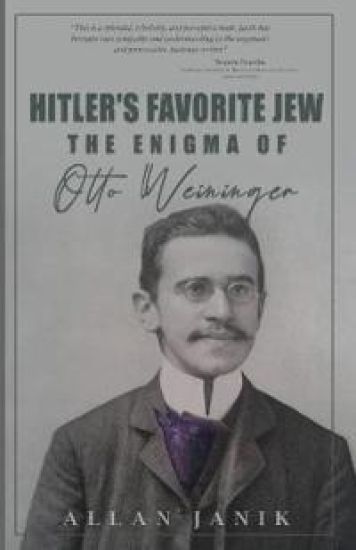
This is a book about Otto Weininger, his works and their reception. Why write a book about Weininger who is usually considered to be a mad racist fanatic? One need only look to Hitler's opinion of the only "decent" Jew he had ever heard about; decent because he committed suicide upon gaining insight into his own character as a Jew. The idea of Weininger, the ultimate Jewish self-hater, is one of the dominant streams in the Weininger reception. If it were the whole story, there would be little more to say about him. Others tell us that a 23 year-old could never have been so bright as to produce the sophisticated views that Weininger did but they seem to forget phenomena like Mozart, who composed from early childhood, Georg B chner, who produced several of the most powerful, path-breaking works in modern German literature before his untimely demise at the tender age of twenty-four and variste Galois, who left the whole mathematical world a century full of brilliant problems, writing until dawn the night before he died in a duel. There is no lack of evidence that youth can be genuinely brilliant. We begin to grasp why Weininger has been an enigma for so long at the moment when we realize that, in a curious way, without attaining anything like their achievements, he was of a similar brilliant cast of mind. The sheer breadth of his knowledge and imagination demonstrate that.
Wittgenstein's Vienna Revisited

Wittgenstein's Vienna Revisited

Allan Janik

Routledge
2018
nidottu
Fin de siecle Vienna was once memorably described by Karl Kraus as a "proving ground for the destruction of the world." In the decades leading to the World War that brought down the Austro-Hungarian empire, the city was at once an operetta dream world masking social and political problems and tension, as well as a center for the far-reaching explorations and innovations in music, art, science, and philosophy that would help to define modernity. One of the most powerful critiques of the retreat into fantasy was that of the philosopher Ludwig Wittgenstein, whose early career in Vienna has helped frame debates about ethical and aesthetic values in culture. In Wittgenstein's Vienna Revisited Allan Janik expands upon his work Wittgenstein's Vienna (co-authored with Stephen Toulmin) to amplify a number of significant points concerning the genesis of Wittgenstein's thought, the nature of Viennese culture, and criticism of contemporary culture. Although Wittgenstein is the central figure in this volume, Janik places considerable emphasis on other influential figures, both Viennese and non-Viennese, in order to break down some of the persistent stereotypes about the philosopher and his surrounding culture, especially the myths of "carefree" Vienna and Wittgenstein the positivist. The persistence of these myths, in Janik's view, stems in part from the inability of many historians to differentiate past from present in the evaluation of intellectual currents. Janik reviews a number of figures overlooked in assessing Wittgenstein: Otto Weininger, Kraus, Schoenberg, Nietzsche, Wagner, Ibsen, Offenbach, and Georg Trakl. All of these, Janik demonstrates, are absolutely necessary to understand what was at stake in the debates on aestheticism and the critique of a modern culture. Wittgenstein's efforts to recognize the limits of thought and language and thus to be fair to science, religion, and art account for his place of honor among critical modernists. These essays elucidate Wittgenstein's perspective on our culture.
Wittgensteins Wien

Wittgensteins Wien

Allan Janik; Stephen Toulmin

Santérus Förlag
2014
nidottu
Wien i slutet av 1800-talet och början av 1900-talet var ett myller. Ett myller av tankar och idéer som bröts mot varandra. Allt fler gjorde uppror mot det gamla kejsardömets alltmer förljugna moral. Det var en kreativ och dynamisk tid där många av de tankegångar föddes som sedan, på gott och ont, kom att forma Europa under det kommande århundradet. En av de stora tänkarna som växte upp under denna tid var Ludwig Wittgenstein. I detta mycket prisade verk passerar många kända personer revy och författarna berättar på ett medryckande sätt om Wien vid denna tid. De visar att man inte kan förstå Wittgensteins verk och tankar utan att ställa dem i relation till vad som skedde i Wien. Boken vänder sig lika mycket till dem som vill förstå Wittgenstein som till dem som vill förstå och veta mer om Europas kultur- och idéhistoria"Wittgensteins Wien" är en oundgänglig bok för kunskapen om dagens och gårdagens Europa och för dem som vill tränga in i Wittgensteins tankevärld.
Turingmänniskan: Dialoger 87-88, 2011

Turingmänniskan: Dialoger 87-88, 2011

Helena Granström; Bo Göranzon; Allan Janik; Anna Lindal; Anna Pettersson; Sven Åberg; Henrik Åhsberg

Santérus Förlag
2011
nidottu
År 1951 ställde matematikern Alan Turing frågan "Kan en maskin tänka?" Hans fråga inspirerade 1972 till att formulera idén om informationssamhället. När idéns förverkligande i samtiden utvärderades i en studie 1985 användes termen funktionell autism för att beskriva formaliseringen av arbets- och samhällsliv som kraftigt reducerade ­människans möjligheter att agera utifrån eget omdöme. Studien fokuserade på ­kunskapsteori och pekade på nödvändigheten av balans mellan teknologi, filosofi, historia och litteratur när vetenskap och teknik utvecklas. År 1985/86 inrättades Dialogseminariet och tidskriften Dialoger för att konfrontera de bärande idéerna kring informationssamhället. Med detta temanummer, som också blir det sista av tidskriften Dialoger, firar tidskriften 25-årsjubileum.
Assembling reminders : studies in the genesis of Wittgenstein's concept of p
Astonishingly, Wittgenstein insisted that he was not an original thinker but one who passionately seized upon the thoughts of truly original thinkers with a view to developing a method of conceptual clarification. He compared his mind to fertile ground in which the seeds of the truly original: Ludwig Boltzmann, Heinrich Hertz, Arthur Schopenhauer, Gottlob Frege, Bertrand Russell, Karl Kraus, Adolf Loos, Otto Weininger, Oswald Spengler and Piero Sraffa, could blossom. Assembling Reminders is the first full length study to explore how these figures influenced Wittgenstein - but also how he could claim to have understood them better than they did themselves. It illuminates Wittgenstein's uniqueness in the history of 20th century thought at the same time that it clarifies his relationship to both analytical and Continental philosophy as well as to Viennese critical modernism. Allan Janik, (1941) is currently Research Fellow at the University of Innsbruck's Brenner Archives Reseach Institute. He is also Adjunct Professor for the Philosophy of Culture at the University of Vienna and at the Skill and technology Ph D. program at Stockholm's Royal Institute of Technology. »Janik's book is a wonderful achievement« Newton Garver in Journal of the History of Philosophy Volume 45, Number 4, October 2007
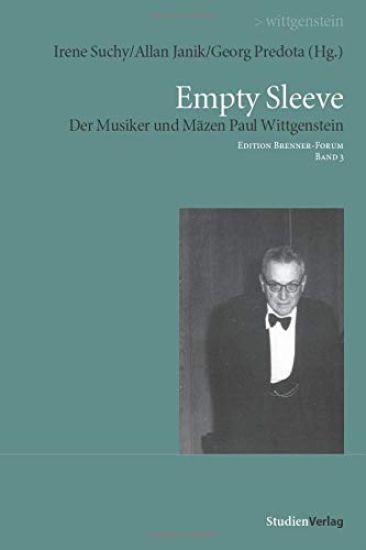
Empty Sleeve

Empty Sleeve

Irene Suchy; Allan Janik; Georg Predota

StudienVerlag
2006
nidottu
Empty Sleeve - ?der leere Ärmel? - augenscheinlichstes Merkmal des Arm-amputierten Pianisten. Paul Wittgenstein verlor im Ersten Weltkrieg seinen rechten Arm und begann eine beispiellose Karriere als Pianist und Produzent. Erst im Dezember 2004 wurde das letzte seiner 17 in Auftrag gegebenen Klavierkonzerte uraufgeführt, jenes von Paul Hindemith. An dem von ihm initiierten Oeuvre an Klavierkonzert-, Solo- und Kammermusikliteratur arbeiteten die Großen der europäischen Musikgeschichte; es reicht von Ravel bis Richard Strauss, von Prokofjew bis Franz Schmidt, von Britten bis Tansman. Paul Wittgensteins Wirken stand bislang im Schatten seines Bruders Ludwig. Seine Geschichte ist auch die einer berühmten Familie, die Österreichs Wirtschaft und Kunstszene geprägt hat; sie ist eine ganz besondere des Exils, der Flucht vor den Nazis, des Freikaufes und der Restitution; sie ist ein Brennspiegel der österreichischen Geschichte des 20. Jahrhunderts und in weiterer Folge Teil der US-amerikanischen Musikszene. Und sie is
Wittgenstein's Vienna Revisited

Wittgenstein's Vienna Revisited

Allan Janik

Transaction Publishers
2001
sidottu
Fin de siecle Vienna was once memorably described by Karl Kraus as a "proving ground for the destruction of the world." In the decades leading to the World War that brought down the Austro-Hungarian empire, the city was at once an operetta dream world masking social and political problems and tension, as well as a center for the far-reaching explorations and innovations in music, art, science, and philosophy that would help to define modernity. One of the most powerful critiques of the retreat into fantasy was that of the philosopher Ludwig Wittgenstein, whose early career in Vienna has helped frame debates about ethical and aesthetic values in culture. In Wittgenstein's Vienna Revisited Allan Janik expands upon his work Wittgenstein's Vienna (co-authored with Stephen Toulmin) to amplify a number of significant points concerning the genesis of Wittgenstein's thought, the nature of Viennese culture, and criticism of contemporary culture. Although Wittgenstein is the central figure in this volume, Janik places considerable emphasis on other influential figures, both Viennese and non-Viennese, in order to break down some of the persistent stereotypes about the philosopher and his surrounding culture, especially the myths of "carefree" Vienna and Wittgenstein the positivist. The persistence of these myths, in Janik's view, stems in part from the inability of many historians to differentiate past from present in the evaluation of intellectual currents. Janik reviews a number of figures overlooked in assessing Wittgenstein: Otto Weininger, Kraus, Schoenberg, Nietzsche, Wagner, Ibsen, Offenbach, and Georg Trakl. All of these, Janik demonstrates, are absolutely necessary to understand what was at stake in the debates on aestheticism and the critique of a modern culture. Wittgenstein's efforts to recognize the limits of thought and language and thus to be fair to science, religion, and art account for his place of honor among critical modernists. These essays elucidate Wittgenstein's perspective on our culture.
Die Praxis der Physik

Die Praxis der Physik

Allan Janik; Monika Seekircher; Jörg Markowitsch

Springer Verlag GmbH
2000
nidottu
Diese Studie analysiert das praktische Wissen, welches PhysikerInnen im Labor benötigen, sowie dessen Aneignung und Vermittlung. Die erkenntnistheoretische Grundlage dazu bilden Michael Polanyis Konzept des impliziten Wissens und Ludwig Wittgensteins pragmatische Sprachauffassung. Die Untersuchung steht im Umfeld der sogenannten "Laborstudien" und zeichnet sich vor allem durch ihren problemorientierten Ansatz aus. Sie zeigt die Praxis der Physik, wie sie PhysikerInnen in ihren eigenen Worten beschreiben: Probleme im Umgang mit Apparaturen, Fehlersuche, Problemerkennen, Messen und Interpretieren … Die Rolle von Frauen in der physikalischen Forschung bildet einen besonderen Schwerpunkt. Als Grundlage für eine moderne Wissenschaftsdidaktik, Know-how-Vermittlung sowie für die Evaluation und Kompetenzentwicklung von Forschungseinrichtungen wendet sich das Buch an eine breite Zielgruppe: In Forschung und Lehre tätige PhysikerInnen oder PhysiklehrerInnen an höheren Schulen, Philosophen, Wissenschaftsforscher und -soziologen, Bildungs- und Berufsforscher.
Wittgenstein's Vienna

Wittgenstein's Vienna

Allan Janik; Stephen Toulmin

Ivan R Dee, Inc
1996
pokkari

Halvin toimitettuna 30,50 €

This is a remarkable book about a man (perhaps the most important and original philosopher of our age), a society (the corrupt Austro-Hungarian Empire on the eve of dissolution), and a city (Vienna, with its fin-de siècle gaiety and corrosive melancholy). The central figure in this study of a crumbling society that gave birth to the modern world is Wittgenstein, the brilliant and gifted young thinker. With others, including Freud, Viktor Adler, and Arnold Schoenberg, he forged his ideas in a classical revolt against the stuffy, doomed, and moralistic lives of the old regime. As a portrait of Wittgenstein, the book is superbly realized; it is even better as a portrait of the age, with dazzling and unusual parallels to our own confused society. “Allan Janik and Stephen Toulmin have acted on a striking premise: an understanding of prewar Vienna, Wittgenstein’s native city, will make it easier to comprehend both his work and our own problems…. This is an independent work containing much that is challenging, new, and useful.”—New York Times Book Review.