Kirjojen hintavertailu – 12 859 827 kirjaa ja 27 kauppaa

Kirjailija

Allan Kornberg

Kirjat ja teokset yhdessä paikassa: 4 kirjaa, julkaisuja vuosilta 1992–2011, suosituimpiin kuuluu A Polity on the Edge. Vertaile teosten hintoja ja tarkista saatavuus suomalaisista kirjakaupoista.

4 kirjaa

Kirjojen julkaisuvuodet: 1992–2011.

Citizens and Community

Citizens and Community

Allan Kornberg; Harold D. Clarke

Cambridge University Press
2011
pokkari
The related subjects of political legitimacy and system support are key theoretical concerns of students of democratic societies. They have received very little scholarly attention, however, because of the conceptual and methodological complexities they engender. In this book the authors address these concerns through systematic multivariate analyses of the sources, distribution, and consequences of variations in citizen support for key political objects in one such society, Canada. Although the authors do so within a comparative context, their primary focus is on Canada because it is one of the world's oldest democracies and is a country that has experienced support problems that periodically have reached crisis proportion. Many of the problems facing Canada are more extreme examples of difficulties that have vexed other democracies. This study helps illuminate both the conditions under which democracies in general are able to sustain themselves and those under which they could flounder.
Making Political Choices

Making Political Choices

Harold Clarke; Allan Kornberg; Thomas J Scotto

University of Toronto Press
2008
pokkari
Recent national elections in Canada and the United States have been exciting, consequential contests. In the 2004 federal election in Canada, the Liberal Party narrowly clung to power after a volatile and bitter battle with the new Conservative Party. In 2006, the Conservative Party won a fragile victory, replacing the scandal-ridden Liberal government. In the 2000 American presidential election, Republican George W. Bush became the first candidate in over 100 years to capture the presidency without a majority popular vote. Four years later, Bush finally attained a narrow popular mandate but only after a hard fought campaign. Then, in 2006, the Republicans suffered a stunning reversal of political fortune, losing control of both Houses of Congress, as public opinion turned massively against the president. In Making Political Choices: Canada and the United States, Harold Clarke, Allan Kornberg, and Thomas Scotto employ a wealth of new survey data to describe these elections and evaluate competing theories of party support and voter turnout. While examining various arguments, the authors contend that a valence politics model provides a powerful explanation of voting behavior in Canada, the United States, and other mature democracies.
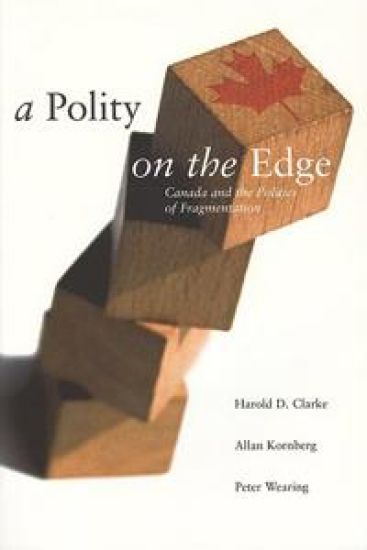
A Polity on the Edge

A Polity on the Edge

Harold Clarke; Allan Kornberg; Peter Wearing

Broadview Press Ltd
2000
pokkari
Winner: 2001 Choice Outstanding Academic Book Award This is a book about forces challenging the continued integrity of Canada, one of the world's oldest and most admired democracies. It focuses on six critical events, beginning with the 1988 federal election and the fierce debate over the risks of free trade with the United States for Canada's economy and cherished social programs. It ends with the 1998 re-election of the Parti Qu b cois and the possibility of a third sovereignty referendum. Collectively, these events have pushed Canada to the edge of disintegration. The book's analyses and interpretations of these events are based on a unique collection of survey data gathered over the past two decades. Conversations with thousands of Canadians map the dynamics of public beliefs, attitudes and behavior in an era of economic dislocation and political crisis. Struggling to adapt its political institutions and processes to regional and ethno-linguistic cleavages invigorated by forces of economic restructuring and globalization, Canada exemplifies many of the "forces from above and below" that have beset democracies, new and old alike, in recent years. By explaining how these forces have brought a "charter member" of that very special political club to the brink of fragmentation, this book will be of interest to all those concerned with the future of democracy in polycommunal societies.
Citizens and Community

Citizens and Community

Allan Kornberg; Harold D. Clarke

Cambridge University Press
1992
sidottu
The related subjects of political legitimacy and system support are key theoretical concerns of students of democratic societies. They have received very little scholarly attention, however, because of the conceptual and methodological complexities they engender. In this book the authors address these concerns through systematic multivariate analyses of the sources, distribution, and consequences of variations in citizen support for key political objects in one such society, Canada. Although the authors do so within a comparative context, their primary focus is on Canada because it is one of the world’s oldest democracies and is a country that has experienced support problems that periodically have reached crisis proportion. Many of the problems facing Canada are more extreme examples of difficulties that have vexed other democracies. This study helps illuminate both the conditions under which democracies in general are able to sustain themselves and those under which they could flounder. The authors demonstrate that political support has its origins in people’s political socialization experiences and their instrumental judgments about the operation of key political and economic institutions and processes. They find that political support is not ‘of a piece’. Average citizens are able to distinguish among and ascribe different degrees of support to key objects such as parliament, the bureaucracy, judiciary, political community itself. Support also is dynamic and can vary markedly over relatively brief intervals of time. For example, periodic national elections, changing economic conditions, and the activities of political parties have a significant impact on support levels. And, differences in support for authorities, regime, and community do matter. They affect the levels of public participation in a variety of conventional and unconventional political activities as well as the relative willingness of people to comply with the authoritative edicts of government.