Kirjojen hintavertailu – 12 903 725 kirjaa ja 27 kauppaa

Kirjailija

Allan Peterson

Kirjat ja teokset yhdessä paikassa: 7 kirjaa, julkaisuja vuosilta 2001–2019, suosituimpiin kuuluu Dynamic Equations on Time Scales. Vertaile teosten hintoja ja tarkista saatavuus suomalaisista kirjakaupoista.

7 kirjaa

Kirjojen julkaisuvuodet: 2001–2019.

Dynamic Equations on Time Scales

Dynamic Equations on Time Scales

Martin Bohner; Allan Peterson

Springer-Verlag New York Inc.
2012
nidottu
On becoming familiar with difference equations and their close re­ lation to differential equations, I was in hopes that the theory of difference equations could be brought completely abreast with that for ordinary differential equations. [HUGH L. TURRITTIN, My Mathematical Expectations, Springer Lecture Notes 312 (page 10), 1973] A major task of mathematics today is to harmonize the continuous and the discrete, to include them in one comprehensive mathematics, and to eliminate obscurity from both. [E. T. BELL, Men of Mathematics, Simon and Schuster, New York (page 13/14), 1937] The theory of time scales, which has recently received a lot of attention, was introduced by Stefan Hilger in his PhD thesis [159] in 1988 (supervised by Bernd Aulbach) in order to unify continuous and discrete analysis. This book is an intro­ duction to the study of dynamic equations on time scales. Many results concerning differential equations carryover quite easily to corresponding results for difference equations, while other results seem to be completely different in nature from their continuous counterparts. The study of dynamic equations on time scales reveals such discrepancies, and helps avoid proving results twice, once for differential equa­ tions and once for difference equations. The general idea is to prove a result for a dynamic equation where the domain of the unknown function is a so-called time scale, which is an arbitrary nonempty closed subset of the reals.

Other Than They Seem

Other Than They Seem

Allan Peterson

Tupelo Press, Incorporated
2016
nidottu
Soft spoken and intuitive, these deeply reflective poems demonstrate the miraculous common currency of thinking, expressed like confidences shared with a reader: “the latent world wavers between us. . . .” Highly visual and verbally chromatic, eschewing punctuation and rigorously open-ended, these poems pursue intimate recognitions in compact forms energized by intuitive jumps.
Precarious

Precarious

Allan Peterson

INDIANA UNIVERSITY PRESS
2014
pokkari
Poetry. "Allan Peterson, in PRECARIOUS, his fifth full-length collection of poems, refuses the easy path of a consoling clarity, opting instead for a difficulty that more accurately reveals the blurred perspective of one human being's singular fixity from his place in Nature. What there is to see or know shifts, hardens into focus, then flies away into the collapsing moment when the eye misperceives or the mind suddenly remembers or misremembers... or comes to rest on a centering image or idea. It is challenging poetry and yet there isn't a trace of cynicism in this work. Like a modern day Cezanne, Allan Peterson writes poems that slowly clarify via the subconscious, moving by increments into focus in the conscious mind. The attention to detail functions as a mosaic that coalesces into a whole by poem's end, and we are but a fragment of the world depicted, and yet, like Peterson, we are also actively engaged in this splintering into wholeness." David Dodd Lee"
Fragile Acts

Fragile Acts

Allan Peterson

McSweeney's Publishing
2012
sidottu
The world is terrifying and exhilarating. Believing firmly in the romantic notion that "embellishment is love," Allan Peterson in Fragile Acts combines the intellectual force of T. S. Eliot and Wallace Stevens, the ethereal wonder of Robert Hass, and the tight lyric beauty of Elizabeth Bishop and Donald Hall. These steely, wide-ranging poems are at once personal and philosophical, incisive and meditative-funny, serious, compassionate and searching. Juxtaposing the fast pace of contemporary society with the quiet localism and naturalism of the great American transcendentalists, Peterson's sinewy, muscular collection reveals a profoundly intelligent, curious mind leaping from object to thought to emotion. And yet, poem after poem, Peterson somehow binds seemingly unrelated elements into one stunning whole. You'll nod your head in reflection one moment and laugh out loud the next. These moving poems are a profound delight to read. Peterson writes with wondering beauty: "As a child I knew I was sleeping when I began / falling though still furled in my sheets / and I would look over other people's shoulders / to see what they were reading / the headlines the footnotes / Extra! Extra! / a boy has left his room through a map on the wall." And again later, with a sly smile: "When she twirled and slapped / a mosquito and missed, a red sun stayed on her leg throughout / most of the chapter on Self Reliance."
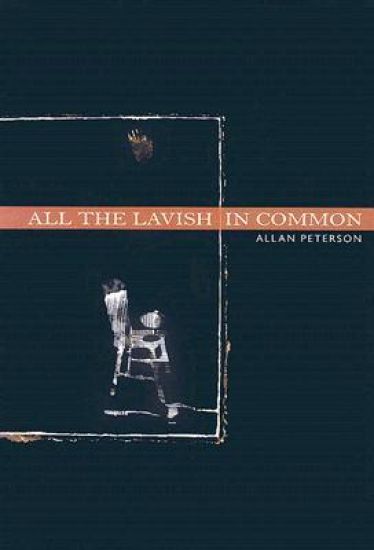
All the Lavish in Common

All the Lavish in Common

Allan Peterson

University of Massachusetts Press
2006
nidottu
These poems remind us that we are all in the thick of things, the rich and complicated givens. Moving fluently from subjects as diverse as the surface of Europa to a tiny spider in a tear of wallpaper, from Pythagoras at Tyre to the wings of a dragonfly, they are in love with the world and the deep seriousness of living. Often lavish themselves, they reflect that fact that the author is a visual artist, as well as a poet of insightful and sustained imagination.
Dynamic Equations on Time Scales

Dynamic Equations on Time Scales

Martin Bohner; Allan Peterson

Birkhauser Boston Inc
2001
sidottu
On becoming familiar with difference equations and their close re­ lation to differential equations, I was in hopes that the theory of difference equations could be brought completely abreast with that for ordinary differential equations. [HUGH L. TURRITTIN, My Mathematical Expectations, Springer Lecture Notes 312 (page 10), 1973] A major task of mathematics today is to harmonize the continuous and the discrete, to include them in one comprehensive mathematics, and to eliminate obscurity from both. [E. T. BELL, Men of Mathematics, Simon and Schuster, New York (page 13/14), 1937] The theory of time scales, which has recently received a lot of attention, was introduced by Stefan Hilger in his PhD thesis [159] in 1988 (supervised by Bernd Aulbach) in order to unify continuous and discrete analysis. This book is an intro­ duction to the study of dynamic equations on time scales. Many results concerning differential equations carryover quite easily to corresponding results for difference equations, while other results seem to be completely different in nature from their continuous counterparts. The study of dynamic equations on time scales reveals such discrepancies, and helps avoid proving results twice, once for differential equa­ tions and once for difference equations. The general idea is to prove a result for a dynamic equation where the domain of the unknown function is a so-called time scale, which is an arbitrary nonempty closed subset of the reals.