Kirjailija
Alvin Plantinga
Kirjat ja teokset yhdessä paikassa: 16 kirjaa, julkaisuja vuosilta 1959–2015, suosituimpiin kuuluu Science and Religion. Vertaile teosten hintoja ja tarkista saatavuus suomalaisista kirjakaupoista.
16 kirjaa
Kirjojen julkaisuvuodet: 1959–2015.
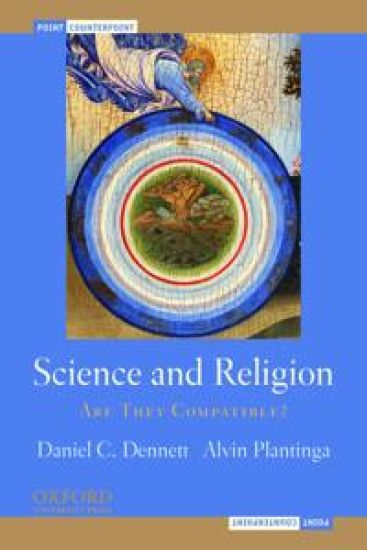
One of today's most controversial and heated issues is whether or not the conflict between science and religion can be reconciled. In Science and Religion: Are They Compatible?, renowned philosophers Daniel C. Dennett and Alvin Plantinga expand upon the arguments that they presented in an exciting live debate held at the 2009 American Philosophical Association Central Division conference. An enlightening discussion that will motivate students to think critically, Science and Religion: Are They Compatible? opens with Plantinga's assertion that Christianity is compatible with evolutionary theory because Christians believe that God created the living world, and it is entirely possible that God did so by using a process of evolution. Dennett vigorously rejects this argument, provoking a reply from Plantinga, another response from Dennett, and final statements from both sides. As philosophers, the authors possess expert skills in critical analysis; their arguments provide a model of dialogue between those who strongly disagree. Ideal for courses in philosophy of religion, science and religion, and philosophy of science, Science and Religion is also captivating reading for general readers.

Mit "Gew hrleisteter Christlicher Glaube" liegt nun endlich die deutsche bersetzung des Hauptwerkes von Alvin Plantinga vor ("Warranted Christian Belief"), dem einflussreichsten Religionsphilosophen der letzten Jahrzehnte. Mit dem schwer bersetzbaren Ausdruck "warrant" (in etwa: Gew hrleistung) meint Plantinga diejenige Eigenschaft, die eine wahre berzeugung von Wissen unterscheidet. Genauer gesagt ist eine Meinung von S warranted, wenn S' auf Wahrheit ausgerichtetes Erkenntnisverm gen in einer angemessenen Umwelt bauplanm ig funktioniert; und Plantingas Hauptthese lautet, dass religi se berzeugungen warrant haben k nnen. Das religi se Erkenntnisverm gen erl utert Plantinga als (erweitertes) Aquinas/Calvin-Modell: Menschen verf gen demnach ber einen Sensus Divinitatis, der allerdings durch die Erbs nde verdorben sei, so dass sie der Hilfe des Heiligen Geistes bed rften. Dass eine (religi se) berzeugung warrant hat, hei t nicht, dass sie nicht widerlegt werden k nnte; solchen Widerlegungsm glichkeiten (Projektionstheorien, die historisch-kritische Bibelwissenschaft, Postmodernismus, Pluralismus, Theodizeeproblem) widmet Plantinga einen gro en Teil seines Buches.
In his widely praised Warranted Christian Belief (Oxford, 2000) Alvin Plantinga discussed in great depth the question of the rationality, or sensibility, of Christian belief. In this book Plantinga presents the same ideas in a briefer, much more accessible fashion. Recognized worldwide as a leading Christian philosopher, Plantinga probes what exactly is meant by the claim that religious -- and specifically Christian -- belief is irrational and cannot sensibly be held. He argues that the criticisms of such well-known atheists as Richard Dawkins, Daniel Dennett, Sam Harris, and Christopher Hitchens are completely wrong. Finally, Plantinga addresses several potential -defeaters- to Christian belief -- pluralism, science, evil and suffering -- and shows how they fail to successfully defeat rational Christian belief.
Where the Conflict Really Lies
Alvin Plantinga
Oxford University Press Inc
2012
sidottu
Halvin toimitettuna 62,40 €
This book is a long-awaited major statement by a pre-eminent analytic philosopher, Alvin Plantinga, on one of our biggest debates -- the compatibility of science and religion. The last twenty years has seen a cottage industry of books on this divide, but with little consensus emerging. Plantinga, as a top philosopher but also a proponent of the rationality of religious belief, has a unique contribution to make. His theme in this short book is that the conflict between science and theistic religion is actually superficial, and that at a deeper level they are in concord. Plantinga examines where this conflict is supposed to exist -- evolution, evolutionary psychology, analysis of scripture, scientific study of religion -- as well as claims by Dan Dennett, Richard Dawkins, and Philip Kitcher that evolution and theistic belief cannot co-exist. Plantinga makes a case that their arguments are not only inconclusive but that the supposed conflicts themselves are superficial, due to the methodological naturalism used by science. On the other hand, science can actually offer support to theistic doctrines, and Plantinga uses the notion of biological and cosmological "fine-tuning" in support of this idea. Plantinga argues that we might think about arguments in science and religion in a new way -- as different forms of discourse that try to persuade people to look at questions from a perspective such that they can see that something is true. In this way, there is a deep and massive consonance between theism and the scientific enterprise.
Knowledge of God
Alvin Plantinga; Michael Tooley
Wiley-Blackwell (an imprint of John Wiley Sons Ltd)
2008
nidottu
Is belief in God epistemically justified? That's the question at the heart of this volume in the Great Debates in Philosophy series, with Alvin Plantinga and Michael Tooley each addressing this fundamental question with distinctive arguments from opposing perspectives. The first half of the book contains each philosopher's explanation of his particular view; the second half allows them to directly respond to each other's arguments, in a lively and engaging conversationOffers the reader a one of a kind, interactive discussionForms part of the acclaimed Great Debates in Philosophy series
Knowledge of God
Alvin Plantinga; Michael Tooley
Wiley-Blackwell (an imprint of John Wiley Sons Ltd)
2008
sidottu
Is belief in God epistemically justified? That's the question at the heart of this volume in the Great Debates in Philosophy series, with Alvin Plantinga and Michael Tooley each addressing this fundamental question with distinctive arguments from opposing perspectives. The first half of the book contains each philosopher's explanation of his particular view; the second half allows them to directly respond to each other's arguments, in a lively and engaging conversationOffers the reader a one of a kind, interactive discussionForms part of the acclaimed Great Debates in Philosophy series
This volume collects the most important articles on the _ metaphysics of modality by noted philosopher Alvin _ Plantinga. The book chronicles Plantinga's thought from the late 1960's to the present. Platinga is here concerned with fundamental issues in mataphysics: what is the nature of _ abstract objects like possible worlds, properties, _ propositions, and such phenomena? Are there possible but _ non-actual objects? Can objects that do not exist exemplify properties? In this thorough and searching book, Plantinga addresses these and many other questions that continue to_ preoccupy philosophers in the field. This volume contains_ some of the best work in metaphysics from the past 30 years, and will remain a source of critical contention and keen interest among philosophers of metaphysics and philosophical logic for years to come.
This volume collects the most important articles on the metaphysics of modality by noted philosopher Alvin Plantinga. The book chronicles Plantinga's thought from the late 1960's to the present. Plantinga here is concerned with fundamental issues in metaphysics: what is the nature of abstract objects like possible worlds, properties, propositions, and such phenomena? Are there possible but non-actual objects? Can objects that do not exist exemplify properties? In this thorough and searching book, Plantinga addresses these and many other questions that continue to preoccupy philosophers in the field. This volume contains some of the best work in metaphysics from the past 30 years, and will remain a source of critical contention and keen interest among philosophers of metaphysics and philosophical logic for years to come.
This is the third volume in Alvin Plantinga's trilogy on the notion of warrant, which he defines as that which distinguishes knowledge from true belief. In this volume, Plantinga examines warrant's role in theistic belief, tackling the questions of whether it is rational, reasonable, justifiable, and warranted to accept Christian belief and whether there is something epistemically unacceptable in doing so. He contends that Christian beliefs are warranted to the extent that they are formed by properly functioning cognitive faculties, thus, insofar as they are warranted, Christian beliefs are knowledge if they are true.
Warranted Christian Belief
Alvin Plantinga
Oxford University Press Inc
2000
nidottu
Halvin toimitettuna 50,00 €
This is the third volume in Alvin Plantinga's trilogy on the notion of warrant, which he defines as that which distinguishes knowledge from true belief. In this volume, Plantinga examines warrant's role in theistic belief, tackling the questions of whether it is rational, reasonable, justifiable, and warranted to accept Christian belief and whether there is something epistemically unacceptable in doing so. He contends that Christian beliefs are warranted to the extent that they are formed by properly functioning cognitive faculties, thus, insofar as they are warranted, Christian beliefs are knowledge if they are true.
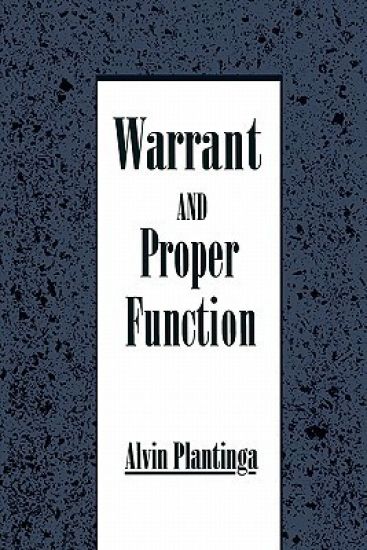
Warrant and Proper Function
Alvin Plantinga
Oxford University Press Inc
1993
nidottu
Halvin toimitettuna 68,30 €
Professor Plantinga is known for distinguished work in the fields of epistemology and philosophy of religion. In this companion volume to Warrant: The Current Debate, Plantinga develops an original approach to the question of what justifies belief and makes it knowledge. He argues that what is crucial to turning true belief into knowledge is the "proper functioning" of one's cognitive faculties, and this clears the way for the proposal that a belief is warranted whenever it is the product of properly functioning cognitive processes. Although this is in some sense a sequel to the companion volume, the arguments in no way presuppose those of the first book and it can therefore stand alone.
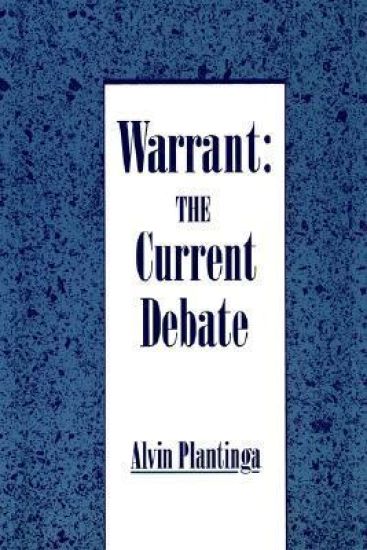
Warrant: The Current Debate
Alvin Plantinga
Oxford University Press Inc
1993
nidottu
Halvin toimitettuna 54,50 €
This book is intended for professional philosophers as well as upper-level undergraduate and graduate students (courses in epistemology).
This is a reissue of a book which is an exploration and defence of the notion of modality 'de re', the idea that objects have both essential and accidental properties. It is one of the first full-length studies of the modalities to emerge from the debate to which Saul Kripke, David Lewis, Ruth Marcus and others have contributed. The argument is developed by means of the notion of possible worlds, and ranges over key problems including the nature of essence, trans-world identity, negative existential propositions, and the existence of unactual objects in other possible worlds. In the final chapters Professor Plantinga applies his logical theories to the clarification of two problems in the philosophy of religion - the Problem of Evil and the Ontological Argument.
In his discussion of natural theology (arguments to prove the existence of God) and natural atheology (arguments for the falsehood of theistic belief) Plantinga focuses on two of the traditional arguments: the ontological argument as an example of natural theology, and the problem of evil as the most important representative of natural atheology. Accessible to serious general readers.