Kirjojen hintavertailu – 12 903 725 kirjaa ja 27 kauppaa

Kirjailija

Alvin Y. So

Kirjat ja teokset yhdessä paikassa: 13 kirjaa, julkaisuja vuosilta 1990–2015, suosituimpiin kuuluu The Hong Kong-Guangdong Link. Vertaile teosten hintoja ja tarkista saatavuus suomalaisista kirjakaupoista.

Nimi esiintyy myös muodoissa: Alvin Y So

13 kirjaa

Kirjojen julkaisuvuodet: 1990–2015.

The Global Rise of China

The Global Rise of China

Alvin Y. So; Yin-Wah Chu

Polity Press
2015
sidottu
This book sets out to unravel and explain the puzzle of the global rise of China: how, in just forty years, China has been quickly transformed from a poor, backward third-world country to one of the world’s core economic powerhouses. Exactly how did this Chinese developmental miracle happen? Focusing on the key historical turning point in China’s post-socialist development, the book examines the complex processes through which China interacted with the global neoliberal project of the late twentieth century. Alvin Y. So and Yin-Wah Chu reveal the centrality of the communist party-state in propelling China onto the world scene, and how it has successfully responded to the developmental challenges of technological upgrading, environmental degradation, inter-state rivalry, and maintaining its power. This book provides a comprehensive and insightful study of the rise of China not solely from an economic, social, and political perspective, but also from a global and historical perspective. It will be an invaluable guide for students and non-specialists interested in post-socialist development and the global rise of China in the twenty-first century.
The Global Rise of China

The Global Rise of China

Alvin Y. So; Yin-Wah Chu

Polity Press
2015
nidottu
This book sets out to unravel and explain the puzzle of the global rise of China: how, in just forty years, China has been quickly transformed from a poor, backward third-world country to one of the world’s core economic powerhouses. Exactly how did this Chinese developmental miracle happen? Focusing on the key historical turning point in China’s post-socialist development, the book examines the complex processes through which China interacted with the global neoliberal project of the late twentieth century. Alvin Y. So and Yin-Wah Chu reveal the centrality of the communist party-state in propelling China onto the world scene, and how it has successfully responded to the developmental challenges of technological upgrading, environmental degradation, inter-state rivalry, and maintaining its power. This book provides a comprehensive and insightful study of the rise of China not solely from an economic, social, and political perspective, but also from a global and historical perspective. It will be an invaluable guide for students and non-specialists interested in post-socialist development and the global rise of China in the twenty-first century.
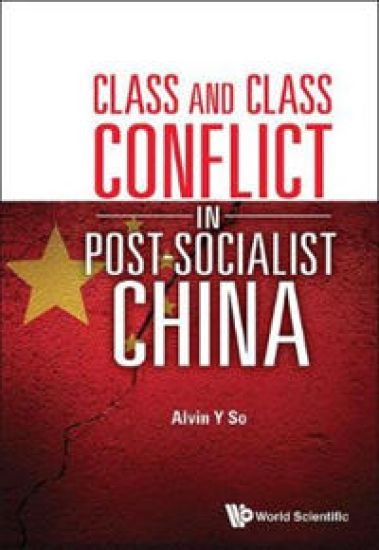
Class And Class Conflict In Post-socialist China

Class And Class Conflict In Post-socialist China

Alvin Y So

World Scientific Publishing Co Pte Ltd
2013
sidottu
Class and Class Conflict in Post-Socialist China traces the origins and the profound changes of the patterns of class conflict in post-socialist China since 1978. The first of its kind in the field of China Studies that offers comprehensive overviews and traces the historical evolutions of different patterns of class conflict (among workers, peasants, capitalists, and the middle class) in post-socialist China, the book provides comprehensive overviews of different patterns of class conflict. It uses a state-centered approach to study class conflict, i.e., study how the communist party-state restructures the patterns of class conflict in Chinese society, and brings in a historical dimension by tracing the origins and developments of class conflict in socialist and post-socialist China.
China's Developmental Miracle

China's Developmental Miracle

Alvin Y. So

Routledge
2003
nidottu
In contrast to the failure to economic reforms in Eastern Europe, China's economic reforms have been quite successful. Decollectivization, marketization, state enterprise reforms, and reintegration into the world economy have led to very rapid economic development in China over the past two decades. These economic reforms, in turn, triggered profound social and political changes. This collection examines the origins, nature, and impact, as well as the future prospects of these reforms and changes. The contributors are all active researchers from a variety of disciplines, including economics, sociology, political science, and geography.
China's Developmental Miracle

China's Developmental Miracle

Alvin Y. So

Routledge
2003
sidottu
In contrast to the failure to economic reforms in Eastern Europe, China's economic reforms have been quite successful. Decollectivization, marketization, state enterprise reforms, and reintegration into the world economy have led to very rapid economic development in China over the past two decades. These economic reforms, in turn, triggered profound social and political changes. This collection examines the origins, nature, and impact, as well as the future prospects of these reforms and changes. The contributors are all active researchers from a variety of disciplines, including economics, sociology, political science, and geography.
Asia's Environmental Movements

Asia's Environmental Movements

Alvin Y. So; Lily Xiao Hong Lee; Lee F. Yok-Shiu

M.E. Sharpe
1999
nidottu
Adopting a comparative perspective, this book traces the social, political, economic and cultural conditions under which environmental movements have emerged, and assesses the transformative capacities of these movements.
The Hong Kong-Guangdong Link

The Hong Kong-Guangdong Link

Reginald Yin-Wang Kwok; Alvin Y. So

M.E. Sharpe
1995
sidottu
This text focuses on the relationship of Hong Kong with the adjacent Chinese province Guangdong, the territories most directly involved in the 1997 transfer of Hong Kong to Chinese rule. The socio-economic, political and cultural impact of this crucial link and the implications for the future of both Hong Kong and China are studied. A multi-disciplinary approach is taken to examine the complexity of economic, political and cultural transformation of the Hong Kong-Guangdong link and this book presents a historical perspective to trace the long-term structural transformation. The dynamics of the integration process between the two territories is also explored.
East Asia and the World Economy

East Asia and the World Economy

Alvin Y. So; Stephen W.K. Chiu

SAGE Publications Inc
1995
sidottu
What role do East Asian states play in the world economy? Can the world-systems model originally designed for studying development in Europe and North America be applied to East Asia? To what extent has the rivalry between the United States and Japan had an impact on the development of East Asia? Examining these and other key questions, the authors offer a clear, comprehensive analysis of the economic development of East Asia. Offering a unique perspective, this book examines the origins and transformation of East Asia from a world-systems analysis. In contrast to the literature's focus on market, culture, state, and dependency, East Asia and the World Economy points to the crucial role of geopolitical and regional factors in East Asian development. The authors provide a cohesive review of the world-systems model as it applies to East Asia, exploring its intellectual heritage, the historical context through which it arose, its basic assumptions, and its policy implications. To illustrate how this model works in East Asia, the authors examine the economies of Hong Kong, Taiwan, China, North Korea, and Japan. The result is a fascinating study that demonstrates how the world-systems model provides a more focused explanation of East Asia's peculiar pattern of development. For scholars and students in the fields of political science, economics, Asian studies, international affairs, and development studies, this book is a must. "This book applies world-systems analysis to explain the peculiar pattern of East Asian development over the past two centuries. . . . It offers a fresh and fascinating approach to the study of economic and political evolution in the East asian nations. The volume is well organized and written for both scholars and students. It will make an excellent text for an undergraduate course in East Asian Economics and politics." --Choice CONTENTS: I. Theoretical Introduction // 1. Current Perspectives on East Asian Development // II. Incorporation // 2. The Decline of the Chinese Empire / 3. The Great Escape of Japan // III. Regionalization // 4. Japan and Its Colonial Empire / 5. The Sino-Japanese War and the Chinese Communist Revolution // IV. Ascent // 6. The Social Trajectories of China and North Korea / 7. The "Corization" of Japan / 8. The Semiperipherization of the NIEs (Hong Kong, South Korea, Taiwan) // V. Centrality // 9. United States - Japan Hegemonic Rivalry / 10. The Chinese Triangle of Mainland - Taiwan - Hong Kong / 11. Conclusion / Index ABRIDGED CONTENTS: I. Theoretical Introduction / II. Incorporation / III. Regionalization / IV. Ascent / V. Centrality
East Asia and the World Economy

East Asia and the World Economy

Alvin Y. So; Stephen W.K. Chiu

SAGE Publications Inc
1995
nidottu
What role do East Asian states play in the world economy? Can the world-systems model originally designed for studying development in Europe and North America be applied to East Asia? To what extent has the rivalry between the United States and Japan had an impact on the development of East Asia? Examining these and other key questions, the authors offer a clear, comprehensive analysis of the economic development of East Asia. Offering a unique perspective, this book examines the origins and transformation of East Asia from a world-systems analysis. In contrast to the literature's focus on market, culture, state, and dependency, East Asia and the World Economy points to the crucial role of geopolitical and regional factors in East Asian development. The authors provide a cohesive review of the world-systems model as it applies to East Asia, exploring its intellectual heritage, the historical context through which it arose, its basic assumptions, and its policy implications. To illustrate how this model works in East Asia, the authors examine the economies of Hong Kong, Taiwan, China, North Korea, and Japan. The result is a fascinating study that demonstrates how the world-systems model provides a more focused explanation of East Asia's peculiar pattern of development. For scholars and students in the fields of political science, economics, Asian studies, international affairs, and development studies, this book is a must. "This book applies world-systems analysis to explain the peculiar pattern of East Asian development over the past two centuries. . . . It offers a fresh and fascinating approach to the study of economic and political evolution in the East asian nations. The volume is well organized and written for both scholars and students. It will make an excellent text for an undergraduate course in East Asian Economics and politics." --Choice CONTENTS: I. Theoretical Introduction // 1. Current Perspectives on East Asian Development // II. Incorporation // 2. The Decline of the Chinese Empire / 3. The Great Escape of Japan // III. Regionalization // 4. Japan and Its Colonial Empire / 5. The Sino-Japanese War and the Chinese Communist Revolution // IV. Ascent // 6. The Social Trajectories of China and North Korea / 7. The "Corization" of Japan / 8. The Semiperipherization of the NIEs (Hong Kong, South Korea, Taiwan) // V. Centrality // 9. United States - Japan Hegemonic Rivalry / 10. The Chinese Triangle of Mainland - Taiwan - Hong Kong / 11. Conclusion / Index ABRIDGED CONTENTS: I. Theoretical Introduction / II. Incorporation / III. Regionalization / IV. Ascent / V. Centrality
Social Change and Development

Social Change and Development

Alvin Y. So

SAGE Publications Inc
1990
nidottu
During the past four decades, the field of development has been dominated by three schools of research. The 1950s saw the modernization school, the 1960s experienced the dependency school, the 1970s developed the new world-system school, and the 1980s is a convergence of all three schools. Alvin Y. So examines the dynamic nature of these schools of development--what each of them represents, their contributions, how they have criticized each other, how they have defended themselves, and how they were transformed. He reviews a variety of empirical studies, focusing on the "classical" and the "new" models, to show how each of the perspectives affects the study of development. In addition, this book features a unique emphasis on the research implications of the three perspectives, involving changes in orientation, agenda, methodology, and findings. Social Change and Development is the first study that compares the strengths and weaknesses of the three schools of development in a thorough, comprehensive manner. It will be of great interest to students and professionals in urban studies, development studies, political science and comparative politics. "Highly recommended." --Development Update "The book is valuable both to the beginners as well as the serious student of development ." -Indian Journal of Public Administration "The book will fill a needed niche, and better than anything heretofore." --Immanuel Wallerstein, SUNY, Binghamton "[The] book is a remarkable piece of work and will, I am sure, be of great service to many teachers and students in a number of fields." --Winston Davis, Southwestern University "Professor So has provided students of development with an excellent review of three major theories of development. He skillfully meets his goals of providing a sympathetic presentation of early expressions of each theory, reviewing major criticisms, and then presenting recent expressions of each theory that have taken criticisms into account. The use of extensive reviews of a few studies within each theory provides students with a clear image of the character of the theory, and more importantly an image of the link between theoretical development and social research. The book avoids unfair caricature of theories and research, and provides a solid basis for further study and research on issues of development." --Robert Fiala, University of New Mexico "The author has succeeded in objectively delineating each theoretical perspective so that the reader is not encumbered with attempting to separate academic theory from political ideology. This is no minor achievement and the author is to be applauded for both his efforts and his achievement of this task. . . . The book will be fascinating reading for anyone interested in the historical and contemporary functioning of nation-states and their interdependency." --Journal of Applied Rehabilitation Counseling "I would like to pass along my compliments on So's new volume. The writing is exceptionally clear and the presentations superb." --Marc W. Steinberg, University of Michigan "A useful analysis of the major development theories. . . . A good text for students and teachers and the only study to address the research implications of the three development theories in a comprehensive fashion." --Development Bookshelf "An exceptionally useful book. . . . So's command of the relevant literature and ability to explain complex material, as well as his even-handed (even sympathetic) treatments of three quite different (and often antagonistic) schools, makes this stimulating book useful for a variety of audiences: scholars interested in problems of Third-World development, specialists in modern world history, and even advanced undergraduates ready to tackle problems of theory." --Journal of World History "Alvin So does a thorough job of presenting three ways to understand development. . . . The writing is clear and the territory covered is vast. The result is an impressive survey." --Contemporary Sociology "Alvin So does a thorough job of presenting three ways to understand development.... So provides valuable extended summaries of early and later formulations within each perspective. The writing is clear and the territory covered is vast. The result is an impressive survey, with two main audiences: advanced undergraduates and graduate students interested in a manageable overview of the field, and scholars in other fields who are interested but prefer not to retrace every step of these long and complex debates through the original texts....the book is generally balanced which is no small accomplishment." --Industrial and Labor Relations Review "Fills a gap in the social science literature in the field of development. . .useful not only for students but for faculty members teaching different courses in sociology, history, and political science. It may also be of interest to a wide and diverse non-professional audience wanting to know more of the past and contemporary research carried out by the three schools." --International Journal of Comparative Sociology