Kirjojen hintavertailu – 12 903 724 kirjaa ja 27 kauppaa

Kirjailija

Amanda Machin

Kirjat ja teokset yhdessä paikassa: 6 kirjaa, julkaisuja vuosilta 2013–2019, suosituimpiin kuuluu Negotiating Climate Change. Vertaile teosten hintoja ja tarkista saatavuus suomalaisista kirjakaupoista.

6 kirjaa

Kirjojen julkaisuvuodet: 2013–2019.

Against Political Compromise

Against Political Compromise

Alexander Ruser; Amanda Machin

Routledge
2019
nidottu
Political compromise is emerging as a preferred solution for numerous apparently intractable problems. Many have pointed to the rising degree of political polarisation around issues such as climate change, immigration and abortion. These are ‘wicked problems’ that are clearly not conducive to any sort of political consensus. The groups and individuals who are party to these issues disagree, often both fully and fiercely. As an alternative, political compromise seemingly offers a way of respecting difference while simultaneously generating a decision upon which policy can move forward. But proponents of political compromise should also acknowledge its significant weaknesses and dangers. Invoking recent examples from various policy areas to illustrate their claims, the authors assert that compromise can disguise inequality, reduce plurality and heighten uncertainty. In short, compromise can weaken democracy and must not be seen as some sort of political panacea. This concise, accessible text offers a strong and provocative argument that provides a crucial counterpoint to the promise of compromise. It should prove of interest to students and scholars interested in compromise and consensus as well as democratic governance, social inequality, political apathy and environmental politics.

Society And Climate: Transformations And Challenges

Society And Climate: Transformations And Challenges

Nico Stehr; Amanda Machin

World Scientific Publishing Co Pte Ltd
2019
sidottu
Climate has for a long time been a taken-for-granted background against which social, political and economic interactions have taken place. But this taken-for-granted background is cleaving. It is becoming hard to ignore the potential repercussions of a changing climate, and the uneven impact of certain forms of human society and energy cultures that risk undermining their own environmental conditions. In a comprehensive and accessible way, this book:
Against Political Compromise

Against Political Compromise

Alexander Ruser; Amanda Machin

Routledge
2017
sidottu
Political compromise is emerging as a preferred solution for numerous apparently intractable problems. Many have pointed to the rising degree of political polarisation around issues such as climate change, immigration and abortion. These are ‘wicked problems’ that are clearly not conducive to any sort of political consensus. The groups and individuals who are party to these issues disagree, often both fully and fiercely. As an alternative, political compromise seemingly offers a way of respecting difference while simultaneously generating a decision upon which policy can move forward. But proponents of political compromise should also acknowledge its significant weaknesses and dangers. Invoking recent examples from various policy areas to illustrate their claims, the authors assert that compromise can disguise inequality, reduce plurality and heighten uncertainty. In short, compromise can weaken democracy and must not be seen as some sort of political panacea. This concise, accessible text offers a strong and provocative argument that provides a crucial counterpoint to the promise of compromise. It should prove of interest to students and scholars interested in compromise and consensus as well as democratic governance, social inequality, political apathy and environmental politics.

Nations and Democracy

Nations and Democracy

Amanda Machin

Routledge
2017
nidottu
A figure of enduring ingenuity, the nation has for centuries played a part on the socio-political stage. Whether centre stage or background scenery, it has featured in violent tragedies, revolutionary drama and nostalgic fable. Today, the nation is cast simultaneously in the roles of villain and hero. While it is renounced by those advocating trans-national, post-national and cosmopolitan forms of belonging, it has lately also been asserted as the solution to various social failures in liberal democracies. This appears to leave us with two alternatives: to jettison the nation in order to move towards a less parochial world, a world in which new forms of belonging underpin more inclusive politics. Or to celebrate the nation as way of ensuring the social cement that can unite a diverse society. Using the ideas of Wittgenstein and Lacan, Amanda Machin expertly explains that the overlapping and conflicting language games of the nation produce it as an object of desire in an uncertain world. The nation is not a pre-political thing but a matter of persistent political contestation and coalition. She reveals that the nation still has a vital part to play in democratic politics, but that this role is one of improvisation. While they endure as tools of emancipatory promise, nations nonetheless remain potential categories of violent exclusion. They cannot be pinned down as easily as anti-national and pro-national alternatives suggest. It is precisely the indeterminacy of the nation that gives it ongoing importance for democracy today. Providing an urgent riposte to dominant accounts, this thought provoking and highly original account demands a re-politicisation of the nation. This book will appeal to those engaged in theory and empirical research on nations and nationalism and the question of their link to democracy in a changing world, as well as those interested in psychoanalysis and Wittgenstein.
Nations and Democracy

Nations and Democracy

Amanda Machin

Routledge
2014
sidottu
A figure of enduring ingenuity, the nation has for centuries played a part on the socio-political stage. Whether centre stage or background scenery, it has featured in violent tragedies, revolutionary drama and nostalgic fable. Today, the nation is cast simultaneously in the roles of villain and hero. While it is renounced by those advocating trans-national, post-national and cosmopolitan forms of belonging, it has lately also been asserted as the solution to various social failures in liberal democracies. This appears to leave us with two alternatives: to jettison the nation in order to move towards a less parochial world, a world in which new forms of belonging underpin more inclusive politics. Or to celebrate the nation as way of ensuring the social cement that can unite a diverse society. Using the ideas of Wittgenstein and Lacan, Amanda Machin expertly explains that the overlapping and conflicting language games of the nation produce it as an object of desire in an uncertain world. The nation is not a pre-political thing but a matter of persistent political contestation and coalition. She reveals that the nation still has a vital part to play in democratic politics, but that this role is one of improvisation. While they endure as tools of emancipatory promise, nations nonetheless remain potential categories of violent exclusion. They cannot be pinned down as easily as anti-national and pro-national alternatives suggest. It is precisely the indeterminacy of the nation that gives it ongoing importance for democracy today. Providing an urgent riposte to dominant accounts, this thought provoking and highly original account demands a re-politicisation of the nation. This book will appeal to those engaged in theory and empirical research on nations and nationalism and the question of their link to democracy in a changing world, as well as those interested in psychoanalysis and Wittgenstein.
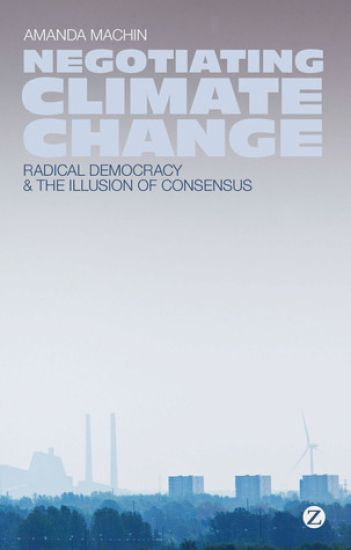
Negotiating Climate Change

Negotiating Climate Change

Amanda Machin

Zed Books Ltd
2013
nidottu
Climate change is the greatest challenge of the age, and yet fierce disagreement still exists over the best way to tackle the problem or, indeed, whether it should be tackled at all. In this original book, Amanda Machin draws on radical democratic theory to show that such disagreement does not have to hinder collective action; rather, democratic differences are necessary if we are to have any hope of acting against climate change. This is an important read for researchers, students, policy makers and anyone concerned about the current (lack of) politics in climate change.