Kirjojen hintavertailu – 12 903 724 kirjaa ja 27 kauppaa

Kirjailija

Amartya Sen

Kirjat ja teokset yhdessä paikassa: 72 kirjaa, julkaisuja vuosilta 1973–2027, suosituimpiin kuuluu The Cement of Humanity. Vertaile teosten hintoja ja tarkista saatavuus suomalaisista kirjakaupoista.

72 kirjaa

Kirjojen julkaisuvuodet: 1973–2027.

India

India

Jean Drèze; Amartya Sen

Clarendon Press
1999
nidottu
This book presents analysis of endemic deprivation in India and the role of public action in addressing the problem. The analysis is based on a broad view of economic development, focusing on human well-being and 'social opportunity' rather than the standard indicators of economic growth. India's success in reducing deprivation since Independence has been limited. Recent diagnoses of this failure of policy have concentrated on the counterproductive role of government regulation, and on the need for economic incentives to accelerate the economy. Professors Drèze and Sen argue that an assessment of India's failure to eliminate basic deprivations has to go beyond this limited focus, and to take note of the role played in that failure by inadequate public involvement in the provision of basic education, health care, social security, and related fields. Even the fostering of fast and participatory economic growth requires some basic social change, which is not addressed by liberalization and economic incentives. The authors also discuss the historical antecedents of these political and social neglects, including the distortion of policy priorities arising from inequalities of political power. Following on from this, the book considers the scope for public action to address these earlier biases and achieve a transformation of policy priorities. ` ... a fine account of India's achievements and failures ... written throughout in a fine style ... it will be a starting-point of subsequent discussions on social life in India.' Partha Dasgupta, Times Higher Education Supplement
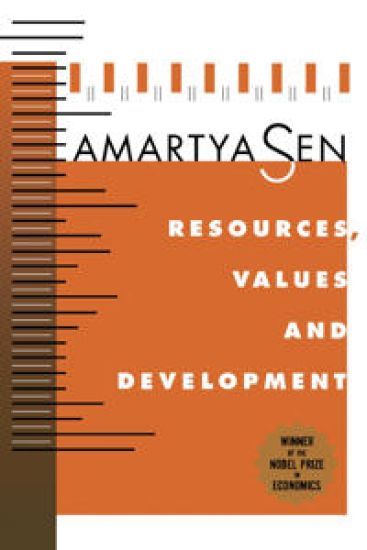
Resources, Values, and Development

Resources, Values, and Development

Amartya Sen

Harvard University Press
1997
nidottu
Resources, Values and Development contains many of Amartya Sen's path-breaking contributions to development economics, including papers on resource allocation in nonwage systems, investment planning, shadow pricing, employment policy, and welfare economics.
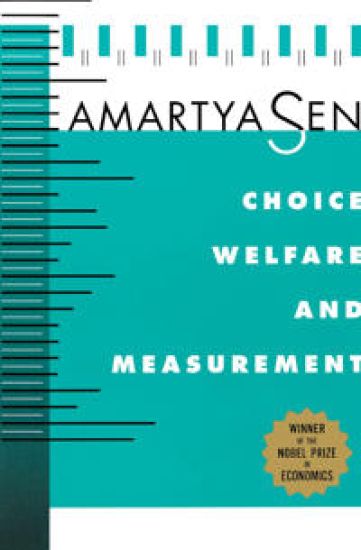
Choice, Welfare and Measurement

Choice, Welfare and Measurement

Amartya Sen

Harvard University Press
1997
nidottu

Halvin toimitettuna 47,30 €

Choice, Welfare and Measurement contains many of Amartya Sen's most important contributions to economic analysis and methods, including papers on choice, preference, rationality, aggregation, and measurement. A substantial introductory essay interrelates his diverse concerns, and also analyzes discussions generated by the original papers, focusing on the underlying issues.
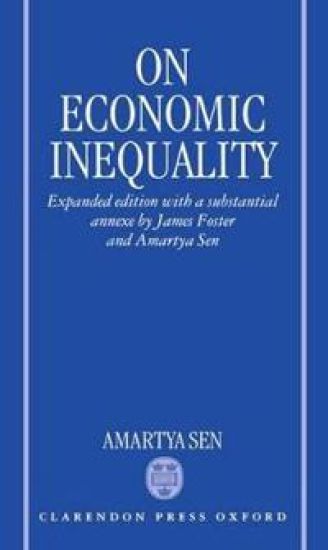
On Economic Inequality

On Economic Inequality

Amartya Sen

Clarendon Press
1997
sidottu
First published in 1973, this book presents a systematic treatment of the conceptual framework as well as the practical problems of measurement of inequality. Alternative approaches are evaluated in terms of their philosophical assumptions, economic content, and statistical requirements. In a new introduction, Amartya Sen, jointly with James Foster, critically surveys the literature that followed the publication of this book, and also evaluates the main analytical issues in the appraisal of economic inequality and poverty.
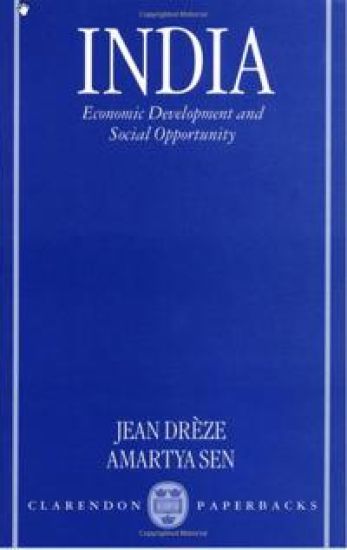
India: Economic Development and Social Opportunity

India: Economic Development and Social Opportunity

Jean Drèze; Amartya Sen

Clarendon Press
1996
sidottu
An analysis of endemic deprivation in India and of the role of public action in addressing that problem. The analysis is based on a broad view of economic development, focusing on human well-being and `social opportunity' rather than on the standard indicators of economic growth. India's success in reducing endemic deprivation since Independence has been quite limited. Recent diagnoses of this failure of policy have concentrated on the counterproductive role of government regulation, and on the need for economic incentives to accelerate the growth of the economy. This book argues that an assessment of India's failure to eliminate basic deprivations has to go beyond this limited focus, and to take note of the role played in that failure by inadequate public involvement in the provision of basic education, health care, social security, and related fields, Even the fostering of fast and participatory economic growth requires some basic social change, which is not addressed by liberalization and economic incentives. The authors also discuss the historical antecedents of these political and social neglects, including the distortion of policy priorities arising from inequalities of political power. Following on from this, the book considers the scope for public action to address these earlier biases and achieve a transformation of policy priorities. The introductory chapter presents the motivation, focus, and approach of the book. Chapter 2 discusses the respective roles of the market mechanism and government action in economic development and discusses the particular role of public involvement in the fields of health and education. In chapters 3 and 4, international comparisons of development experiences are brought to bear on the diagnosis of India's successes and failures. These two chapters also discuss the lessons to be learnt from the contrasting development experiences of different states within India, with particular attention to Kerala's outstanding success in social fields. Chapter 5 considers the role of public action and political organization in promoting social opportunities. Attention is drawn, in particular, to the part played by widespread illiteracy in suppressing that process and perpetuating social inequalities. The issue of basic education is further examined in chapter 6, which includes a critical assessment of public policy in this field. Chapter 7 discusses the specific problem on gender inequality, and the role of women's agency in the expansion of social opportunities for both women and men. The concluding chapter consolidates the argument and discusses the policy implication of the analyses presented. A statistical appendix presents a comparative picture of India and other developing countries, and also the comparative performance of different states within India.
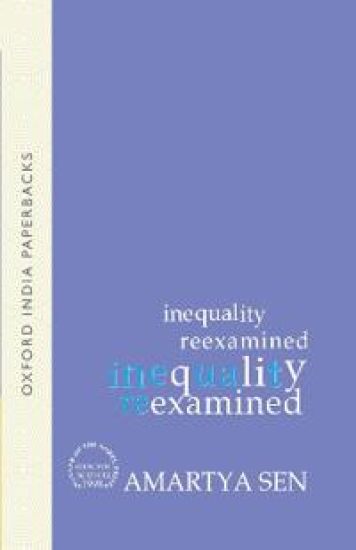
Inequality Reexamined

Inequality Reexamined

Amartya Sen

Clarendon Press
1995
nidottu
This book brings together and develops some of the most important economic, social, and ethical ideas Sen has explored over the last two decades. It examines the claims of equality in social arrangements, stressing that we should be concerned with people's capabilities rather than either their resources or their welfare. Sen also looks at some types of inequality that have been less systematically studied than those of class or wealth.
Inequality Reexamined

Inequality Reexamined

Amartya Sen

Clarendon Press
1992
sidottu
Professor Sen revisits the issues tackled in his previous seminal work, On Economic Inequality, first published in 1973, and provides new analyses and insights in this crucial area. This original and incisive book brings together and develops some of the most important themes of Sen's work over the last decade. He notes that the difference between virtually all contemporary ethical approaches to social arrangements lies not in whether they demand equality or not–they all demand equality of something–but in what sort of equality they propound. Any claim to equality must take account of the diversity of human beings and their characteristics. Sen argues in a rich and subtle approach that we should be concerned with people's capabilities rather than either their resources or their welfare. Sen also looks at some types of inequalities that have not yet been studied as systematically as inequalities of class and wealth have been. These include, inter alia, the important issue of gender inequality.
Hunger and Public Action

Hunger and Public Action

Jean Drèze; Amartya Sen

Clarendon Press
1991
nidottu
This is an open access publication, available online and distributed under the terms of the Creative Commons Attribution-Non Commercial-Share Alike 3.0 IGO licence (CC BY-NC-ND 3.0 IGO). It is free to read at Oxford Scholarship Online and offered as a free PDF download from OUP and selected open access locations. This study was well-received and widely discussed when it appeared in hardback in 1990. It is devoted to analysis of the enduring problem of hunger in the modern world, and of the role that public action can play in countering it. The book is divided into four parts. The first attempts to provide a coherent perspective on the complex nutritional, economic, social and political issues involved in the causation of hunger and deprivation. The second deals with famine prevention, paying special attention to Africa and India. The third focuses on chronic undernourishment and related deprivations. Parts two and three include a number of case studies of successful public action for the prevention of hunger and famines in various parts of the world. The fourth part of the book draws together the main themes and concerns of the earlier chapters, and provides an integrated view of the role of public action in eliminating hunger.
The Standard of Living

The Standard of Living

Amartya Sen

Cambridge University Press
1988
pokkari
Amartya Sen reconsiders the idea of ‘the standard of living’. He rejects the more conventional economic interpretations in terms of ‘unity’ and of wealth or ‘opulence’, and suggests an interpretation in terms of the ‘capabilities and freedoms’ that states of affairs do or do not allow. His argument is conceptual, but it refers to a wide range of examples. In elaborations of it, John Muellbauer explains how parts of it might be applied; Ravi Kanbur discusses the difficulties raised by choice ex ante, under uncertainty, and choice ex post; Keith Hart discusses the ways in which one might think about living standards in societies in which there is a substantial amount of what he calls ‘self provisioning’ outside the market; and Bernard Williams reflects on some of the moral and political implications of Sen’s argument. There is a bibliography of most of the more important works on the subject. The book will be of interest to economists, sociologists, students of development and moral and political philosophers; it will also be of interest to those concerned with public policy.
Poverty and Famines

Poverty and Famines

Amartya Sen

Oxford University Press
1983
nidottu
The main focus of this book is on the causation of starvation in general and of famines in particular. The author develops the alternative method of analysis--the 'entitlement approach'--concentrating on ownership and exchange, not on food supply. The book also provides a general analysis of the characterization and measurement of poverty. Various approaches used in economics, sociology, and political theory are critically examined. The predominance of distributional issues, including distribution between different occupation groups, links up the problem of conceptualizing poverty with that of analyzing starvation.
On Economic Inequality

On Economic Inequality

Amartya Sen

Clarendon Press
1973
nidottu
First published in 1973, this book presents a systematic treatment of the conceptual framework as well as the practical problems of measurement of inequality. Alternative approaches are evaluated in terms of their philosophical assumptions, economic content, and statistical requirements. In a new introduction, Amartya Sen, jointly with James Foster, critically surveys the literature that followed the r s1ication of this book, and also evaluates the main analytical issues in the appraisal of economic inequality and poverty.