Kirjojen hintavertailu – 12 859 829 kirjaa ja 27 kauppaa

Kirjailija

Amit Agrawal

Kirjat ja teokset yhdessä paikassa: 29 kirjaa, julkaisuja vuosilta 2010–2026, suosituimpiin kuuluu Motivazioni e tecniche del rialzo del seno mascellare. Vertaile teosten hintoja ja tarkista saatavuus suomalaisista kirjakaupoista.

29 kirjaa

Kirjojen julkaisuvuodet: 2010–2026.

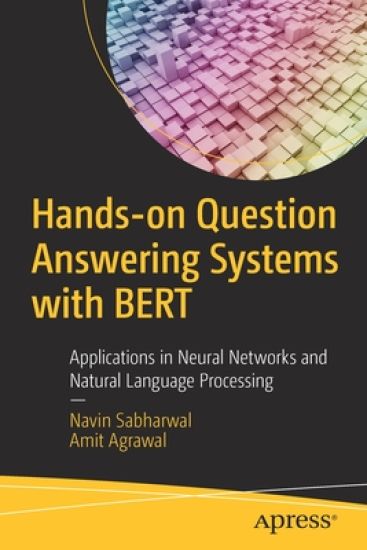
Hands-on Question Answering Systems with BERT

Hands-on Question Answering Systems with BERT

Navin Sabharwal; Amit Agrawal

APress
2021
nidottu
Get hands-on knowledge of how BERT (Bidirectional Encoder Representations from Transformers) can be used to develop question answering (QA) systems by using natural language processing (NLP) and deep learning. The book begins with an overview of the technology landscape behind BERT. It takes you through the basics of NLP, including natural language understanding with tokenization, stemming, and lemmatization, and bag of words. Next, you’ll look at neural networks for NLP starting with its variants such as recurrent neural networks, encoders and decoders, bi-directional encoders and decoders, and transformer models. Along the way, you’ll cover word embedding and their types along with the basics of BERT. After this solid foundation, you’ll be ready to take a deep dive into BERT algorithms such as masked language models and next sentence prediction. You’ll see different BERT variations followed by a hands-on example of a question answering system. Hands-on Question Answering Systems with BERT is a good starting point for developers and data scientists who want to develop and design NLP systems using BERT. It provides step-by-step guidance for using BERT. What You Will Learn Examine the fundamentals of word embeddings Apply neural networks and BERT for various NLP tasks Develop a question-answering system from scratch Train question-answering systems for your own data Who This Book Is For AI and machine learning developers and natural language processing developers.
Up and Running Google AutoML and AI Platform

Up and Running Google AutoML and AI Platform

Amit Agrawal; Navin Sabharwal

BPB Publications
2020
pokkari
Learn how to work towards making the most out of a career in emerging tech Key Features Understand the core concepts related to careers in emerging tech. Learn innovative, exclusive, and exciting ways to design a successful career in ET. Reduce your learning curve by examining the career trajectories of eminent ET professionals. Ways to evolve and adapt to changing ET paradigms. Practical perspective from the field. Description Cracking the emerging tech code will help you attain your Emerging Technology (ET) career goals faster without spending years in committing avoidable mistakes, recovering from them, and learning things the hard way. You can apply practical tips in areas such as improving your ability to craft market-friendly use cases and evolving a solution approach in new and diverse tech or business environments, to propel forward your career in strategic and proactive ways. It outlines ways in which you can explore and capitalize on hidden opportunities while working on important career aspects. The anecdotes and solutions provided will aid you in getting an inside out view to reduce your learning curve. This book will help you in gaining both magnitude and direction in your ET career journey and prevent you from getting overwhelmed or pinned down by the forces of ET. Authored by an ET professional, this book will take you through a series of steps to deepen your understanding of the forces that shape one's ET career and successfully dealing with them. It also helps bust myths, addresses fallacies, and common misconceptions that could harm one's career prospects. There are also practical and easy-to-adopt tips, methods, tracking mechanisms, and information that will improve career standing and professional growth. This book makes it easy for you to enhance your employability and job market relevance so that you can sprint towards a rewarding career. What will you learnThrough this book, you will connect with ways and means to build a strong and rewarding emerging tech career. You will be able to work on identifying the right technology and employer, enhancing employability and differentiation in the job market, addressing challenges and connecting with enablers, accurate growth strategies and execution principles. Who this book is forThis book is for current and aspiring emerging tech professionals, students, and anyone who wishes to understand ways to have a fulfilling career in emerging technologies such as AI, blockchain, cybersecurity, IoT, space tech, and more. Table of Contents 1. Introduction2. The best ET for me and some myth bursting3. Getting prepared and charting a roadmap4. Identifying the requirements and getting help5. Dealing with headwinds and drawing a career change action plan6. Building an ET friendly r sum and finding the right employer7. Getting hired through social media8. Job search9. Impressing the emerging tech jury10. The secret sauce11. Becoming a thought leader12. Measuring success and making course corrections13. Drawing the two-year plan14. Building your leadership capabilities15. To start-up or not?16. Communications skills: getting it right17. Building a personal brand18. Post-scriptAbout the Authors Prayukth has been actively involved in productizing and promoting cross eco-system collaboration in the IoT space for over half-a-decade. In recent years, he has focused on exposing APT groups, global footprint, and in evaluating the evolving threat landscape surrounding IoT and OT environments. In his current role, he has taken Subex's IoT business to new geographies. Your Linkedin profile: https: //www.linkedin.com/in/prayukthkv/

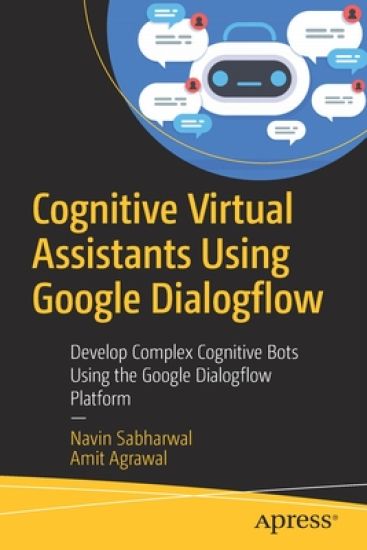
Cognitive Virtual Assistants Using Google Dialogflow

Cognitive Virtual Assistants Using Google Dialogflow

Navin Sabharwal; Amit Agrawal

APress
2020
nidottu
Follow a step-by-step, hands-on approach to building production-ready enterprise cognitive virtual assistants using Google Dialogflow. This book provides an overview of the various cognitive technology choices available and takes a deep dive into cognitive virtual agents for handling complex real-life use cases in various industries such as travel and weather. You’ll delve deeper into the advanced features of cognitive virtual assistants implementing features such as input/output context, follow-up intents, actions and parameters, and handling complex multiple intents. You’ll learn how to integrate with third-party messaging platforms by integrating your cognitive bot with Facebook messenger. You’ll also integrate with third-party APIs to enrich your cognitive bots using webhooks. Cognitive Virtual Assistants Using Google Dialogflow takes the complexity out of the cognitive platform and provides rich guidance which you can use when developing your owncognitive bots. The book covers Google Dialogflow in-depth and starts with the basics, serving as a hands-on guide for developers who are starting out on their journey with Google Dialogflow. All the code presented in the book will be available in the form of scripts and configuration files, which allows you to try out the examples and extend them in interesting ways. What You Will LearnDevelop cognitive bots with Google Dialogflow technologyUse advanced features to handle complex conversation scenariosEnrich the bot’s conversations by understanding the sentiment of the userSee best practices for developing cognitive botsEnhance a cognitive bot by integrating with third-party services Who This Book Is For AI and ML developers.
Microscale Flow and Heat Transfer

Microscale Flow and Heat Transfer

Amit Agrawal; Hari Mohan Kushwaha; Ravi Sudam Jadhav

Springer Nature Switzerland AG
2019
sidottu
This book covers concepts and the latest developments on microscale flow and heat transfer phenomena involving a gas. The book is organised in two parts: the first part focuses on the fluid flow and heat transfer characteristics of gaseous slip flows. The second part presents modelling of such flows using higher-order continuum transport equations. The Navier-Stokes equations based solution is provided to various problems in the slip regime. Several interesting characteristics of slip flows along with useful empirical correlations are documented in the first part of the book. The examples bring out the failure of the conventional equations to adequately describe various phenomena at the microscale. Thereby the readers are introduced to higher order continuum transport (Burnett and Grad) equations, which can potentially overcome these limitations. A clear and easy to follow step by step derivation of the Burnett and Grad equations (superset of the Navier-Stokesequations) is provided in the second part of the book. Analytical solution of these equations, the latest developments in the field, along with scope for future work in this area are also brought out. Presents characteristics of flow in the slip and transition regimes for a clear understanding of microscale flow problems;Provides a derivation of Navier-Stokes equations from microscopic viewpoint;Features a clear and easy to follow step-by-step approach to derive Burnett and Grad equations;Describes a complete compilation of few known exact solutions of the Burnett and Grad equations, along with a discussion of the solution aided with plots;Introduces the variants of the Navier-Stokes, Burnett and Grad equations, including the recently proposed Onsager-Burnett and O13 moment equations.