Kirjojen hintavertailu – 12 903 724 kirjaa ja 27 kauppaa

Kirjailija

Amit Kumar Tyagi

Kirjat ja teokset yhdessä paikassa: 9 kirjaa, julkaisuja vuosilta 2022–2027, suosituimpiin kuuluu Generative AI for Fraud Detection. Vertaile teosten hintoja ja tarkista saatavuus suomalaisista kirjakaupoista.

9 kirjaa

Kirjojen julkaisuvuodet: 2022–2027.

Generative AI for Fraud Detection

Generative AI for Fraud Detection

Amit Kumar Tyagi; Shrikant Tiwari

Taylor & Francis
2027
Nidottu
With the growth of complex frauds, cyber threats, and financial crimes, standard detection approaches typically fall short. Generative AI, with its capacity to synthesize synthetic data, analyze anomalies, and improve predictive analytics, provides creative answers to these difficulties. This book addresses the revolutionary impact of generative AI in fraud detection, addressing the expanding complexity of fraudulent operations in numerous sectors. This book starts with core idea, providing readers to the foundations of fraud detection and generative AI technologies such as Generative Adversarial Networks (GANs) and Variational Autoencoders (VAEs). It then advances to key ideas, concentrating on synthetic data creation, anomaly detection, and the integration of machine learning models in fraud analytics. In this book, some topics like practical applications are also highlighted via case studies in financial services, healthcare, insurance, retail, and cybersecurity. This book illustrates how generative AI can detect credit card fraud, identify fake insurance claims, and safeguard e-commerce platforms against fraudulent transactions. On other side, emerging technologies like blockchain, IoT, and quantum AI are investigated as complementary methods for increasing fraud prevention frameworks. Also, some ethical aspects, including data privacy, AI biases, and regulatory compliance, are also highlighted to meet the problems of deploying generative AI ethically. With this book, readers will get insights on open-source technologies, industry-specific frameworks, and assessment criteria for installing fraud detection systems efficiently. We can assure to our readers that this book will provide a major setback to future researchers by addressing future trends, including real-time threat mitigation and policy implications for global fraud prevention.

Probabilistic Modelling for Advanced Data Analysis

Probabilistic Modelling for Advanced Data Analysis

Amit Kumar Tyagi; Soumya Mazumdar

Elsevier Science & Technology
2027
Nidottu
Probabilistic Modelling for Advanced Data Analysis provides a practical and rigorous guide for data practitioners to effectively implement probabilistic models in real-world scenarios. The book strikes a balance between high-level intuition and technical derivations, offering step-by-step explanations, real-world case studies, and Python implementation examples. The authors offer specific solutions that include modelling and quantifying uncertainty in data-driven decision-making, applying Bayesian inference to real-world problems, and implementing scalable probabilistic models for large-scale datasets, all of which contribute to explainable and trustworthy AI. Probabilistic modeling is a crucial tool in data analysis due to big data, artificial intelligence, and complex decision-making. Traditional statistical methods often fail to capture the inherent uncertainty in real-world datasets. This book presents readers with theoretical foundations and practical applications of probabilistic modeling, providing a structured approach for researchers, data scientists, and industry professionals. The book meets the increasing demand for uncertainty-aware AI models, Bayesian inference, and probabilistic graphical models across various fields of research. The authors have written a comprehensive handbook for probabilistic modelling, incorporating diverse perspectives and real-world case studies from a variety of fields. The book is written with accessibility in mind, benefiting readers from various backgrounds, including those new to the field.
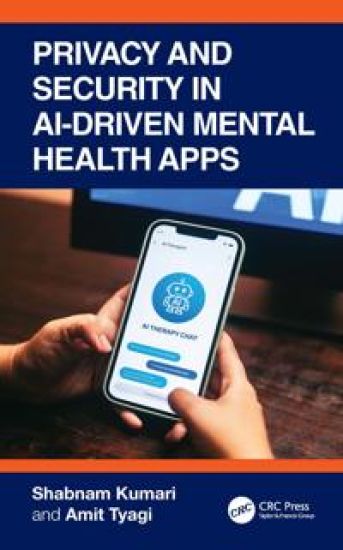
Privacy and Security in AI-Driven Mental Health Apps

Privacy and Security in AI-Driven Mental Health Apps

Shabnam Kumari; Amit Kumar Tyagi

TAYLOR FRANCIS LTD
2026
sidottu
Today Privacy and Security in AI-Driven Mental Health Apps has expanding landscape of mental health technology. For that, we need to concentrate on the essential topics of privacy and security in AI-powered mental health apps. As the use of AI-driven solutions in mental health treatment advances, questions about the ethical management of sensitive data, user privacy, and system vulnerabilities have surfaced as serious challenges. This book gives a complete investigation of these difficulties, addressing how privacy-preserving approaches and secure systems might maintain trust, openness, and ethical integrity in mental health applications. The book is organized to cover a broad variety of subjects. It starts with an introduction to mental health applications and their integration with AI technology, followed by a full discussion on the sorts of data acquired, including sensitive behavioral, physiological, and psychological data. It then analyzes privacy threats, such as data breaches and abuse of personal information, and security problems including cyberattacks and flaws in AI systems. This book has some chapters which cover advanced solutions, including encryption approaches, differential privacy, blockchain integration, and federated learning, as well as the importance of regulatory frameworks like GDPR and HIPAA (including case studies of real-world applications to exhibit both achievements and failures in privacy and security). The last parts cover future directions, ethical issues, and suggestions for developers, physicians, and politicians. With contributions from specialists across disciplines, this book serves as important collection for understanding the convergence of AI, mental health, and data security, seeking to stimulate innovation while respecting user rights.
Human Centric Intelligent Transportation Systems

Human Centric Intelligent Transportation Systems

Amit Kumar Tyagi

TAYLOR FRANCIS LTD
2026
sidottu
In the era rapid technological advancement, the transportation sector stands at the cusp of a transformative era. Human-Centric Intelligent Transportation Systems (HC-ITS) represent a significant leap forward, emphasizing the integration of human factors into the design, implementation, and operation of transportation networks. This book explores the multifaceted dimensions of HC-ITS, highlighting their potential to revolutionize transportation. The foundation of HC-ITS lies in recognizing the importance of human needs, behaviors, and safety. By prioritizing these elements, HC-ITS aims to create more efficient, accessible, and safer transportation environments. This approach not only enhances user experience but also fosters a sustainable and inclusive transportation ecosystem. This book provides a detailed overview of HC-ITS, beginning with the fundamental principles that underpin this innovative approach. It then delves into the core concepts, exploring how user-centered design, human-machine interaction, and advanced data analytics converge to create intelligent transportation solutions. The practical applications of HC-ITS are vast and varied. The volume examines their implementation in smart traffic management, public transportation systems, autonomous vehicles, and initiatives aimed at improving pedestrian and cyclist safety. Through detailed case studies and real-world examples, it illustrates how HC-ITS are being deployed to address current transportation challenges and enhance the quality of urban life. Key features: Explores fundamentals of human-centric ITS technologies comprehensively, including AI personalization and sensor fusion for user safety. Provides diverse applications of human-centric ITS, such as adaptive urban mobility and personalized routing. Provides an in-depth analysis of human-centric ITS performance metrics, like traffic flow optimization and accessibility. Includes real-world case studies, used for emission reductions currently. Reviews challenges and future directions of HC-ITS, focusing on privacy, equity, and multimodal integration.
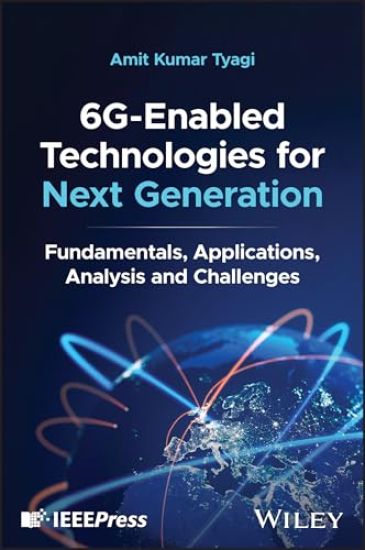
6G-Enabled Technologies for Next Generation

6G-Enabled Technologies for Next Generation

Amit Kumar Tyagi; Shrikant Tiwari; Shivani Gupta; Anand Kumar Mishra

JOHN WILEY SONS INC
2024
sidottu
A comprehensive reference on 6G wireless technologies, covering applications, hardware, security and privacy concerns, existing challenges, analytics methods, and much more 6G-Enabled Technologies for Next Generation delivers a thorough overview of the emerging sixth generation of wireless technology, presenting critical challenges of implementing 6G technologies including spectrum allocation, energy efficiency, security, interoperability, and more. Explaining ways we can use technologies to ensure a sustainable environment through renewable energy and a resilient industry, this book covers the applications and use cases such as smart grid, IoT, smart manufacturing, addressing security and privacy issues with privacy-preserving techniques and authentication control mechanisms. This book discusses the analytical methods used to study the performance of 6G technologies, covering simulation techniques, performance metrics, and predictive modeling. Introducing the core principles of 6G technology, including the advantages and disadvantages of the technology and how wireless communications have evolved, energy-efficient hardware and the different types of green communication technologies is explained. Many case studies are included in this book with a detailed explanation. Written by a team of experienced researchers, this book discusses: Terahertz (ThZ) communication, massive MIMO and beamforming, quantum communication, bandwidth management, and ultra-dense networks and small cell deploymentsSmart cities, telemedicine, and autonomous vehicles and schemes for waveform design, modulation, error correction, and advanced coding and modulationSensor networks, edge computing and mobile cloud computing, and spatial, quantum, and dew computing Quantum-safe encryption, privacy-preserving technologies and techniques, threats and vulnerabilities, and authentication and access control mechanismsNetwork slicing and service differentiation, multi-connectivity and heterogeneous networks, and wireless power transfer 6G-Enabled Technologies for Next Generation is a comprehensive, up-to-date reference for students, academics, and researchers, along with professionals in the telecommunications field.
Intelligent Transportation Systems: Theory and Practice

Intelligent Transportation Systems: Theory and Practice

Amit Kumar Tyagi; Niladhuri Sreenath

SPRINGER VERLAG, SINGAPORE
2023
nidottu
This book provides fundamental principles of intelligent transport systems with comprehensive insight and state of the art of vehicles, vehicular technology, connecting vehicles, and intelligent vehicles/autonomous intelligent vehicles. The book discusses different approaches for multiple sensor-based multiple-objects tracking, in addition to blockchain-based solutions for building tamper-proof sensing devices. It introduces various algorithms for security, privacy, and trust for intelligent vehicles. This book countermeasures all the drawbacks and provides useful information to students, researchers, and scientific communities. It contains chapters from national and international experts and will be essential for researchers and advanced students from academia, and industry experts who are working on intelligent transportation systems.
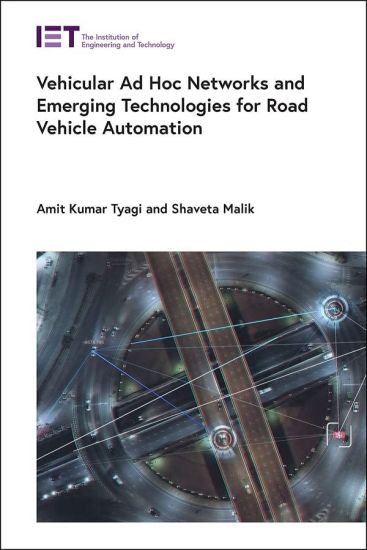
Vehicular Ad Hoc Networks and Emerging Technologies for Road Vehicle Automation

Vehicular Ad Hoc Networks and Emerging Technologies for Road Vehicle Automation

Amit Kumar Tyagi; Shaveta Malik

INSTITUTION OF ENGINEERING AND TECHNOLOGY
2023
sidottu
The automation of road vehicles is still developing, moving towards improved technology, safety, energy and fuel efficiency, comfort, economic growth, and real-world applications. Vehicle connectivity and information exchange over the road is an essential requirement for the future of automated driving. This book is intended to help bridge the gap between theory and applications of autonomous vehicles. Vehicular Ad Hoc Networks and Emerging Technologies for Road Vehicle Automation covers autonomous road vehicles and systems, with a particular focus on vehicular ad-hoc networks (VANETs). VANETs are a key part of the intelligent transport systems framework. They are created by applying the principles of mobile ad-hoc networks to vehicles; that is, the spontaneous creation of a wireless network of mobile devices based on inter-vehicle communication. Coverage also includes further aspects of autonomous road vehicles, including hybrid vehicles, autonomous intelligent vehicles, and autonomous decentralized systems (ADS). The book is essential reading for researchers and advanced students from academia, industry and government working on the automation of road vehicles. Additionally, it is a helpful resource for students, researchers and newcomers to the field; providing an in-depth understanding of autonomous road vehicles, their internal structure, types, and fundamental principles, helping to inform and direct their research, and identify challenging areas and problems where further investigations are needed.
Intelligent Transportation Systems: Theory and Practice

Intelligent Transportation Systems: Theory and Practice

Amit Kumar Tyagi; Niladhuri Sreenath

SPRINGER VERLAG, SINGAPORE
2022
sidottu
This book provides fundamental principles of intelligent transport systems with comprehensive insight and state of the art of vehicles, vehicular technology, connecting vehicles, and intelligent vehicles/autonomous intelligent vehicles. The book discusses different approaches for multiple sensor-based multiple-objects tracking, in addition to blockchain-based solutions for building tamper-proof sensing devices. It introduces various algorithms for security, privacy, and trust for intelligent vehicles. This book countermeasures all the drawbacks and provides useful information to students, researchers, and scientific communities. It contains chapters from national and international experts and will be essential for researchers and advanced students from academia, and industry experts who are working on intelligent transportation systems.
Internet of Things Theory and Practice

Internet of Things Theory and Practice

Amit Kumar Tyagi

BPB PUBLICATIONS
2022
pokkari
Explore the IoT with other emerging technologies like Artificial Intelligence, Machine Learning, Cloud Computing, and Blockchain Technology KEY FEATURES ● Learn from the basics of Internet of Everything, Industry 4.0, and Society 5.0.● Check your knowledge with self-assessment questions and case studies.● Supports the Government of India project "Digital India" and visualizes its completeness through the Internet of Things.● Build a smarter environment (Smart Grid, Smart Home, Smart Transportation) through smart devices.● Explore critical challenges with the future of IoT devices and possible uses in the next decade with IoTs devices. DESCRIPTION The Internet of Things is a new technology that scientists predict will transform the entire Internet and its components. This book explores how the Internet of Things would be incomplete without Artificial Intelligence. The emphasis would be on recent breakthroughs in the Internet of Things and their societal applications. IoT and IoE can deliver effective services in various areas, improving people's lives. This book teaches readers about the Internet of Things, its varieties, and its applications in various beneficial industries, including smart farming, smart homes, waste management systems, smart transportation systems, smart environments, and smart healthcare. In addition, numerous upcoming technologies and their integration with IoT devices have been included in this book through hands-on smart projects to help readers easily grasp the concepts. The book concludes with numerous IoT-AI-Blockchain studies, which are the future of IoT for researchers. WHAT YOU WILL LEARN● Implement IoT and its different technologies to create smarter projects.● Explore IoT and its many variations.● Investigate IoT applications and the cloud-based technology that underpins them.● Consider IoT's impact on healthcare, security, and other industries.● Discover how the Internet of Things (IoT) and the Blockchain will play a role in the Smarter Future. WHO THIS BOOK IS FORThe book is primarily for anyone who wishes to learn about the IoT and its applications. Students, researchers, academicians, industry professionals, governmental organizations, and non-governmental organizations (NGO, Research Labs) will find this book extremely useful for implementing smart projects.