Kirjailija
Amitai Etzioni
Kirjat ja teokset yhdessä paikassa: 40 kirjaa, julkaisuja vuosilta 1975–2023, suosituimpiin kuuluu The Socio-economics of Conversion from War to Peace. Vertaile teosten hintoja ja tarkista saatavuus suomalaisista kirjakaupoista.
40 kirjaa
Kirjojen julkaisuvuodet: 1975–2023.
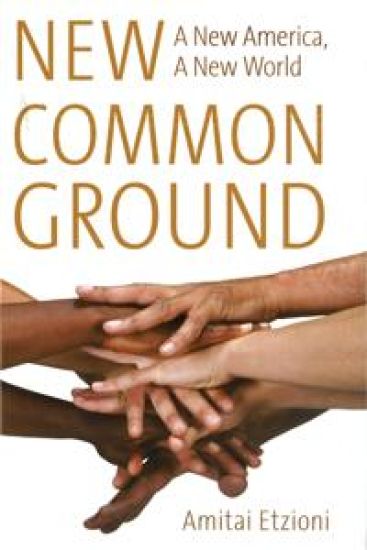
Race, age, political affiliation, country of origin, native language—too often Americans define themselves, and are defined, by the differences that separate them. But if the 2008 presidential campaign has taught us anything, it is that we as a people want to look beyond these divisions to the values and interests that unite us. New Common Ground embodies this zeitgeist, showing the ways that traditional boundaries among ethnic groups, political ideologies, and generations are blurring, and how to hasten the process. New Common Ground demonstrates that even though the deepest divide in America is said to be racial, the differences in viewpoints and values among races are declining, even in an age of increased intermarriage. On immigration and other controversial matters, Etzioni argues for diversity within unity and the means to achieve that necessary end. New Common Ground is a provocative and insightful look into how we as Americans can reach consensus not just in spite of our diversity but also in ways that strengthen our commitment to the good of one and all as we seek to overcome the divisiveness that sometimes results from identity politics. The book closes by looking beyond our shores to the bridges that bring America closer to the rest of the world.

"Die aktive Gesellschaft" ist das Hauptwerk der umfangreichen Schaffensperiode von Amitai Etzioni. Er legt hier seinen Theorieansatz auf der Basis soziologischer, kybernetischer und psychologischer Grundlagen dar.
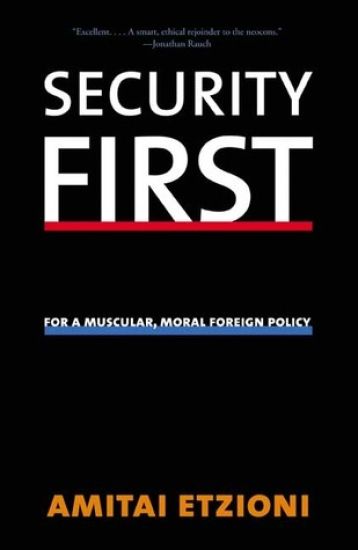
The need for drastic change in American foreign policy is clear, argues Etzioni, and he proposes an approach that is both pragmatic and morally sound “Rarely have more profound changes in American foreign policy been called for than today,” begins Amitai Etzioni in the preface to this book. Yet Etzioni’s concern is not to lay blame for past mistakes but to address the future: What can now be done to improve U. S. relations with the rest of the world? What should American policies be toward recently liberated countries such as Iraq and Afghanistan, or rogue states like North Korea and Iran? When should the United States undertake humanitarian intervention abroad? What must be done to protect America from nuclear terrorism? The author asserts that providing basic security must be the first priority in all foreign policy considerations, even ahead of efforts to democratize. He sets out essential guidelines for a foreign policy that makes sense in the real world, builds on moral principles, and creates the possibility of establishing positive relationships with Muslim nations and all others. Etzioni has considered the issues deeply and for many years. His conclusions fall into no neat categories—neither “liberal” nor “conservative”—for he is guided not by ideology but by empirical evidence and moral deliberation. His proposal rings with the sound of reason, and this important book belongs on the reading list of every concerned leader, policy maker, and voter in America.
In this short book, Etzioni, the well-known and respected public intellectual and communitarian thinker, charts a middle course, or third way 'between those who are committed to shore up our liberties but blind to the needs of public security, as well as those who never met a right they are not willing to curtail to give authorities an even freer hand.' This book will prove a useful guide for citizens looking for a thought provoking, well-reasoned and sober analysis of one of the hot button issues of our time.
When faced with George W. Bush's continuing moves toward an American empire, it is difficult to see a chance for cooperative, community-building approaches toward solving global problems, but that is exactly what Amitai Etzioni argues in this bold new look at international relations. The war on terrorism has helped build the groundwork for a communitarian approach to world politics, and Etzioni shows how it can lead to a new global authority that will be both more legitimate and more effective in dealing with major challenges facing the world than Bush's unilateralist policies. Basic safety, human rights, and global social issues, such as environmental protection are best solved cooperatively, and Etzioni explores ways of creating global authorities robust enough to handle these issues as he outlines the journey from "empire to community."
In this book, Amitai Etzioni, public intellectual and leading proponent of communitarian values, defends the view that no society can flourish without a shared obligation to “the common good.” Rejecting claims made by some liberal thinkers that it is not possible to balance individual rights with uncoerced civic responsibility, Etzioni explores a number of key issues which pose important questions for those concerned with promoting the common good in contemporary society. Are we morally obliged to do more for our communities beyond treating everyone as endowed with basic rights? Should privacy be regarded not merely as a right but also as an obligation? And should the right to free speech take priority over the need to protect children from harmful material in the media and on the internet? Etzioni asks how we can strike a healthy balance between individual rights and public safety in an age of global terrorism. He evaluates various new government devices, from wiretaps to viruses, which open our lives to public scrutiny. Particular attention is given to the issues surrounding government-issued DNA tests. The book concludes by questioning whether we can still talk of a relationship between the common good and the nation-state, or whether the “online” society in which we live will make it increasingly difficult to maintain those communities which are the very homeland of the common good. This new book, by one of the world’s leading social and political thinkers, will be important reading for students and scholars of political science, social philosophy, sociology, and public policy, as well as for the interested general reader.
Amitai Etzioni is one of the most influential social and political thinkers of our day, a man synonymous with the ideas of communitarianism. In this book, Etzioni challenges those who argue that diversity or multiculturalism is about to become the governing American creed. On the surface, America may seem like a fractured mosaic, but the country is in reality far more socially monochromatic and united than most observers have claimed. In the first chapter, Etzioni presents a great deal of evidence that Americans, whites and African Americans, Hispanics and Asian Americans, new immigrants and decedents of the Pilgrims, continue to share the same core of basic American values and aspirations. He goes on to show that we need not merely a civil but also a good society, one that nurtures virtues. He assesses key social institutions that can serve such a society ranging from revived holidays to greater reliance on public shaming. The most effective sources of bonding and of shared ideas about virtue, he insists throughout, come from the community, not from the state. Etzioni also challenges moral relativists who argue that we have no right to "impose" our moral values on other societies. He responds to those who fear that a cohesive community must also be one that is oppressive, authoritarian, and exclusive. And he explores and assesses possible new sources and definitions of community, including computer-mediated communities and stakeholding in corporations. By turns provocative and reassuring, the chapters here cut to the heart of several of our most pressing social and political issues. The book is further evidence of Etzioni's enduring place in contemporary thought.
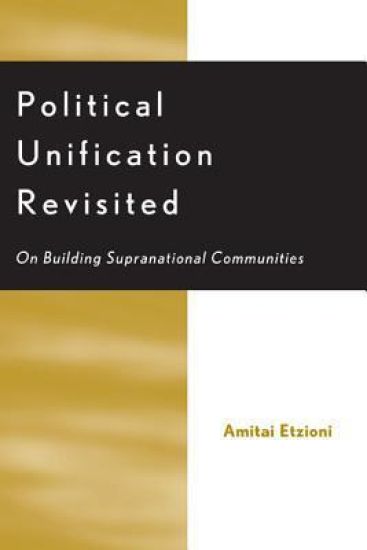
Can independent nations unify politically? Amitai Etzioni raised this searching question in his seminal 1965 book, Political Unification: A Comparative Study of Leaders and Forces. In this revised edition—now with an extensive new introduction—Etzioni convincingly argues that the experiment of collective self-determination is the only viable replacement for a perilously overloaded international system. This fascinating work debates the limitations of informal networks of governance, transnational agencies and cross-nation bonding—including the grand experiment of the European Union—to argue that only a truly transcendent supranational community can effectively succeed the nation-state. He doubts whether the traditional system of international relations can withstand the threat of transnational forces. Old-fashioned diplomacy can neither prevent weapons of mass destruction and hate material moving easily across national borders, nor deal with mass cross-border immigration in the wake of civil war and the rise of political and ethnic separatism. Political Unification Revisited is essential reading for political scientists and scholars of international law and international relations seeking to navigate the path from national sovereignty to world government in the 21st century..
Privacy is perhaps the most hallowed of American rights,and most people are concerned that new technologies available to governments and corporations threaten to erode this most privileged of rights. But in The Limits of Privacy, Amitai Etzioni offers a decidedly different point of view, in which the right to privacy is balanced against concern for public safety and health. Etzioni looks at five flashpoint issues: Megan's Laws, HIV testing of infants, deciphering of encrypted messages, national identification cards, and medical records, and concludes that there are times when Amricans' insistence on privacy is not in the best interests of society at large. He offers four clear and concise criteria which, when applied jointly, help us to determine when the right to privacy should be overridden for the greater public good. Almost every week headlines warn us that our cell phones are being monitored, our e-mails read, and our medical records traded on the open market. Public opinion polls show that Americans are dismayed about incursions against personal privacy. Congress and state legislatures are considering laws designed to address their concerns. Focusing on five flashpoint issues,Megan's Law, mandatory HIV testing of infants, encryption of electronic documents, national identification cards and biometric identifiers, and medical records,The Limits of Privacy argues counterintuitively that sometimes major public health and safety concerns should outweigh the individual's right to privacy. Presenting four concise criteria to determine when the right to privacy should be preserved and when it should be overridden in the interests of the wider community, Etzioni argues that, in some cases, we would do well to sacrifice the privacy of the individual in the name of the common good.
The Sociological Imagination
C. Wright Mills; Amitai Etzioni
Oxford University Press Inc
1999
nidottu
Halvin toimitettuna 24,00 €
C. Wright Mills is best remembered for his highly acclaimed work The Sociological Imagination, in which he set forth his views on how social science should be pursued. Hailed upon publication as a cogent and hard-hitting critique, The Sociological Imagination took issue with the ascendant schools of sociology in the United States, calling for a humanist sociology connecting the social, personal, and historical dimensions of our lives. The sociological imagination Mills calls for is a sociological vision, a way of looking at the world that can see links between the apparently private problems of the individual and important social issues. Leading sociologist Amitai Etzioni brings this fortieth anniversary edition up to date with a lucid introduction in which he considers the ways social analysis has progressed since Mills first published his study in 1959. A classic in the field, this book still provides rich food for our imagination.
Essays in Socio-Economics
Amitai Etzioni
Springer-Verlag Berlin and Heidelberg GmbH Co. K
1999
sidottu
These essays deal with various aspects of a new, rising field, socio economics. The field is seeking to combine the variables studied by neoclassical economists with those typically studied by other social sciences. The combination is expected to provide a better understanding of economic behavior and the economy as well as society; make more reliable predictions; and be more in line with normative values we seek to uphold. The new field, though, may be less elegant mathematically and possibly less parsimonious than neoclassical economics. Some of my ideas on this subject are included in a previously published book, The Moral Dimension: TowardA New Economics (New York: The Free Press, 1988). They also led to a formation of an international society of several thousand scholars who are interested in the field, the Society for the Advancement of Socio-Economics. The essays at hand are in effect grouped. The first two, previously published respectively in the Journal of Economic Psychology and Business Ethics Quarterly, reflect my most recent thinking. They both have a utopian streak that may stand out especially in these days when unfeathered capitalism is the rage. The first points to people, who far from making consuming ever more their life's project, seek a less affiuent way oflife. It examines the psychological foundations and the social consequences of such an approach.
In this book, Francis Lovett examines public parks, especially those administered by the National Park Service, from a communitarian perspective. The author views the parks as an example of a common good_something which is valued for its service to a community or society at large, and not merely for the benefits it brings to individuals or sub-groups. In all public spaces, such as parks, there arise issues regarding the proper balance between individual and sub-group rights and interests on the one hand, and the needs and value of community on the other. Lovett explores these issues in light of the communitarian idea of a common good, and suggests guidelines for the resolutions of these public policy problems. With an extensive introduction by Amitai Etzioni, founder of the Communitarian Network.
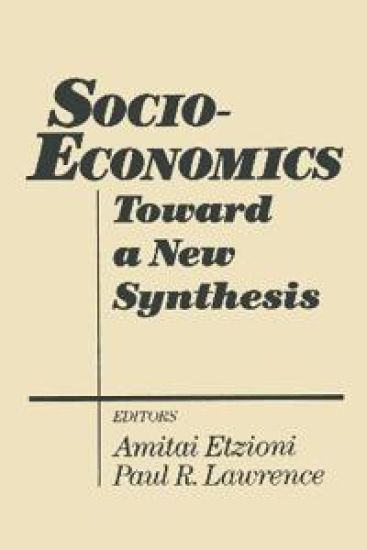
This work is organized in seven sections around major themes of socio-economics. The first section outlines socio-economics in an historical perspective, drawing on the "Methodenstreit" in the German school of economics at the turn of the century. Four additional essays view economic behaviour from the perspective of psychology, sociology and values outside the realm of economics. The second section of the book explores the process of choice and goals made by the variety of economic factors, among them factors that influence choices, values and motivations outside economics. The next two sections, each containing three papers, examine executive leadership and entrepreneurship from the broader socio-economic perspective. Section five includes papers that deal with the role of institutions in the modern political economy. It develops an institutional theory of markets, firms, human values in economic behaviour and investment in ethnic goals and morality. Section six focuses on the modern corporate culture considering collective human capital. The final three papers examine the boundaries that embrace the processes and activities of firms. They consider the bonds and relationships that develop between firms and organizations in the modern political economy.
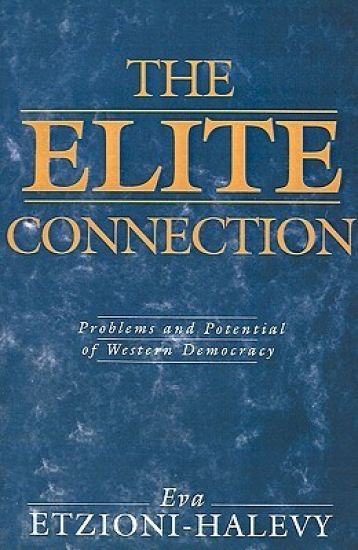
Designed as a textbook for courses in political theory, political sociology and comparative politics, and as a contribution in its own right, this book explores the role of elite relations as a key to understanding democracy. Following a critical review of the literature on classes, democracy and elites, the author argues that although Western democracy is not `governed by the people' and has not created equality, it is unique in that (more than any other regime) it has generated a relative separation of power holders, or a relative autonomy of elites and sub-elites in the control of resources. Developing this argument the author discloses strengths and weaknesses in democracy's infrastructure. The Elite Connection contains a warning that a major danger to democracy stems from the tendency of elites to make incursions into the autonomy of other elites, and to develop excessively close dependency relations, either in subjugation of them, or in collusion with them, which result in threats to civil liberties and to the very foundations of democracy. It argues, however, that democracy has the built-in potential to counter its own subversions. Although it focuses on elites, the book has an egalitarian perspective: it concludes with the argument that the separation of elites makes possible struggles for greater equality. The still relatively independent elites of social movements have the potential of pushing democracy towards greater participation and equality.
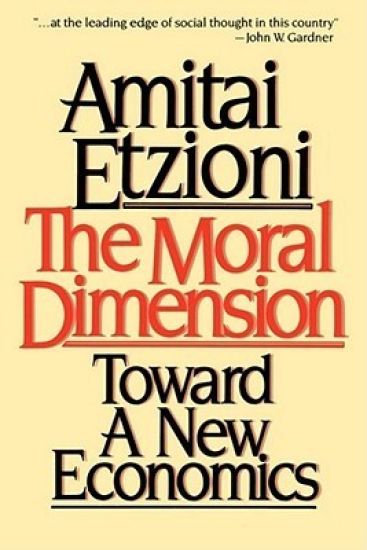
Blending elements of psychology, philosophy, and sociology with economics, Etzioni presents a bold new vision of the social sciences - one which proposes that broader moral, social and political concerns modify economic behaviour and shape individual decision-making. In establishing the necessitary of moral and social considerations in economic behaviour, he provides a provocative new framework for a more comprehensive, ethical and realistic approach to the social sciences today.
Wenn Sie sich von der einen oder anderen der folgenden Fragen betroffen fiihlen, sollten Sie sich unbedingt Klarheit tiber den neuesten Stand der Genetik verschaffen, sowie tiber die Aussich- ten, Rechte und Moglichkeiten, die Sie auf diesem Gebiet haben. Konnen, dtirfen und sollen Sie daraufhin untersucht werden, ob Sie, ohne es zu wissen, in Ihren Genen eine Krankheit mit sich herumtragen, die Sie in spateren Jahren an den Rollstuhl fesselt? (Wissenschaftler haben tiber 1500 Krankheiten identi- fiziert, die teilweise oder ausschlieBlich genetisch bedingt sind). - Falls Sie an ein weiteres Kind denken: Kennen Sie die Schritte, die Sie bereits jetzt unternehmen konnen, damit es ein norma- les Kind wird, Schritte, die verhindern, daB Sie ein durch Phe- nylketonurie (PKU, Brenztraubensaure-Schwachsinn) zuriick- gebliebenes oder ein mongoloides Kind bekommen (eine Tra- godie, die in Amerika unter 600 Geburten einmal eintritt) oder ein Kind, das das Opfer eines anderen verheerenden Leidens ist? Wenn Sie wollen, daB Ihr nachstes Kind mit Sicherheit ein Junge bzw.
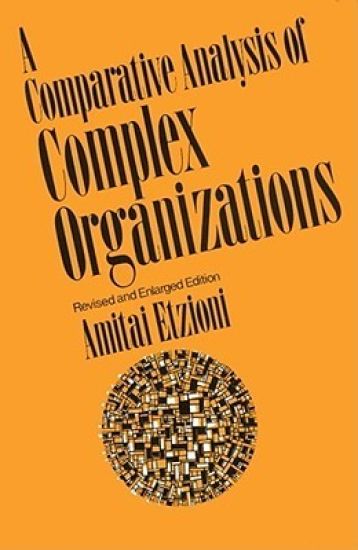
This important book “classifies organizations on the basis of organizational properties and systemically examines variations amount different types of organization” (American Sociological Review). Bringing light to a neglected field, A Comparative Analysis of Complex Organizations presents models for the analysis of various organizational types and examines how they are constructed. Primarily discussing the relationship between compliance and each variable it introduces, this book works as a cornerstone for the comparative analysis of organizations.
Die radikale Transfonnation nach dem Zweiten Weltkrieg markiert das Ende der Moderne. Nach dem Zweiten Weltkrieg endete die moderne Zeit mit der radi- kalen Transfonnation der Kommunikations-, Wissens- und Energietechnologien. Ihr zentrales Merkmal war die kontinuierliche Zunahme der Effizienz der Produk- tionstechnologie, die eine wachsende Herausforderung flir den Primat jener Werte bedeutete, denen diese Mittel dienen sollten. Die postmoderne Zeit, deren Beginn wir mit dem Jahr 1945 festsetzen konnen, wird entweder eine weitere und noch weitgehendere Bedrohung des Status dieser Werte durch den Ansturm der Techno- logien oder die Wiederherstellung ihrer normativen Prioritat erleben. Welche der Alternativen sich durchsetzt, wird dariiber entscheiden, ob die Gesellschaft Diener oder Meister der von ihr erzeugten Instrumente sein wird. Die aktive Gesellschaft, die Herr ihrer selbst ist, ist eine Option, die sich mit der postmodernen Zeit erOff- net. Der Gegenstand dieser Arbeit ist die Untersuchung der Bedingungen, unter denen diese Option verwirklicht werden kann. Die hier prasentierte Theorie verbindet analytische und historische Perspektiven: sie enthiilt eine Analyse der aktiven Qualitat und ihrer Komponenten sowie eine Reihe von Hypothesen uber die historischen Umstande, unter denen Gesellschaften oder Subgesellschaften (ethnische Gruppierungen, Klassen) verschiedene Grade von Selbstkontrolle erreichen. Als analytisches Konzept ist die aktive Gesellschaft ein Modell, mit dem die tatsiichliche Struktur verschiedener Gesellschaften und Sub- gesellschaften verglichen werden kann und mit dessen Hllfe sie analysiert werden konnen. Die heutige Zivilisation und ihre Transformation ist der historische Kon- text, in dem sich die aktive Option entwickelt.