Kirjojen hintavertailu – 12 903 725 kirjaa ja 27 kauppaa

Kirjailija

Amy Benjamin

Kirjat ja teokset yhdessä paikassa: 32 kirjaa, julkaisuja vuosilta 2000–2021, suosituimpiin kuuluu Infusing Grammar Into the Writer's Workshop. Vertaile teosten hintoja ja tarkista saatavuus suomalaisista kirjakaupoista.

32 kirjaa

Kirjojen julkaisuvuodet: 2000–2021.

Big Skills for the Common Core

Big Skills for the Common Core

Amy Benjamin; Michael Hugelmeyer

Eye On Education, Inc
2012
nidottu
Zoom in on the academic skills students are required to learn in reading, writing, speaking/listening, and language! This book cuts through all of the Common Core jargon and gets right to the heart of what students need to learn now. Big Skills for the Common Core is packed with engaging strategies you can use immediately to improve your students' literacy skills and help them retain those skills. Special features include... Charts that break down the skills for each anchor standard and put them into teacher- friendly language. BONUS! The charts highlight the big shifts for teachers for discussion and sharing. Practical strategies to help students tackle and understand complex texts. Helpful ideas for teaching argument writing, plus writing rubrics and assessment strategies. Clear information on Tier II and Tier III words and how to teach them. In addition, each section of the book ends with "Classroom Close-Ups," which take you inside real classrooms that are implementing the Common Core. You'll see the standards in action across the curriculum and get takeaway tips you can use tomorrow in your own classroom!
Vocabulary at the Core

Vocabulary at the Core

Amy Benjamin; John T. Crow

Eye On Education, Inc
2012
nidottu
Vocabulary at the Core, the expanded and updated edition of Vocabulary at the Center (© 2009), is the definitive guide for every teacher engaged in helping students learn essential academic vocabulary. In clear, precise language, Benjamin and Crow explain why vocabulary is at the core of all learning and communicating and why word study should play a more significant role in English class and across the curriculum—as emphasized by the Common Core State Standards. You will learn... How words get learned and stay learned. Why teachers must emphasize useful academic words. Why rote memorization doesn’t work and why students need opportunities for deep processing. How and why to teach derivations, collocations, register, idioms, and gender. How and why to teach context clues, fluency, and pronunciation. The benefits of graphic organizers and word games in the classroom. Each chapter includes engaging, easy-to-implement classroom applications that are correlated to the Common Core State Standards and will fit seamlessly into your lesson plans. BONUS! Vocabulary at the Core also provides ideas for formative and summative assessments.
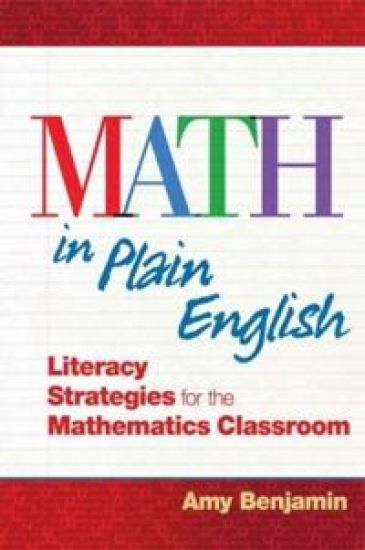
Math In Plain English

Math In Plain English

Amy Benjamin

Eye On Education, Inc
2011
nidottu
Do word problems and math vocabulary confuse students in your mathematics classes? Do simple keywords like "value" and "portion" seem to mislead them? Many words that students already know can have a different meaning in mathematics. To grasp that difference, students need to connect English literacy skills to math. Successful students speak, read, write, and listen to each other so they can understand, retain, and apply mathematics concepts. This book explains how to use 10 classroom-ready literacy strategies in concert with your mathematics instruction. You’ll learn how to develop students who are able to explain to themselves - and communicate to others - what problems mean and how to attack them. Embedding these strategies in your instruction will help your students gain the literacy skills required to achieve the eight Common Core State Standards for Mathematics. You’ll discover the best answer to their question, "When am I ever going to use this?" The 10 Strategies: 1. Teaching mathematical words explicitly 2. Teaching academic words implicitly 3. Reinforcing reading comprehension skills that apply to mathematics 4. Teaching mathematics with metaphor and gesture 5. Unlocking the meaning of word problems 6. Teaching note-taking skills for mathematics 7. Using language-based formative assessment in mathematics 8. Connecting memorization to meaning in mathematics 9. Incorporating writing-to-learn activities in mathematics 10. Preparing students for algebraic thinking
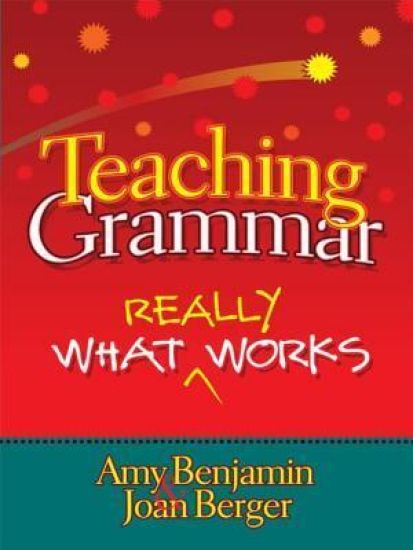
Teaching Grammar

Teaching Grammar

Amy Benjamin; Joan Berger

Eye On Education, Inc
2010
nidottu
Instill grammar fundamentals using lessons that stick! In this book, authors Amy Benjamin and Joan Berger share procedures for teaching grammar effectively and dynamically, in ways that appeal to students and teachers alike. Ideal for teachers just beginning their work in grammar instruction, this book includes day-by-day units and reproducibles to help them embed grammar lessons into writing instruction. Using visuals, wordplay, problem solving, and pattern-finding activities, teachers can forgo methods that fail to engage students in grammar. Through a series of activities designed to delve deeper into grammar learning, the authors share strategies that have proven successful during their extensive years of teaching and literacy consulting. Topics include: Using time wisely: Assess for cumulative understanding and development of writing style The "Verb Map": A visual metaphor of the verb system Teaching parts of speech for effective expression, not just memorization And more!
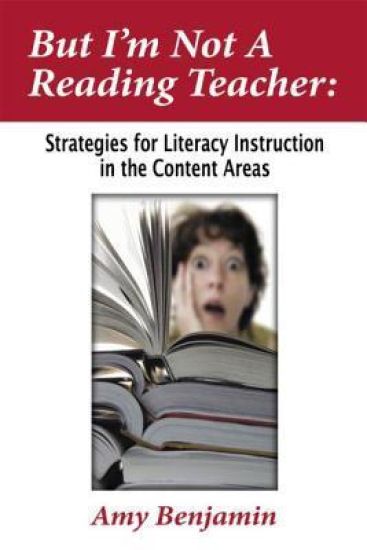
But I'm Not a Reading Teacher

But I'm Not a Reading Teacher

Amy Benjamin

Eye On Education, Inc
2007
nidottu
This book shows content area teachers in middle and high schools how to boost student achievement by including lessons and strategies which focus on students' reading comprehension without detracting from content area focus. These mini-lessons and strategies are research-based and address the specific literacy challenges of each particular subject area (social studies, mathematics, science, etc.). The author has provided a large number of reading examples from texts, sample tests and assessments, and actual mini-lessons, their content areas identified by marginal tabs.
Writing Put to the Test

Writing Put to the Test

Amy Benjamin

Eye On Education, Inc
2006
nidottu
This book helps educators improve students’ ability to write clear, coherent essays in response to on-demand writing prompts. While it focuses on students’ abilities to succeed at on-demand writing, it also promotes the teaching of writing as an expression of art and self. For grades 4 -12, it provides examples of responses to narrative and persuasive prompts, and provides savvy advice about what scorers look for.
Writing in the Content Areas

Writing in the Content Areas

Amy Benjamin

Eye On Education, Inc
2005
nidottu
Do you spend entirely too much time correcting your students' papers? Do your students' essays and term papers take side trips to nowhere? Is their writing riddled with mechanical errors? Do their lab reports and essays lack specificity and clarity? Writing in the Content Areas, Second Edition is for middle and high school content area teachers who assign essays, term papers, lab reports, and other writing tasks to students. This book provides strategies and tips to help teachers of social studies, science, art, etc. improve the quality of students' writing and apply national and state curriculum standards in your classroom. The strategies in this book can be integrated easily into every teacher's daily plans. They will help your students improve their abilities to - reflect before writing - organize and classify - provide detail without padding - use technical terminology correctly - avoid unnecessary words - spell correctly- take useful notes while they read and during your lectures. This book will help teachers - get what they want from a writing task - frame their assignments more precisely - correct student papers more quickly and efficientlyThe new second edition offers activities and strategies which involve technology (word processing, presentation programming, the Internet, and e-communications), differentiated instruction, and brain-based learning.
Differentiated Instruction Using Technology

Differentiated Instruction Using Technology

Amy Benjamin

Eye On Education, Inc
2005
nidottu
Like Amy Benjamin’s other books, this one is easy to read and simple to implement. It demonstrates that you can manage the complexities of differentiated instruction – and save time -- by using technology as you teach. It showcases classroom-tested activities and strategies which are easy to apply in your own classroom.
Differentiated Instruction

Differentiated Instruction

Amy Benjamin

Eye On Education, Inc
2003
nidottu
This book demonstrates how to make your classroom more responsive to the needs of individual students with a wide variety of learning styles, interests, goals, cultural backgrounds, and prior knowledge. Focusing on grades K through 6, it showcases classroom-tested activities and strategies. Differentiated Instruction: A Guide for Elementary School Teachers shows you how to vary your instruction so you can respond to the needs of individual learners. The examples and classroom activities in this book focus on - reading fiction - reading non-fiction - vocabulary- spelling - penmanship - map and globe skills - math - science - the artsAlso included is coverage of - differentiated instruction for English language learners- brain-based learning and multiple intelligences- the impact of differentiated instruction on high stakes testing.
Differentiated Instruction

Differentiated Instruction

Amy Benjamin

Eye On Education, Inc
2002
nidottu
This book demonstrates how to make your classroom more responsive to the needs of individual students with a wide variety of learning styles, interests, goals, cultural backgrounds, and prior knowledge. Focusing on grades 6 through 12, this book showcases classroom-tested activities and strategies. Differentiated Instruction: A Guide for Middle and High School Teachers shows you how to vary your instruction so you can respond to the needs of individual learners. The concrete examples in this book demonstrate how you can use differentiated instruction to clarify: the content (what you want students to know and be able to do) the process (how students are going to go about learning the content) and the product (how they will show you what they know.)This book is uniquely interactive. It features "Reflections" to help you understand your teaching style and guide you towards developing habits of mind which result in effective differentiated instruction. Also included is a chapter on teaching students whose native language is not English.