Kirjojen hintavertailu – 12 903 725 kirjaa ja 27 kauppaa
Kirjailija
Anatole Katok
Kirjat ja teokset yhdessä paikassa: 7 kirjaa, julkaisuja vuosilta 1986–2017, suosituimpiin kuuluu Invariant Manifolds, Entropy and Billiards. Smooth Maps with Singularities. Vertaile teosten hintoja ja tarkista saatavuus suomalaisista kirjakaupoista.
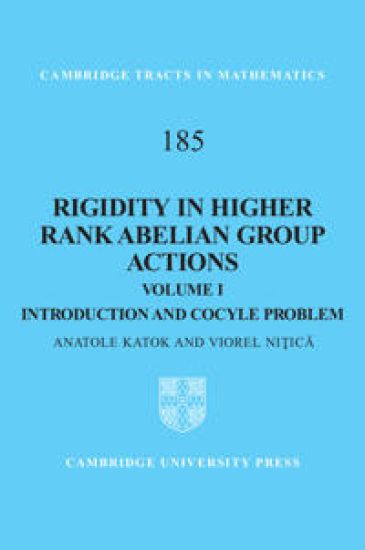
This self-contained monograph presents rigidity theory for a large class of dynamical systems, differentiable higher rank hyperbolic and partially hyperbolic actions. This first volume describes the subject in detail and develops the principal methods presently used in various aspects of the rigidity theory. Part I serves as an exposition and preparation, including a large collection of examples that are difficult to find in the existing literature. Part II focuses on cocycle rigidity, which serves as a model for rigidity phenomena as well as a useful tool for studying them. The book is an ideal reference for applied mathematicians and scientists working in dynamical systems and a useful introduction for graduate students interested in entering the field. Its wealth of examples also makes it excellent supplementary reading for any introductory course in dynamical systems.
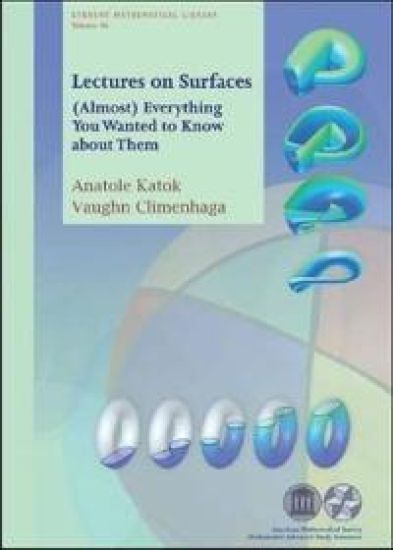
Surfaces are among the most common and easily visualized mathematical objects, and their study brings into focus fundamental ideas, concepts, and methods from geometry, topology, complex analysis, Morse theory, and group theory. At the same time, many of those notions appear in a technically simpler and more graphic form than in their general 'natural' settings. The first, primarily expository, chapter introduces many of the principal actors - the round sphere, flat torus, Mobius strip, Klein bottle, elliptic plane, etc. - as well as various methods of describing surfaces, beginning with the traditional representation by equations in three-dimensional space, proceeding to parametric representation, and also introducing the less intuitive, but central for our purposes, representation as factor spaces. It concludes with a preliminary discussion of the metric geometry of surfaces, and the associated isometry groups. Subsequent chapters introduce fundamental mathematical structures - topological, combinatorial (piecewise linear), smooth, Riemannian (metric), and complex - in the specific context of surfaces. The focal point of the book is the Euler characteristic, which appears in many different guises and ties together concepts from combinatorics, algebraic topology, Morse theory, ordinary differential equations, and Riemannian geometry. The repeated appearance of the Euler characteristic provides both a unifying theme and a powerful illustration of the notion of an invariant in all those theories. The assumed background is the standard calculus sequence, some linear algebra, and rudiments of ODE and real analysis. All notions are introduced and discussed, and virtually all results proved, based on this background. This book is a result of the MASS course in geometry in the fall semester of 2007.
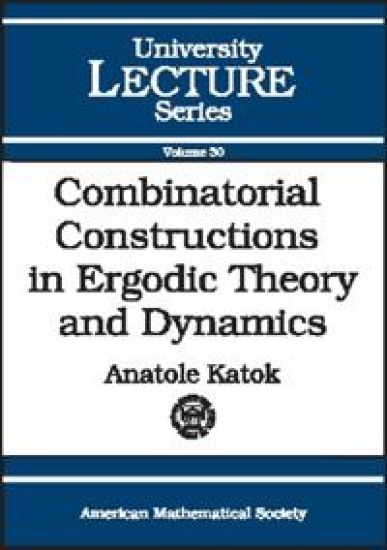
Ergodic theory studies measure-preserving transformations of measure spaces. These objects are intrinsically infinite, and the notion of an individual point or of an orbit makes no sense. Still there are a variety of situations when a measure-preserving transformation (and its asymptotic behavior) can be well described as a limit of certain finite objects (periodic processes). The first part of this book develops this idea systematically. Genericity of approximation in various categories is explored, and numerous applications are presented, including spectral multiplicity and properties of the maximal spectral type. The second part of the book contains a treatment of various constructions of cohomological nature with an emphasis on obtaining interesting asymptotic behavior from approximate pictures at different time scales. The book presents a view of ergodic theory not found in other expository sources. It is suitable for graduate students familiar with measure theory and basic functional analysis.
This book provided the first self-contained comprehensive exposition of the theory of dynamical systems as a core mathematical discipline closely intertwined with most of the main areas of mathematics. The authors introduce and rigorously develop the theory while providing researchers interested in applications with fundamental tools and paradigms. The book begins with a discussion of several elementary but fundamental examples. These are used to formulate a program for the general study of asymptotic properties and to introduce the principal theoretical concepts and methods. The main theme of the second part of the book is the interplay between local analysis near individual orbits and the global complexity of the orbit structure. The third and fourth parts develop the theories of low-dimensional dynamical systems and hyperbolic dynamical systems in depth. Over 400 systematic exercises are included in the text. The book is aimed at students and researchers in mathematics at all levels from advanced undergraduate up.
This book provided the first self-contained comprehensive exposition of the theory of dynamical systems as a core mathematical discipline closely intertwined with most of the main areas of mathematics. The authors introduce and rigorously develop the theory while providing researchers interested in applications with fundamental tools and paradigms. The book begins with a discussion of several elementary but fundamental examples. These are used to formulate a program for the general study of asymptotic properties and to introduce the principal theoretical concepts and methods. The main theme of the second part of the book is the interplay between local analysis near individual orbits and the global complexity of the orbit structure. The third and fourth parts develop the theories of low-dimensional dynamical systems and hyperbolic dynamical systems in depth. Over 400 systematic exercises are included in the text. The book is aimed at students and researchers in mathematics at all levels from advanced undergraduate up.