Kirjojen hintavertailu – 12 903 725 kirjaa ja 27 kauppaa

Kirjailija

Anders Sandström

Kirjat ja teokset yhdessä paikassa: 4 kirjaa, julkaisuja vuosilta 2012–2026, suosituimpiin kuuluu Stockholm : örlogsstaden. Vertaile teosten hintoja ja tarkista saatavuus suomalaisista kirjakaupoista.

4 kirjaa

Kirjojen julkaisuvuodet: 2012–2026.

Stockholm : örlogsstaden

Stockholm : örlogsstaden

Magnus Anderberg; Richard Areschoug; Carl Olof Cederlund; Tommy Dahlström; Lars-Erik Hansson; Klas Helmerson; Marcus Hjulhammar; Eva Hult; Ole Lisberg Jensen; Bengt Norling; Thomas Roth; Anders Sandström; Hans Soop; Gustaf Taube; Lars Ericson Wolke

Medströms Bokförlag
2012
sidottu
En stor och rikt illustrerad bok som guidar till Stockholm som marin stad. Staden var en (delvis hemlig) örlogsbas från 1520-talet ända fram till 1969. Den marina närvaron satte sin prägel på staden. Boken innehåller hundratals unika bilder och utförliga kartor: den siste amiralens bostad, skeppsvraken runt holmarna (svenska linjeskepp och ryska galärer!), de kända namnen på Galärvarvskyrkogården, örlogsskepp byggda i Stockholm, örlogsbesök genom tiderna, från ryska tsarer i lustjakter via sovjetiska ubåtar till engelska hangarfartyg. En unik Stockholmsbok! Kartor och rekonstruktioner lockar till nya promenader på Skeppsholmen, Kastellholmen, Galärvarvet och Östermalm. Boken är skriven av en rad ledande historiker och Stockholmskännare.

The Participatory Economy

The Participatory Economy

Anders Sandström

Taylor & Francis
2026
Sidottu
This book explores the participatory economy model (parecon) as a democratic alternative to capitalism and central planning. Written from an accounting perspective, it addresses two critical challenges in implementing this theoretical framework: product categorisation and contextualising annual planning. It outlines a comprehensive product catalogue framework by analysing how consumers and producers influence product categorisation, design, and production processes across nine distinct product types, which collectively shape annual planning proposals, costing, and pricing mechanisms. Further, the book positions the contextualisation of annual planning clearly and concretely within the framework of the ongoing and complex relations existing in an open, fair and democratic modern economy. It identifies the most important coordination tasks and support functions necessary in a participatory economy for the formal annual planning procedure and the implementation of a fair and efficient agreed annual plan. Overall, the author proposes possible and viable ways to bridge the gap between abstract economic theory and the present reality, illuminating complex issues and demonstrating how a participatory economy can function efficiently without markets or private ownership. The work emphasises democratic decision-making, equitable income distribution, and self-management while providing detailed frameworks for price formation, production coordination, and investment planning in a complex modern economy. As such, it will appeal to researchers, scholars and students of heterodox economics, political economy, and socialist theory, as well as activists and practitioners interested in alternative economic systems.
Anarchist Accounting

Anarchist Accounting

Anders Sandström

Routledge
2020
sidottu
This book is about accounting in an alternative libertarian socialist economic system. It explores what information and transactions we need to enable democratic and effective financial decisions by those affected by the decisions. Based on the economic model, participatory economics, the author proposes a set of accounting principles for an economy comprised of common ownership of productive resources, worker and consumer councils, and democratic planning, promoting the model’s core values. The author tackles questions such as how accounting could be organised in an economy with no private equity owners or private lenders and creditors that is not based on greed and competition but instead on cooperation and solidarity. A large part of the book is focused on issues regarding investments; thus, he asks how and on what basis decisions are made about the allocation of an economy’s production between consumption today and investments that enable more consumption in the future, and how investments are accounted for. He also considers how investments in capital assets and production facilities would be decided, financed, and valued if they are not owned by private capital owners and if allocation does not take place through markets but through a form of democratic planning. In answering these questions and more, the author demonstrates that alternative economic systems are indeed possible, and not merely lofty utopias that cannot be put into practice, and inspires further discussion about economic vision. By applying accounting to a new economic setting and offering both technical information and the author’s bold vision, this book is a comprehensive and valuable supplementary text for courses touching on critical accounting theory. It will also appeal to readers interested in alternative kinds of economies.
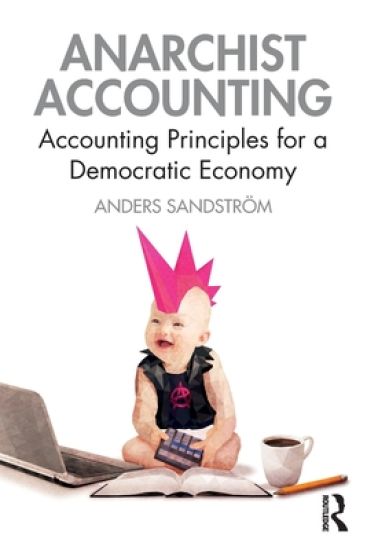
Anarchist Accounting

Anarchist Accounting

Anders Sandström

Routledge
2020
nidottu
This book is about accounting in an alternative libertarian socialist economic system. It explores what information and transactions we need to enable democratic and effective financial decisions by those affected by the decisions. Based on the economic model, participatory economics, the author proposes a set of accounting principles for an economy comprised of common ownership of productive resources, worker and consumer councils, and democratic planning, promoting the model’s core values. The author tackles questions such as how accounting could be organised in an economy with no private equity owners or private lenders and creditors that is not based on greed and competition but instead on cooperation and solidarity. A large part of the book is focused on issues regarding investments; thus, he asks how and on what basis decisions are made about the allocation of an economy’s production between consumption today and investments that enable more consumption in the future, and how investments are accounted for. He also considers how investments in capital assets and production facilities would be decided, financed, and valued if they are not owned by private capital owners and if allocation does not take place through markets but through a form of democratic planning. In answering these questions and more, the author demonstrates that alternative economic systems are indeed possible, and not merely lofty utopias that cannot be put into practice, and inspires further discussion about economic vision. By applying accounting to a new economic setting and offering both technical information and the author’s bold vision, this book is a comprehensive and valuable supplementary text for courses touching on critical accounting theory. It will also appeal to readers interested in alternative kinds of economies.