Kirjojen hintavertailu – 12 859 818 kirjaa ja 27 kauppaa
Kirjailija
Anders Stephanson
Kirjat ja teokset yhdessä paikassa: 6 kirjaa, julkaisuja vuosilta 1992–2025, suosituimpiin kuuluu Om den amerikanska idén. Vertaile teosten hintoja ja tarkista saatavuus suomalaisista kirjakaupoista.
Peter Baldwin; Peter Beinart; Kathleenn Burk; James Carroll; David Ellwood; Godfrey Hodgson; Daniel Walker Howe; Oliver Kamm; Deepak Lal; Anatol Lieven; Edward Luce; Pauline Maier; Douglas Murray; Jong-Yil Ra; David Reynolds; Philippe Roger; Göran Rosenberg; robert J Shapiro; Anders Stephanson; Reinhold Wagnleitner; Alan Wolfe
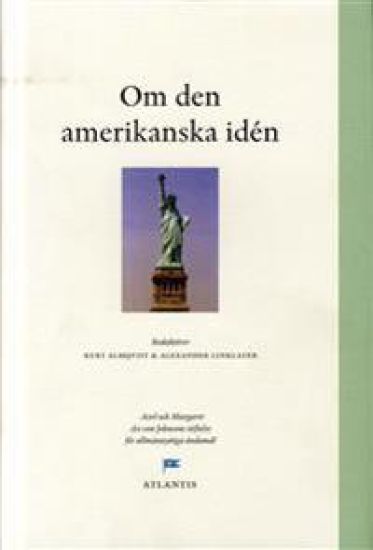
Hur uppstod idén om Amerika, hur har den omformats genom historien, vart är den på väg? Kring dessa och liknande frågor kretsade Engelsbergsseminariet 2009. Vilka är komponenterna i den amerikanska idén? Hur förvaltas de i dagens USA? Hur reagerar resten av världen på dem? Sker idag en övergång till en post-amerikansk värld? Vem kommer i så fall att ta över USA:s ledande ställning? Indien? Kina? Och vad skulle det innebära? Vilka tankefigurer skulle då komma att prägla världen? Eller har USA chansen att bli kvar som herre på täppan? Bevittnar vi början på slutet för idén om Amerika eller befinner vi oss bara i början av en amerikansk era? Bland bidragsgivarna märks Anatol Lieven, Deepak Lal, Jong-Yil Ra, Edward Luce och Alan Wolfe.
Risto Alapuro; Perry Anderson; Robin Blackburn; Chang Kyung-sup; Gabriella Elgenius; Anita Göransson; Eric Hobsbawm; Sven Hort; Per H. Jensen; Habibul Haque Khondker; Lisa Kings; Zhanna Kravchenko; Aliaksei Lastouski; Åsa Cristina Laurell; Lena Lavinas; Gunnar Olofsson; Bo Rothstein; Anders Stephanson
Soon, Cities of Power: The Urban, the National, the Popular, and the Global by Göran Therborn will be on the market. In between Science, Class and Society (1976) and The Killing Fields of Inequality (2013, Swedish translation: Ojämlikhet dödar, 2016) Göran has consistently challenged received wisdom in politics and the social sciences. His Between Sex and Power (2004) is the current global map of family relations and gender equality. With the 1968 article "From Petrograd to Saigon" he laid the foundation for his worldwide reputation as an innovative public intellectual. His critique of the Frankfurt School had repercussions around Europe. Today his work is spread across six continents, Latin America in particular, and has been translated into more than twenty languages. This book is a critical appraisal of the themes Göran Therborn has pursued up till now, and is introduced by Robin Blackburn, for almost twenty years his editor at New Left Review." Göran's continual alertness to different paths to or through modernity, and to varieties of capitalism, will very soon be tested in a dramatic way." - Ian Gough, London School of Economics"This is a very important project and Göran richly deserves it." - Michael Burawoy, UC BerkeleyCONTENTS: INTRODUCTIONS Robin Blackburn, Göran Therborn and the Old Mole Sven Hort & Gunnar Olofsson, A Portrait of the Sociologist as a Young Rebel SECTION I. Class, Politics and Revolutions Anders Stephanson, On Geopolitics in Therbornism, Early and Late Risto Alapuro, Finnish Demonstrations as Confrontations Per H. Jensen, Origins of Danish Flexicurity Robin Blackburn, From Miliband to Corbyn Aliaksei Lastouski, Nikolay Zakharov & Sven Hort, Belarus - Another "Iceberg Society"? Elisabeth Özdalga, Islam-Oriented Trajectories and Turkey's Fluctuating Encounters with European Modernity Åsa Cristina Laurell, Structural Adjustment, Social Exclusion and Violence Lena Lavinas, The Untold Battlefields Against Inequality in Latin America Chang Kyung-sup, Post-Socialist Class Politics with Chinese Characteristics SECTION II. Sex, Gender and Power Anita Göransson & Karin Widerberg, Göran between Sex and Power Eric Hobsbawm, Retreat of the Male Perry Anderson, Atlas of the Family SECTION III. Global Modernities Immanuel Wallerstein, Empire: Dangerous Slippage of a Concept Habibul Haque Khondker, Entangled Globality Gabriella Elgenius, The Principles and Products of the Identity Market Zhanna Kravchenko, Lisa Kings & Sven Hort, Power Ideology and Transformations of Space Bo Rothstein, Manufacturing Social Solidarity Erik Olin Wright, The Capitalist State and the Possibility of SocialismSamtidigt med denna engelska vänbok till Göran Therborn publiceras en svensk pendang i form av en "festskriftsavdelning" i Arkiv. Tidskrift för samhällsanalys nr 6. Numret finns fritt tillgängligt, gratis att läsa och ladda ned, på www.tidskriftenarkiv.se. Det kan också beställas som tryckt utgåva i de vanliga bokhandelskanalerna och direkt från förlaget.
Glimmering Gone focuses on the work of two artists who live on different continents - Europe and North America. Ingalena Klenell is recognized for her intricate, lacelike kiln-formed compositions, while Beth Lipman is best known for her European-inspired glass still lifes. Both use colorless glass in large-scale installations to convey the strength and fragility of nature and the relationship of humans to the landscape. The two artists have collaborated on three large-scale installations of colorless and white glass - Landscape, Mementos, and Artifacts - that present a metaphor for material culture, landscape, and life. Glimmering Gone presents their work in an elegant accordian-fold, slipcased volume. Watch the trailer: http://www.youtube.com/user/museumofglass?feature=mhum#p/u/12/nKevjOvSui0
What was the cold war? Conventional wisdom makes it coextensive with an epoch stretching from the end of the Second World War to the collapse of the Soviet Union, a geopolitical period dominated by the confrontation between the United States and the USSR. In a fundamental challenge to prevailing orthodoxy, Anders Stephanson explodes this misconception, which has misled historians and obscured the US-centered nature of the entire process. He argues that "the cold war" is better understood as the frame that made the global role of the US after 1947 not only possible but imperative, and that in its classic form it ended in 1963, after the Cuban Missile Crisis. American Imperatives does not assume that the causes of the great superpower rivalry rest solely with the United States. But the frame was unmistakably and ineradicably American. Without it, there would not have been, properly speaking, a cold war.
Sarah Schulman; Jonny Hjelm; Antonio Gramsci; Anders Stephanson; Marcus Lauri; Paulina de los Reyes; Anders Björnsson; Christian Andersson; Bo Rothstein; Klas Åmark; Mikael Stigendal
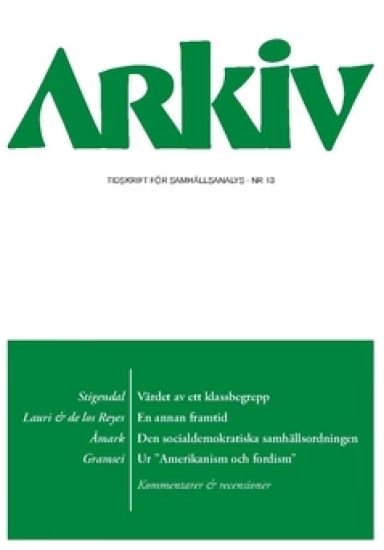
Arkiv. Tidskrift för samhällsanalys samlar samhällsvetenskaplig och historisk forskning från Sverige och världen. Alla artiklar finns fritt tillgängliga, gratis att läsa och ladda ned, på www.tidskriftenarkiv.se. För dem som hellre vill läsa mellan två pärmar tillhandahåller vi den här tryckta utgåvan. I detta nummer: Redaktionen, ”Inbjudan till dialog och diskussion om klass” Mikael Stigendal, ”Värdet av ett klassbegrepp” Marcus Lauri & Paulina de los Reyes, ”Vad hände sen? Våld, trygghet och tankar om en annan framtid efter oroligheterna i Husby 2013” Klas Åmark, ”Den socialdemokratiska samhällsordningen” Antonio Gramsci, ”Två anteckningar ur ’Amerikanism och fordism’” Kommentarer: Anders Stephanson, ”En sorts bildningsroman” Bo Rothstein, ”Avvecklingens politiska logik. Brittiska gruvor och svenska varv” Christian Andersson, ”Nordafrika efter de folkliga revolterna – tillbaka till ordningen!” Recensioner: Sarah Schulman, ”Förlorarnas lott” Anders Björnsson, ”Ubåtskrigets magnum opus?” Jonny Hjelm, ”Tegelsten nummer två”
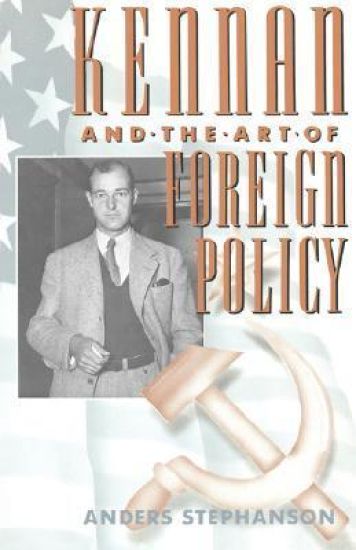
“In the annals of American diplomacy, the presence of George F. Kennan stands tall and daunting, a figure of articulate intelligence who thought about the action but also beyond it. He was not always a great diplomat, for his imagination was lively, and he lacked the self-effacing patience which is so essential to the profession at its most mundane; but he was a great analyst and policymaker, one of the very few this country has produced in foreign affairs, perhaps finest since John Quincy Adams.” Thus begins Anders Stephanson's penetrating study of this complicated, often controversial, yet highly respected public man. From an array of intellectual reference points, Stephanson has written what is not only the most serious assessment of Kennan to appear but is also a work of general significance for a wide range of contemporary issues in foreign and domestic politics and culture. Appropriately, the book's emphasis is on Kennan's lifelong attempt to grasp Soviet foreign policy and devise an effective American response, particularly during the decisive period around the Second World War when the contours of our present world order gradually emerged: the period of wartime alliance with the Soviet Union, the ensuing “containment” policies and division of Europe and much of the world into hostile blocs. Stephanson also examines Kennan's strategic vision, his “realistic” approach to foreign policy, and his disdain for the Third World. An extended final section, “Class and Country,” then situates Kennan as an essentially European kind of “organicist” conservative with no obvious political home in American society, a society manifestly unorganic in all its mobility and mass culture. An outsider without class attachment, he could never reconcile his dislike of American politics and culture with his attachment to values of order and hierarchy. These warring sensibilities produced, for example, vehement denunciations of McCarthyism as well as of the student revolts of the following decade. Yet it was Kennan's marginality, his functional detachment from domestic politics, that made possible his often clairvoyant analyses of foreign affairs. Stephanson's work is an unusually broad and deep characterization of a reflective, sometimes enigmatic but always outstanding American policymaker and man of letters.