Kirjojen hintavertailu – 12 903 735 kirjaa ja 27 kauppaa

Kirjailija

André Bächtiger

Kirjat ja teokset yhdessä paikassa: 5 kirjaa, julkaisuja vuosilta 2005–2024, suosituimpiin kuuluu Mapping and Measuring Deliberation. Vertaile teosten hintoja ja tarkista saatavuus suomalaisista kirjakaupoista.

Nimi esiintyy myös muodoissa: Andre Bachtiger

5 kirjaa

Kirjojen julkaisuvuodet: 2005–2024.

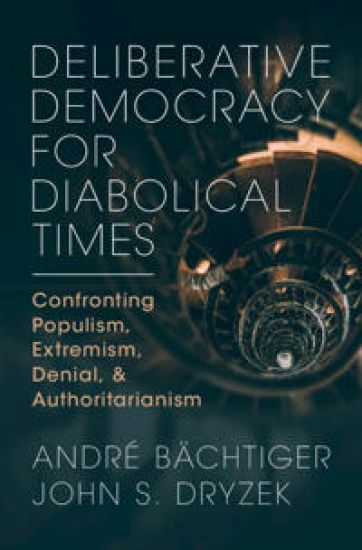
Deliberative Democracy for Diabolical Times

Deliberative Democracy for Diabolical Times

André Bächtiger; John S. Dryzek

Cambridge University Press
2024
pokkari
Democracy today faces deep and complex challenges, especially when it comes to political communication and the quality of public discourse. Dishonest and manipulative communication amplified by unscrupulous politicians and media pervades these diabolical times, enabling right-wing populism, extremism, truth denial, and authoritarianism to flourish. To tackle these issues, we need to encourage meaningful deliberative communication – creating spaces for reflective and constructive dialogue, repairing unhealthy public spheres while preserving healthier ones, and building discursive bridges across deep divides. Citizens who see through elite manipulations should be at the core of this response, especially if bad elite behavior is to be effectively constrained. Democratic activists and leaders, diverse interpersonal networks, resilient public spheres, deliberative innovations and clever communication strategies all have vital roles to play in both defending and renewing democracy. Healthy discursive infrastructures can make democracies work again.
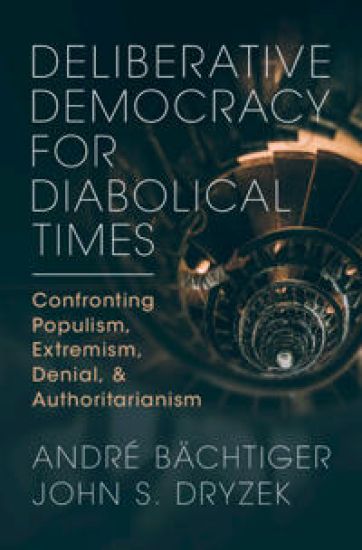
Deliberative Democracy for Diabolical Times

Deliberative Democracy for Diabolical Times

André Bächtiger; John S. Dryzek

Cambridge University Press
2024
sidottu
Democracy today faces deep and complex challenges, especially when it comes to political communication and the quality of public discourse. Dishonest and manipulative communication amplified by unscrupulous politicians and media pervades these diabolical times, enabling right-wing populism, extremism, truth denial, and authoritarianism to flourish. To tackle these issues, we need to encourage meaningful deliberative communication – creating spaces for reflective and constructive dialogue, repairing unhealthy public spheres while preserving healthier ones, and building discursive bridges across deep divides. Citizens who see through elite manipulations should be at the core of this response, especially if bad elite behavior is to be effectively constrained. Democratic activists and leaders, diverse interpersonal networks, resilient public spheres, deliberative innovations and clever communication strategies all have vital roles to play in both defending and renewing democracy. Healthy discursive infrastructures can make democracies work again.

Mapping and Measuring Deliberation

Mapping and Measuring Deliberation

Andre Bachtiger; John Parkinson

Oxford University Press
2019
sidottu
Deliberative democracy has challenged two widely-accepted nostrums about democratic politics: that people lack the capacities for effective self-government; and that democratic procedures are arbitrary and do not reflect popular will; indeed, that the idea of popular will is itself illusory. On the contrary, deliberative democrats have shown that people are capable of being sophisticated, creative problem solvers, given the right opportunities in the right kinds of democratic institutions. But deliberative empirical research has its own problems. In this book two leading deliberative scholars review decades of that research and reveal three important issues. First, the concept 'deliberation' has been inflated so much as to lose empirical bite; second, deliberation has been equated with entire processes of which it is just one feature; and third, such processes are confused with democracy in a deliberative mode more generally. In other words, studies frequently apply micro-level tools and concepts to make macro- and meso-level judgements, and vice versa. Instead, Bächtiger and Parkinson argue that deliberation must be understood as contingent, performative, and distributed. They argue that deliberation needs to be disentangled from other communicative modes; that appropriate tools need to be deployed at the right level of analysis; and that scholars need to be clear about whether they are making additive judgements or summative ones. They then apply that understanding to set out a new agenda and new empirical tools for deliberative empirical scholarship at the micro, meso, and macro levels.
Deliberative Politics in Action

Deliberative Politics in Action

Jürg Steiner; André Bächtiger; Markus Spörndli; Marco R. Steenbergen

Cambridge University Press
2005
sidottu
‘Deliberative politics’ refers to the role of conversation and arguments in politics. Until recently discussion of deliberative politics took place almost exclusively among political philosophers, but many questions raised in this philosophical discussion cry out for empirical investigation. This book provides the first extended empirical study of deliberative politics, addressing, in particular, questions of the preconditions and consequences of high level deliberation. Using parliamentary debates in Germany, Switzerland, the United Kingdom and the United States as an empirical base, the authors measure the level of deliberation by constructing a ‘Discourse Quality Index’. As deliberative politics moves to the forefront of political theory, this book makes an important contribution to deliberative democracy.
Deliberative Politics in Action

Deliberative Politics in Action

Jürg Steiner; André Bächtiger; Markus Spörndli; Marco R. Steenbergen

Cambridge University Press
2005
pokkari
‘Deliberative politics’ refers to the role of conversation and arguments in politics. Until recently discussion of deliberative politics took place almost exclusively among political philosophers, but many questions raised in this philosophical discussion cry out for empirical investigation. This book provides the first extended empirical study of deliberative politics, addressing, in particular, questions of the preconditions and consequences of high level deliberation. Using parliamentary debates in Germany, Switzerland, the United Kingdom and the United States as an empirical base, the authors measure the level of deliberation by constructing a ‘Discourse Quality Index’. As deliberative politics moves to the forefront of political theory, this book makes an important contribution to deliberative democracy.