Kirjojen hintavertailu – 12 903 725 kirjaa ja 27 kauppaa

Kirjailija

André Orléan

Kirjat ja teokset yhdessä paikassa: 5 kirjaa, julkaisuja vuosilta 1998–2023, suosituimpiin kuuluu Currencies: Between Violence and Trust / La Monnaie: entre violence et confiance. Vertaile teosten hintoja ja tarkista saatavuus suomalaisista kirjakaupoista.

Nimi esiintyy myös muodoissa: Andre Orlean

5 kirjaa

Kirjojen julkaisuvuodet: 1998–2023.

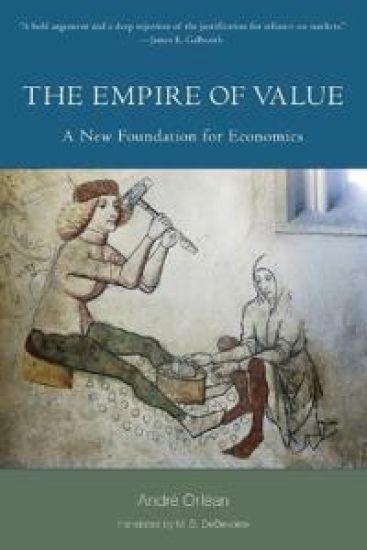
The Empire of Value

The Empire of Value

Andre Orlean

MIT PRESS LTD
2023
pokkari
An argument that conceiving of economic value as a social force makes it possible to develop a new and more powerful theory of market behavior. With the advent of the 2007-2008 financial crisis, the economics profession itself entered into a crisis of legitimacy from which it has yet to emerge. Despite the obviousness of their failures, however, economists continue to rely on the same methods and to proceed from the same underlying assumptions. Andr Orl an challenges the neoclassical paradigm in this book, with a new way of thinking about perhaps its most fundamental concept, economic value. Orl an argues that value is not bound up with labor, or utility, or any other property that preexists market exchange. Economic value, he contends, is a social force whose vast sphere of influence, amounting to a kind of empire, extends to every aspect of economic life. Markets are based on the identification of value with money, and exchange value can only be regarded as a social institution. Financial markets, for example, instead of defining an extrinsic, objective value for securities, act as a mechanism for arriving at a reference price that will be accepted by all investors. What economists must therefore study, Orl an urges, is the hold that value has over individuals and how it shapes their perceptions and behavior. Awarded the prestigious Prix Paul Ricoeur on its original publication in France in 2011, The Empire of Value has been substantially revised and enlarged for this edition, with an entirely new section discussing the financial crisis of 2007-2008.
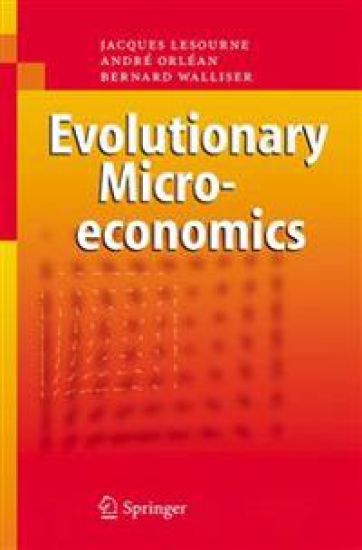
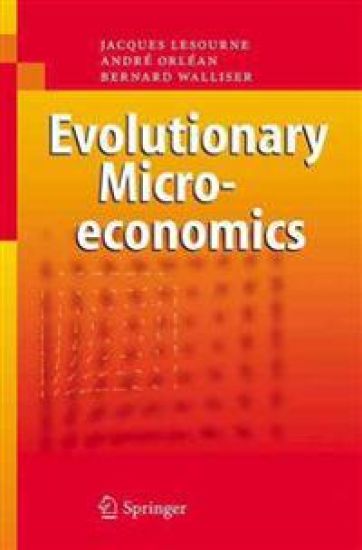
Evolutionary Microeconomics

Evolutionary Microeconomics

Jacques Lesourne; André Orléan; Bernard Walliser

Springer-Verlag Berlin and Heidelberg GmbH Co. K
2010
nidottu
Classical microeconomics is intended to explain how a price system is able to coordinate the economic agents. But even if it can be extended to incomplete information and externalities, it remains grounded on very heroic assumptions. Agents are endowed with a very strong rationality, equilibrium is stated without a concrete process to achieve it, market is the unique institution considered. Evolutionary microeconomics is aimed at bypassing these limitations by considering a dynamic approach, however not biologically oriented. Agents have local information and bounded rationality, they are involved in explicit processes of interactions through time, various institutions sustain the market or substitute to it. It explains then some phenomena hardly explained by classical microeconomics: dispersion of prices, variety of industrial structures, financial bubbles.
Evolutionary Microeconomics

Evolutionary Microeconomics

Jacques Lesourne; André Orléan; Bernard Walliser

Springer-Verlag Berlin and Heidelberg GmbH Co. K
2006
sidottu
Classical microeconomics is intended to explain how a price system is able to coordinate the economic agents. But even if it can be extended to incomplete information and externalities, it remains grounded on very heroic assumptions. Agents are endowed with a very strong rationality, equilibrium is stated without a concrete process to achieve it, market is the unique institution considered. Evolutionary microeconomics is aimed at bypassing these limitations by considering a dynamic approach, however not biologically oriented. Agents have local information and bounded rationality, they are involved in explicit processes of interactions through time, various institutions sustain the market or substitute to it. It explains then some phenomena hardly explained by classical microeconomics: dispersion of prices, variety of industrial structures, financial bubbles.
Currencies: Between Violence and Trust / La Monnaie: entre violence et confiance
Europeans'infatuation with their new currency is in sharp contrast with the despair experienced by Argentineans who have been ruined as a consequence of parity between their currency and the U. S. dollar. Orthodox economic theory does not take currency into account. It either ignores it, in order to carry out investigations in real terms, or treats it as though it were a neutral factor and implements policies that maintain it in this role. In the present book, Michel Aglietta and Andr Orl an, leaders of the heterodox economic school known as 'regulatory', set out to show how, on the contrary, currencies are at the heart of most economic relations, from the simplest (exchanges between two agents) to the most complex (international financial relations). Combining Marx and Girard, they analyse currency and its numerous properties. Currency acts as an intermediary in exchanges, it serves as a means of conserving wealth and helps to socialise economic behaviour through imitation. Not content with abstract analysis ' which would not explain the economic phenomena presented by history and day-to-day life ' the authors have applied their analytical tools in an effort to understand modern and contemporary monetary crises. They have also applied these tools to explaining the innovation represented by the euro. Michel Aglietta teaches at the University of Paris X-Nanterre. He is a member of the Institut de France and of the French Prime Minister's Economic Council. Andr Orl an is a head of research at the Centre National de la Recherche Scientifique.
A Sovereign Currency / La Monnaie souveraine

A Sovereign Currency / La Monnaie souveraine

Michel Aglietta; André Orléan

Odile Jacob
1998
nidottu
The result of many years of work between economists, historians, anthropologists and psychoanalysts, this book shows how money is the cement of societies--the most archaic as well as the most contemporary. Money reigns not only over horizontal relationships between iedividuals, but also over the vertical relationships between iedividuals and the State. This analysis entirely changes our conception of money, and makes us better understand the outpouring of emotion at the passage of the Euro, which opened questions of national sovereignty and of the legitimacy of new financial institutions. Michel Aglietta is an economics professor at Nanterre, and member of the Prime Minister's Council on Economic Analysis. Andr ; Orl an is the Research Director at the CNRS.