Kirjojen hintavertailu – 12 859 818 kirjaa ja 27 kauppaa

Kirjailija

Andreas Bergh

Kirjat ja teokset yhdessä paikassa: 29 kirjaa, julkaisuja vuosilta 2008–2026, suosituimpiin kuuluu Tillit och omdöme - Perspektiv på tillitsbaserad styrning. Vertaile teosten hintoja ja tarkista saatavuus suomalaisista kirjakaupoista.

29 kirjaa

Kirjojen julkaisuvuodet: 2008–2026.

Utvärdering och bedömning i skolan : för vem och varför?

Utvärdering och bedömning i skolan : för vem och varför?

Agneta Hult; Anders Olofsson; Lisa Asp-Onsjö; Andreas Bergh; Hanna Eklöf; Ulf Fredriksson; Lisbeth Gyllander Torkildsen; Anders Jönsson; K G Karlsson; Tord Göran Olovsson; Magnus Oskarsson; Per-Åke Rosvall; Linda Rönnberg; Christina Segerholm; Christina Wikström

Natur Kultur Läromedel och Akademi
2017
nidottu
Utvärdering och bedömning i skolan kommer nu i en reviderad andra utgåva med flera nya aktuella kapitel och uppgifter. Bland annat har boken uppdaterats med kapitel om införandet av betyg i årskurs 6, PISA-undersökningarna, elevinflytande och systematiskt kvalitetsarbete. Antologin är skriven av 15 lärarutbildare och forskare som ger läsaren en både nationell och internationell bild av utvärdering och bedömning. Boken har även ett samhälleligt perspektiv och ger såväl teoretiska kunskaper som användbara strategier. Boken riktar sig främst till lärarstuderande och verksamma lärare och ger en god grund att stå på i arbetet med pedagogisk utvärdering och bedömning i skolan, klassrummet och av eleverna.
Sweden and the Revival of the Capitalist Welfare State

Sweden and the Revival of the Capitalist Welfare State

Andreas Bergh

Edward Elgar Publishing Ltd
2016
nidottu
For some, Sweden is proof that a generous welfare state is fully compatible with a growing competitive economy. For others, it is a frightening example of what big government can do to a once thriving economy. Sweden and the Revival of the Capitalist Welfare State tackles a number of controversial questions regarding Sweden's economic and political development: How did Sweden become rich? How did Sweden become egalitarian? Why has Sweden since the early 90s grown faster than the US and most EU-countries despite its high taxes and generous welfare state? The author uses new research on institutions and economic reforms to explain the rise, the fall and the recent revival of the Swedish welfare state. The central argument is that a generous welfare state like that of Sweden can work well, provided that it is built on well-functioning capitalist institutions and economic openness. The book expertly explains how Sweden developed from a poor and highly unequal society to one of the richest and most egalitarian countries in the world by building a universal welfare state on a capitalist foundation. It also engages in an important discussion about the current and future challenges for the welfare state in general. The book will fit well in introductory and advanced courses on welfare state policy, social work, sociology, economic history, institutional economics and political science. In all these disciplines, the case of Sweden has always provoked interest and debate, due to Sweden's combination of prosperity, equality and extensive welfare state. The rapid pace of change in Sweden over the last 25 years, however, means that most other books are descriptively dated.
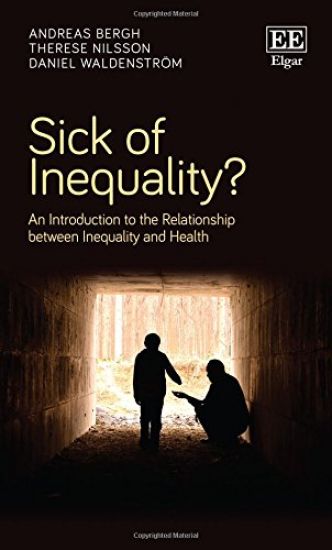
Sick of Inequality?

Sick of Inequality?

Andreas Bergh; Therese Nilsson; Daniel Waldenström

Edward Elgar Publishing Ltd
2016
sidottu
There is a clear trend in rich countries that, despite rising incomes and living standards, the gap between rich and poor is widening. What does this mean for our health? Does increasing income inequality affect outcomes such as obesity, life expectancy and subjective well-being? Are rich and poor groups affected in the same ways? This book reviews the latest research on the relationship between inequality and health, and provides a pedagogical introduction to the tools and knowledge needed to understand and assess the vast literature on the subject. The book includes discussion of the definitions and measurement of objective and subjective health and income inequality, and illustrates how various measures have been developed in different countries. Main conclusions from the literature are then summarized and discussed critically. It incorporates a substantial research overview of the field, as well as a detailed debate of the empirical challenges that arise during research. The book concludes that results are surprisingly contradictory, but that several studies have found that higher inequality is directly linked to lower subjective well-being. Students and scholars in public health, social work, economics, and sociology will find this book an essential exposition of conceptual issues and empirical methods applied to the controversial topic of the health consequences of inequality.
A Clean House? : studies of corruption in Sweden

A Clean House? : studies of corruption in Sweden

Andreas Bergh; Gissur Ó. Erlingsson; Mats Sjölin; Richard Öhrvall

Nordic Academic Press
2016
sidottu
Enligt så gott som alla internationella rankningslistor över korruption är Sverige bland de minst korrupta länderna i världen, med få avslöjade fall. Men innebär det att det svenska samhället inte alls är drabbat? Författarna till A Clean House? kastar med sin bok ljus över en ljusskygg verksamhet. Deras studie kombinerar aktuell forskning och egna empiriska undersökningar. Vad vet vi om korruption i Sverige, och vad kan sägas om utvecklingen över tid? Bokens författare, med bakgrund i samhällsvetenskap och ekonomi, visar hur länder som ses som okorrupta kan ha specifika problem som inte bör underskattas eller ignoreras. Detta är den första djupgående studien på engelska av korruption i ett lågkorrupt, utvecklat välfärdsland. Genom att peka på orsaker, händelseförlopp och konsekvenser av korruption i lågkorrupta länder identifierar författarna faktorer som saknas i internationella undersökningar av korruption. De föreslår konstruktiva reformer som kan motverka de typer av korruption som förekommer i "hälsosamma" samhällen.
Skola för kunskap, valfrihet och trygghet?

Skola för kunskap, valfrihet och trygghet?

Håkan Andersson; Göte Appelberg; Lars Bejstam; Andreas Bergh; Hans Eklund; Anna Gustafsson; Johanna Ringarp

Iustus
2016
sidottu
Institutet för utbildningsrätt , IfU, höll i november 2014 en endagskonferens på temat Skola för kunskap, valfrihet och trygghet?. Föreliggande antologi är i huvudsak sprungen ur forskningsidéer som presenterades på konferensen. IfU har till syfte att på bredast möjliga sätt inspirera till och stödja forskning och utbildning inom det utbildningsrättsliga området i Sverige. Målet är att Uppsala universitet ska bli det viktigaste utbildningsrättsliga centret i Sverige. Denna antologi är tänkt som den första skriften i en skriftserie från IfU.
Utbildning, makt och politik

Utbildning, makt och politik

Sverker Lindblad; Lisbeth Lundahl; Andreas Bergh; Annika Bergviken Rensfeldt; Maria Blomgren; Susanne Dodillet; Rita Foss Lindblad; Michael Hansen; Martin Harling; Ingrid Henning Loeb; Elsi-Brith Jodal; John Benedicto Krejsler; Karin Lumsden Wass; Ulf Lundström; Ulf Olsson; Kenneth Petersson; Daniel Pettersson; Olof Reichenberg; Caroline Runesdotter; Linda Rönnberg; Pia Skott; Caroline Waks; Gun-Britt Wärvik

Studentlitteratur AB
2015
nidottu
Att analysera makt och inflytande är viktigt för att förstå utbildningens villkor och uppgifter i samhället. Med hjälp av sådana analyser kan man förklara varför pedagogiska verksamheter ser ut som de gör och vad som ligger bakom framgångar och misslyckanden. Det är särskilt viktigt att visa på de situationer där maktutövande leder till segregering, diskriminering eller favori­sering inom skolans värld. Utbildning – makt och politik belyser en rad aktuella frågor om utbildningspolitik och maktutövning inom utbildningsområdet. Bland annat behandlas frågor om profession och politik, betydelser av marknadstänkande och konkurrens i skolans värld, och innebörden av internationella jämförelser för utbildningspolitiken. Boken riktar sig till högskolestudenter, till exempel på lärarutbildningarna, och andra som intresserar sig för dessa frågor.
Sweden and the Revival of the Capitalist Welfare State

Sweden and the Revival of the Capitalist Welfare State

Andreas Bergh

Edward Elgar Publishing Ltd
2014
sidottu
For some, Sweden is proof that a generous welfare state is fully compatible with a growing competitive economy. For others, it is a frightening example of what big government can do to a once thriving economy. Sweden and the Revival of the Capitalist Welfare State tackles a number of controversial questions regarding Sweden's economic and political development: How did Sweden become rich? How did Sweden become egalitarian? Why has Sweden since the early 90s grown faster than the US and most EU-countries despite its high taxes and generous welfare state? The author uses new research on institutions and economic reforms to explain the rise, the fall and the recent revival of the Swedish welfare state. The central argument is that a generous welfare state like that of Sweden can work well, provided that it is built on well-functioning capitalist institutions and economic openness. The book expertly explains how Sweden developed from a poor and highly unequal society to one of the richest and most egalitarian countries in the world by building a universal welfare state on a capitalist foundation. It also engages in an important discussion about the current and future challenges for the welfare state in general. The book will fit well in introductory and advanced courses on welfare state policy, social work, sociology, economic history, institutional economics and political science. In all these disciplines, the case of Sweden has always provoked interest and debate, due to Sweden's combination of prosperity, equality and extensive welfare state. The rapid pace of change in Sweden over the last 25 years, however, means that most other books are descriptively dated.
En bit på väg

En bit på väg

Bengt Westerberg; Johan Norberg; Frida Johansson Metso; Andreas Bergh; Susanna Birgersson; Pontus Braunerhjelm; Karin Zelano; Hans L Zetterberg; Emma Söderberg Majanen; Johan E. Eklund; Nina Larsson; Håkan Tribell; Martina Lind; Lennart Nordfors

Bertil Ohlin Förlag
2013
nidottu
Har liberalismen segrat ihjäl sig? Det råder ingen tvekan om att Sverige förändrats kraftigt i liberal riktning de senaste årtiondena. De flesta skulle nog också hålla med om att förändringarna gick snabbast i slutet av 1980-talet och början av 1990-talet. Men hur ser framtiden ut? Är liberaliseringarnas epok till ända? Har liberalismen gjort sitt och andra idéströmningar tagit över? I En bit på väg skriver fjorton liberalt sinnade skribenter om framtiden och de utmaningar som liberalismen står inför i dag: Hur hanterar liberaler klimathotet? Hur human är Sveriges asyl- politik? Finns det något kvar att avreglera? Har de nuvarande riksdagspartierna vad som krävs för nya liberala reformer? Redaktörer är Andreas Bergh och Gabriel Ehrling. Antologin är framtagen av Bertil Ohlininstitutet och Liberala ekonomklubben i samverkan.
Government Size and Implications for Economic Growth

Government Size and Implications for Economic Growth

Andreas Bergh; Magnus Henrekson

AEI Press
2010
nidottu
As economists and policymakers strive to understand the causes of the global financial crisis, pinpointing the relationship between government size and economic growth is crucial. In this incisive economic study, Andreas Bergh and Magnus Henrekson find that in wealthy countries, where government size is measured as total taxes or total expenditure relative to GDP, there is a strong negative correlation between government size and economic growth-where government size increases by 10 percentage points, annual growth rates decrease by 0.5 to 1 percent. Bergh and Henrekson stress that statistical correlations, even when highly significant, are not law. Some countries with high taxes enjoy above-average growth, and some countries with small governments have stagnant economies. The Scandinavian welfare states, for example, have enjoyed steady growth over the last decade despite their large governments. However, these nations compensate for high taxes by employing market-friendly policies in other areas, such as trade openness and inflation control. Government Size and Economic Growth concludes that, in every case, economic freedom is a crucial determinant of economic growth_suggesting that government intervention in the marketplace may be the wrong approach to solving the economic crisis.