Kirjojen hintavertailu – 12 903 725 kirjaa ja 27 kauppaa

Kirjailija

Andreas Öchsner

Kirjat ja teokset yhdessä paikassa: 90 kirjaa, julkaisuja vuosilta 2011–2026, suosituimpiin kuuluu Progettazione di strutture leggere. Vertaile teosten hintoja ja tarkista saatavuus suomalaisista kirjakaupoista.

90 kirjaa

Kirjojen julkaisuvuodet: 2011–2026.

A Review on Dental Materials

A Review on Dental Materials

Hamid Reza Rezaie; Hassan Beigi Rizi; Mojdeh Mahdi Rezaei Khamseh; Andreas Öchsner

Springer Nature Switzerland AG
2021
nidottu
This book discusses the current biomaterials used for dental applications and the basic sciences underpinning their application. The most critical structures in the oral cavity are the teeth, which play a central role in speaking, biting, chewing, tasting and swallowing. Teeth consist of three types of tissue: the cementum, enamel and dentin, with bone and gingival tissue serving as supporting structures. Caries, tooth wear, trauma and mechanical defects can lead to severe facial conditions; however, correcting these defects remains a challenge for scientists and dentists. Presenting insights form a broad range of disciplines, including materials science, biology, physiology and clinical science, this book provides a timely review of the principles, processing and application of dental materials.
Classical Beam Theories of Structural Mechanics

Classical Beam Theories of Structural Mechanics

Andreas Öchsner

Springer Nature Switzerland AG
2021
sidottu
This book provides a systematic and thorough overview of the classical bending members based on the theory for thin beams (shear-rigid) according to Euler-Bernoulli, and the theories for thick beams (shear-flexible) according to Timoshenko and Levinson. The understanding of basic, i.e., one-dimensional structural members, is essential in applied mechanics. A systematic and thorough introduction to the theoretical concepts for one-dimensional members keeps the requirements on engineering mathematics quite low, and allows for a simpler transfer to higher-order structural members. The new approach in this textbook is that it treats single-plane bending in the x-y plane as well in the x-z plane equivalently and applies them to the case of unsymmetrical bending. The fundamental understanding of these one-dimensional members allows a simpler understanding of thin and thick plate bending members. Partial differential equations lay the foundation to mathematically describe the mechanical behavior of all classical structural members known in engineering mechanics. Based on the three basic equations of continuum mechanics, i.e., the kinematics relationship, the constitutive law, and the equilibrium equation, these partial differential equations that describe the physical problem can be derived. Nevertheless, the fundamental knowledge from the first years of engineering education, i.e., higher mathematics, physics, materials science, applied mechanics, design, and programming skills, might be required to master this topic.
Numerical Engineering Optimization

Numerical Engineering Optimization

Andreas Öchsner; Resam Makvandi

Springer Nature Switzerland AG
2021
nidottu
This study aid on numerical optimization techniques is intended for university undergraduate and postgraduate mechanical engineering students. Optimization procedures are becoming more and more important for lightweight design, where weight reduction can, for example in the case of automotive or aerospace industry, lead to lower fuel consumption and a corresponding reduction in operational costs as well as beneficial effects on the environment. Based on the free computer algebra system Maxima, the authors present procedures for numerically solving problems in engineering mathematics as well as applications taken from traditional courses on the strength of materials. The mechanical theories focus on the typical one-dimensional structural elements, i.e., springs, bars, and Euler–Bernoulli beams, in order to reduce the complexity of the numerical framework and limit the resulting design to a low number of variables. The use of a computer algebra system and the incorporated functions, e.g., for derivatives or equation solving, allows a greater focus on the methodology of the optimization methods and not on standard procedures. The book also provides numerous examples, including some that can be solved using a graphical approach to help readers gain a better understanding of the computer implementation.
Structural Mechanics with a Pen

Structural Mechanics with a Pen

Andreas Öchsner

Springer Nature Switzerland AG
2021
sidottu
This book is focused on the introduction of the finite difference method based on the classical one-dimensional structural members, i.e., rods/bars and beams. It is the goal to provide a first introduction to the manifold aspects of the finite difference method and to enable the reader to get a methodical understanding of important subject areas in structural mechanics. The reader learns to understand the assumptions and derivations of different structural members. Furthermore, she/he learns to critically evaluate possibilities and limitations of the finite difference method. Additional comprehensive mathematical descriptions, which solely result from advanced illustrations for two- or three-dimensional problems, are omitted. Hence, the mathematical description largely remains simple and clear.
Distribution Theory Applied to Differential Equations

Distribution Theory Applied to Differential Equations

Adina Chirila; Marin Marin; Andreas Öchsner

Springer Nature Switzerland AG
2021
sidottu
This book presents important contributions to modern theories concerning the distribution theory applied to convex analysis (convex functions, functions of lower semicontinuity, the subdifferential of a convex function). The authors prove several basic results in distribution theory and present ordinary differential equations and partial differential equations by providing generalized solutions. In addition, the book deals with Sobolev spaces, which presents aspects related to variation problems, such as the Stokes system, the elasticity system and the plate equation. The authors also include approximate formulations of variation problems, such as the Galerkin method or the finite element method. The book is accessible to all scientists, and it is especially useful for those who use mathematics to solve engineering and physics problems. The authors have avoided concepts and results contained in other books in order to keep the book comprehensive. Furthermore, they do not present concrete simplified models and pay maximal attention to scientific rigor.
Computational Statics and Dynamics

Computational Statics and Dynamics

Andreas Öchsner

Springer Verlag, Singapore
2021
nidottu
This book is the 2nd edition of an introduction to modern computational mechanics based on the finite element method. It includes more details on the theory, more exercises, and more consistent notation; in addition, all pictures have been revised. Featuring more than 100 pages of new material, the new edition will help students succeed in mechanics courses by showing them how to apply the fundamental knowledge they gained in the first years of their engineering education to more advanced topics. In order to deepen readers’ understanding of the equations and theories discussed, each chapter also includes supplementary problems. These problems start with fundamental knowledge questions on the theory presented in the respective chapter, followed by calculation problems. In total, over 80 such calculation problems are provided, along with brief solutions for each. This book is especially designed to meet the needs of Australian students, reviewing the mathematicscovered in their first two years at university. The 13-week course comprises three hours of lectures and two hours of tutorials per week.
A Project-Based Introduction to Computational Statics

A Project-Based Introduction to Computational Statics

Andreas Öchsner

Springer Nature Switzerland AG
2020
sidottu
This book uses a novel concept to teach the finite element method, applying it to solid mechanics. This major conceptual shift takes away lengthy theoretical derivations in the face-to-face interactions with students and focuses on the summary of key equations and concepts; and to practice these on well-chosen example problems. For this new, 2nd edition, many examples and design modifications have been added, so that the learning-by-doing features of this book make it easier to understand the concepts and put them into practice. The theoretical derivations are provided as additional reading and students must study and review the derivations in a self-study approach. The book provides the theoretical foundations to solve a comprehensive design project in tensile testing. A classical clip-on extensometer serves as the demonstrator on which to apply the provided concepts. The major goal is to derive the calibration curve based on different approaches, i.e., analytical mechanics and based on the finite element method, and to consider further design questions such as technical drawings, manufacturing, and cost assessment. Working with two concepts, i.e., analytical and computational mechanics strengthens the vertical integration of knowledge and allows the student to compare and understand the different concepts, as well as highlighting the essential need for benchmarking any numerical result.
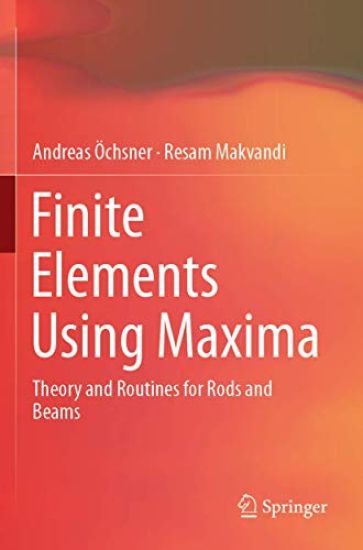
Finite Elements Using Maxima

Finite Elements Using Maxima

Andreas Öchsner; Resam Makvandi

Springer Nature Switzerland AG
2020
nidottu
This book provides a study aid on the finite element method. Based on the free computer algebra system “Maxima”, it presents routines to symbolically or numerically solve problems in the context of plane truss and frame structures. This allows readers to not only check classical “hand calculations” but also understand the computer implementation of the method. The mechanical theories focus on the classical one-dimensional structural elements, i.e. bars, Euler–Bernoulli and Timoshenko beams as well as their combination to generalized beam elements. Focusing on one-dimensional elements reduces the complexity of the mathematical framework and the resulting matrix equations can still be displayed with all components, and not only in a symbolic representation. The use of a computer algebra system and the incorporated functions, e.g. for equation solving, highlights the methodology of the finite element method rather than standard procedures. The book is based on the Springer Brief “Finite Elements for Truss and Frame Structures” (978-3-319-94940-6) by the same authors.
A Review on Dental Materials

A Review on Dental Materials

Hamid Reza Rezaie; Hassan Beigi Rizi; Mojdeh Mahdi Rezaei Khamseh; Andreas Öchsner

Springer Nature Switzerland AG
2020
sidottu
This book discusses the current biomaterials used for dental applications and the basic sciences underpinning their application. The most critical structures in the oral cavity are the teeth, which play a central role in speaking, biting, chewing, tasting and swallowing. Teeth consist of three types of tissue: the cementum, enamel and dentin, with bone and gingival tissue serving as supporting structures. Caries, tooth wear, trauma and mechanical defects can lead to severe facial conditions; however, correcting these defects remains a challenge for scientists and dentists. Presenting insights form a broad range of disciplines, including materials science, biology, physiology and clinical science, this book provides a timely review of the principles, processing and application of dental materials.
Numerical Engineering Optimization

Numerical Engineering Optimization

Andreas Öchsner; Resam Makvandi

Springer Nature Switzerland AG
2020
sidottu
This study aid on numerical optimization techniques is intended for university undergraduate and postgraduate mechanical engineering students. Optimization procedures are becoming more and more important for lightweight design, where weight reduction can, for example in the case of automotive or aerospace industry, lead to lower fuel consumption and a corresponding reduction in operational costs as well as beneficial effects on the environment. Based on the free computer algebra system Maxima, the authors present procedures for numerically solving problems in engineering mathematics as well as applications taken from traditional courses on the strength of materials. The mechanical theories focus on the typical one-dimensional structural elements, i.e., springs, bars, and Euler–Bernoulli beams, in order to reduce the complexity of the numerical framework and limit the resulting design to a low number of variables. The use of a computer algebra system and the incorporated functions, e.g., for derivatives or equation solving, allows a greater focus on the methodology of the optimization methods and not on standard procedures. The book also provides numerous examples, including some that can be solved using a graphical approach to help readers gain a better understanding of the computer implementation.
Eindimensionale Finite Elemente

Eindimensionale Finite Elemente

Markus Merkel; Andreas Öchsner

Springer-Verlag Berlin and Heidelberg GmbH Co. K
2020
nidottu
Der Grundgedanke dieser Einführung in die Methode der Finiten Elemente wird von dem Konzept getragen, die komplexe Methode nur anhand eindimensionaler Elemente zu erläutern. Somit bleibt die mathematische Beschreibung weitgehend einfach und überschaubar. Das Augenmerk liegt in jedem Kapitel auf der Erläuterung der Methode und deren Verständnis selbst. Der Leser lernt die Annahmen und Ableitungen bei verschiedenen physikalischen Problemstellungen in der Strukturmechanik zu verstehen und Möglichkeiten und Grenzen der Methode der Finiten Elemente kritisch zu beurteilen. Die Beschränkung auf eindimensionale Elemente ermöglicht somit das methodische Verständnis wichtiger Themenbereiche (z. B. Plastizität oder Verbundwerkstoffe), die einem angehenden Berechnungsingenieur in der Berufspraxis begegnen, jedoch in dieser Form nur selten an Hochschulen behandelt werden. Somit ist ein einfacher Einstieg – auch in weiterführende Anwendungsgebiete – durch das Konzept (a) Einführung in die Grundlagen (b) exakte Ableitung bei Beschränkung auf eindimensionale Elemente (und in vielen Fällen auch auf eindimensionale Probleme) (c) Umfangreiche Beispiele und weiterführende Aufgaben (mit Kurzlösung im Anhang) gewährleistet. Zur Veranschaulichung wird jedes Kapitel sowohl mit ausführlich durchgerechneten und kommentierten Beispielen als auch mit weiterführenden Aufgaben inklusive Kurzlösungen vertieft.
Bone Cement

Bone Cement

Hamid Reza Rezaie; Mohammad Hossein Esnaashary; Masoud Karfarma; Andreas Öchsner

Springer Nature Switzerland AG
2020
nidottu
This book provides an overview of the composition of polymeric and ceramic bone cements. It also discusses complex, biomimetic structures based on biomaterials, such as cells and bioactive molecules, which more closely resemble natural bone The first chapter describes the main concepts of the cementation process and the parameters affecting it, while the second chapter focuses on the composition and structure of candidate biomaterials. Lastly, the third and fourth chapters present recent research aimed at improving the ability of naked biomaterials to enhance bone healing by adding cells and bioactive agents.
Eigenvalue and Eigenvector Problems in Applied Mechanics

Eigenvalue and Eigenvector Problems in Applied Mechanics

Sorin Vlase; Marin Marin; Andreas Öchsner

Springer Nature Switzerland AG
2019
nidottu
This book presents, in a uniform way, several problems in applied mechanics, which are analysed using the matrix theory and the properties of eigenvalues and eigenvectors. It reveals that various problems and studies in mechanical engineering produce certain patterns that can be treated in a similar way. Accordingly, the same mathematical apparatus allows us to study not only mathematical structures such as quadratic forms, but also mechanics problems such as multibody rigid mechanics, continuum mechanics, vibrations, elastic and dynamic stability, and dynamic systems. In addition, the book explores a wealth of engineering applications.
Partial Differential Equations of Classical Structural Members

Partial Differential Equations of Classical Structural Members

Andreas Öchsner

Springer Nature Switzerland AG
2019
nidottu
The derivation and understanding of Partial Differential Equations relies heavily on the fundamental knowledge of the first years of scientific education, i.e., higher mathematics, physics, materials science, applied mechanics, design, and programming skills. Thus, it is a challenging topic for prospective engineers and scientists. This volume provides a compact overview on the classical Partial Differential Equations of structural members in mechanics. It offers a formal way to uniformly describe these equations. All derivations follow a common approach: the three fundamental equations of continuum mechanics, i.e., the kinematics equation, the constitutive equation, and the equilibrium equation, are combined to construct the partial differential equations.
Complements of Higher Mathematics

Complements of Higher Mathematics

Marin Marin; Andreas Öchsner

Springer International Publishing AG
2019
nidottu
This book highlights the remarkable importance of special functions, operational calculus, and variational methods. A considerable portion of the book is dedicated to second-order partial differential equations, as they offer mathematical models of various phenomena in physics and engineering. The book provides students and researchers with essential help on key mathematical topics, which are applied to a range of practical problems. These topics were chosen because, after teaching university courses for many years, the authors have found them to be essential, especially in the contexts of technology, engineering and economics. Given the diversity topics included in the book, the presentation of each is limited to the basic notions and results of the respective mathematical domain. Chapter 1 is devoted to complex functions. Here, much emphasis is placed on the theory of holomorphic functions, which facilitate the understanding of the role that the theory of functions ofa complex variable plays in mathematical physics, especially in the modeling of plane problems. In addition, the book demonstrates the importance of the theories of special functions, operational calculus, and variational calculus. In the last chapter, the authors discuss the basic elements of one of the most modern areas of mathematics, namely the theory of optimal control.
Finite Elements Using Maxima

Finite Elements Using Maxima

Andreas Öchsner; Resam Makvandi

Springer Nature Switzerland AG
2019
sidottu
This book provides a study aid on the finite element method. Based on the free computer algebra system “Maxima”, it presents routines to symbolically or numerically solve problems in the context of plane truss and frame structures. This allows readers to not only check classical “hand calculations” but also understand the computer implementation of the method. The mechanical theories focus on the classical one-dimensional structural elements, i.e. bars, Euler–Bernoulli and Timoshenko beams as well as their combination to generalized beam elements. Focusing on one-dimensional elements reduces the complexity of the mathematical framework and the resulting matrix equations can still be displayed with all components, and not only in a symbolic representation. The use of a computer algebra system and the incorporated functions, e.g. for equation solving, highlights the methodology of the finite element method rather than standard procedures. The book is based on the Springer Brief “Finite Elements for Truss and Frame Structures” (978-3-319-94940-6) by the same authors.
Leichtbaukonzepte anhand einfacher Strukturelemente

Leichtbaukonzepte anhand einfacher Strukturelemente

Andreas Öchsner

Springer-Verlag Berlin and Heidelberg GmbH Co. K
2019
nidottu
In der Ingenieurpraxis werden in der Regel recht komplexe Systeme, auch unter der Verwendung kommerzieller Programmpakete, optimiert. Zur Einführung der unterschiedlichen Leichtbaukonzepte im Rahmen eines Hochschulingenieurstudiums kann jedoch auch zuerst auf einfache Strukturelemente, die im Rahmen der technischen Mechanik vorgestellt werden, zurückgegriffen werden. Die einfachsten Elemente sind hierbei Stäbe und Balken, die neben Federn den eindimensionalen Strukturelementen zugerechnet werden. Anhand dieser Elemente können recht anschaulich Fragestellungen zur Werkstoffauswahl und der geometrischen Gestaltung und Optimierung von lasttragenden Strukturen diskutiert werden. Somit bietet dieses Lehrbuch eine einfache und umfassende „Anleitung“ zur Anwendung der unterschiedlichen Leichtbaukonzepte, wobei der Schwerpunkt auf dem Soff- und Formleichtbau beziehungsweise der Kombination dieser beiden Konzepte liegt. Das Buch wendet sich an Studierende der Ingenieurwissenschaften.
Essentials of Partial Differential Equations

Essentials of Partial Differential Equations

Marin Marin; Andreas Öchsner

Springer Nature Switzerland AG
2019
nidottu
This book offers engineering students an introduction to the theory of partial differential equations and then guiding them through the modern problems in this subject. Divided into two parts, in the first part readers already well-acquainted with problems from the theory of differential and integral equations gain insights into the classical notions and problems, including differential operators, characteristic surfaces, Levi functions, Green’s function, and Green’s formulas. Readers are also instructed in the extended potential theory in its three forms: the volume potential, the surface single-layer potential and the surface double-layer potential. Furthermore, the book presents the main initial boundary value problems associated with elliptic, parabolic and hyperbolic equations. The second part of the book, which is addressed first and foremost to those who are already acquainted with the notions and the results from the first part, introduces readers to modern aspects ofthe theory of partial differential equations.
One-Dimensional Finite Elements

One-Dimensional Finite Elements

Andreas Öchsner; Markus Merkel

Springer Nature Switzerland AG
2018
nidottu
This textbook presents finite element methods using exclusively one-dimensional elements. It presents the complex methodology in an easily understandable but mathematically correct fashion. The approach of one-dimensional elements enables the reader to focus on the understanding of the principles of basic and advanced mechanical problems. The reader will easily understand the assumptions and limitations of mechanical modeling as well as the underlying physics without struggling with complex mathematics. Although the description is easy, it remains scientifically correct. The approach using only one-dimensional elements covers not only standard problems but allows also for advanced topics such as plasticity or the mechanics of composite materials. Many examples illustrate the concepts and problems at the end of every chapter help to familiarize with the topics. Each chapter also includes a few exercise problems, with short answers provided at the end of the book. The second edition appears with a complete revision of all figures. It also presents a complete new chapter special elements and added the thermal conduction into the analysis of rod elements. The principle of virtual work has also been introduced for the derivation of the finite-element principal equation.
Cancellous Bone

Cancellous Bone

Ardiyansyah Syahrom; Mohd Al-Fatihhi bin Mohd Szali Januddi; Muhamad Noor Harun; Andreas Öchsner

Springer Verlag, Singapore
2018
nidottu
This book provides comprehensive mechanobiological insights into bone, including the microstructure of cancellous bone and its realistic loading in the human body. This approach considers different types of loads, i.e. static and dynamic, and the response under uniaxial and multiaxial loading conditions. The book also reviews additional factors influencing biomechanical properties, e.g. fluid transport. In closing, the mechanobiological approach is discussed in the context of the finite element method.