Kirjojen hintavertailu – 12 859 819 kirjaa ja 27 kauppaa

Kirjailija

Andrei Martyanov

Kirjat ja teokset yhdessä paikassa: 5 kirjaa, julkaisuja vuosilta 2018–2024, suosituimpiin kuuluu America's Final War. Vertaile teosten hintoja ja tarkista saatavuus suomalaisista kirjakaupoista.

5 kirjaa

Kirjojen julkaisuvuodet: 2018–2024.

America's Final War

America's Final War

Andrei Martyanov

Clarity Press
2024
pokkari

Halvin toimitettuna 28,10 €

Warfare is a geopolitical tool of the first order; only wars of scale can measure the real strength of nations. For decades American claims of hegemony, and by extension that of the West, have been based on what has now proved to be a carefully constructed mythology of economic and military supremacy. This is Andrei Martyanov's fourth book addressing this issue, now as it concerns the war in Ukraine. In America's Final War, he lays out in detail the underpinning causes and extent of its self-deception. Washington's eight years of preparing Ukraine and its armed forces for war with Russia was a mistake of historic proportions, due to its misperception of American military power based on its 1991 Gulf War victory against a minor military player. Washington believed its own propaganda about crippling sanctions on Russia, about the viability of its Ukrainian proxy army, and the economic and military weakness of Russia, spelling doom for the American empire and its "rules-based order". Martyanov lays out Washington's utter incompetence and shocking military amateurism. But then, he claims, the US doesn't do strategy; it does business plans Through 2022-2023, Russia's Special Military Operation (SMO) exposed US and NATO forces as legacy armies stuck in the 1990s, still viewing the world from that vantage point. The massive destruction of the West's high-cost weaponry ensued, annulling their vaunted superiority. Western armaments, from anti-tank Javelins to APC Bradleys to air defense complexes such as the Patriot PAC3 or NASAMS, performed dismally and proved unready for what has become the largest military conflict in Europe since WWII. By 2023 the Kiev regime could no longer exist without the West's support, both financial and in war materiel. By 2024 Russia will have not just exhausted Ukraine, but also demilitarized NATO as a whole, exposing the industrial and military impotence of the US and its European vassals. The finance and tech-based economy is not a real economy; expeditionary warfare and doctrine is not real war. The global balance of power has shifted to Eurasia. Western Europe has become a collection of weak and fast deindustrializing economies which will increasingly become irrelevant against the background of the explosive economic, technologic, scientific and military development in Eurasia The world has noticed what has been exposed, and because of that, life as we knew it is no more. The rule of the West of the last half-millennium is over.
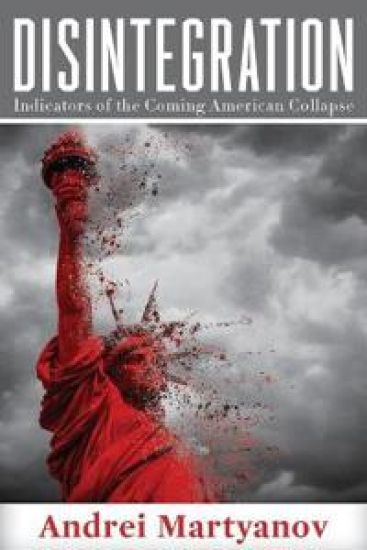
Disintegration

Disintegration

Andrei Martyanov

Clarity Press
2021
pokkari

Halvin toimitettuna 26,30 €

The United States is undergoing a profound and radical transformation, all features of which point to the fact of its departure at an accelerated rate from its largely self-proclaimed status as a global hegemon. The United States has lost ground in every single category that defines the power and status of a nation in relation to its rivals. This book delves into the reasons for a catastrophic decline of the American nation, addressing a range of factors from the economic (especially energy), to cultural, technological and military factors. America's deindustrialized economy is now deeply affected by what can only be described as a massacre of her small and middle-size businesses and the implosion of the US commercial aerospace industry. America's only driver of real growth, the shale oil industry, is facing realities which may make the Great Depression pale in comparison. Disintegration also seeks answers to the precipitous moral and professional decline of the always mediocre qualities of the American elites, from the corridors of political power to those of the military and business, now spiraling out of control. More alarmingly, the trend also points to the possibility of the actual physical disintegration of the United States as a unified entity--whether the divisions are ethnic or ideological. The most profound fault line is cultural--between the Coastal self-proclaimed elites backed by the secular, liberal media and deep state, who promote the most radical ideologies as it concerns gender and race, and the working class majority whom the former polemicize as deplorables, Christian fundamentalists, white supremacists, and climate and science denialists. Investigating these factors sheds light on America's future which holds very little promise for the country which had once proclaimed itself to be a shining city on the hill. The American collapse is not just coming, we are presently experiencing it. How can we deal with a catastrophe which is unfolding before our very eyes? Disintegration lays out some possibilities.
The (Real) Revolution in Military Affairs

The (Real) Revolution in Military Affairs

Andrei Martyanov

Clarity Press
2019
pokkari
The liberal world order, a euphemism for American global hegemony, is crumbling at an accelerating pace. While its collapse is tangible, the outcome of such a collapse remains a matter of speculation and public debate. The US is desperately seeking to preserve the status quo, which rests primarily upon recognition of its military supremacy. For millennia, warfare has been a driving force behind changes in the geopolitical status of power configurations (whether of peoples, states or empires), and it remains so, today. Accordingly, short of actual warfare, the assessment (modeling) of relative military power plays an inordinate role in the determination of national status. Models of emerging changes in military capability range from relatively simple to extremely complex ones. Viewing the evolution of the current system of international relations outside the framework of actual, rather than propaganda-driven, military capabilities is not only useless, it is dangerous since states' mistaken assessment of their own and other states' military power can lead to misadventures and catastrophic mistakes. The United States' efforts to preserve not just its dominance but the perception of its dominance are bound to fail for many important reasons, none more important than what is often misidentified in past American military-theoretical hypotheses about the future of warfare, known generically as the Revolution in Military Affairs (RMA). This book explains why those hypotheses are failing and will continue to fail, and addresses the real RMA. In the end, technological development in weaponry as a response to tactical, operational and strategic requirements defines not only a nation's geopolitical status but determines the global order. Assessments of military capacity, if reality-based, serve as good predictors of the level of volatility in international relations and the level of violence globally. This book gives an insight into the evolution of weapons and the way they influenced international relations in the 20th and 21st centuries. It also defines Revolution in Military Affairs as manifested via policy, politics, and technology. It reviews some models which are useful in assessing the current geopolitical situation. This book also tries to give a forecast of the future development of warfare and the ways in which it is going to change the whole system of international relations, hopefully towards a new geopolitical equilibrium.

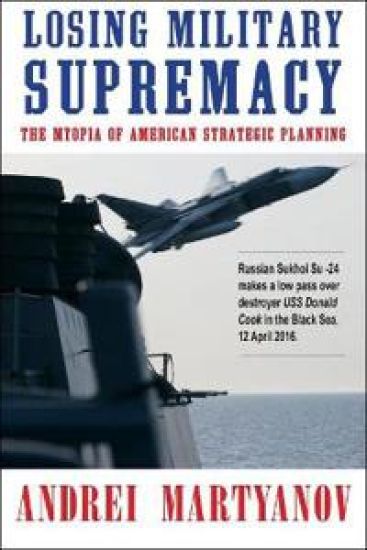
Losing Military Supremacy

Losing Military Supremacy

Andrei Martyanov

Clarity Press
2018
nidottu

Halvin toimitettuna 26,50 €

Our competitive edge has eroded in every domain of warfare – air, land, sea, space, and cyberspace,General Mattis said. And it is continually eroding. American exceptionalist culture has deep roots in the American founding, which even Alexis De Tocqueville observed in his seminal work in 1837. While exceptionalism is not unique to America, the intensity of their conviction and its global ramifications are. This view of its exceptionalism has led the US to grossly misinterpret—sometimes deliberately—the causative factors of key events of the past two centuries. Accordingly, the wrong conclusions have been derived, and very wrong lessons learned. Nowhere has this been more manifest than in American military thought and its actual application of military power. Time after time the American military has failed to match lofty declarations about its superiority, producing instead a mediocre record of military accomplishments. Starting from the Korean War the United States hasn't won a single war against a technologically inferior, but mentally tough enemy. The technological dimension of American strategy has completely overshadowed any concern with the social, cultural, operational and even tactical requirements of military (and political) conflict. With a new Cold War with Russia emerging, the United States enters a new period of geopolitical turbulence completely unprepared in any meaningful way—intellectually, economically, militarily or culturally—to face a reality which was hidden for the last 70+ years behind the curtain of never-ending Chalabi moments and a strategic delusion concerning Russia, whose history the US viewed through a Solzhenitsified caricature kept alive by a powerful neocon lobby, which even today dominates US policy makers' minds. This book: Explores the dramatic difference between the Russian and US approach to warfare, which manifests itself across the whole spectrum of activities from art and the economy, to the respective national cultures. Illustrates the fact that Russian economic, military and cultural realities and power are no longer what American elites think they are by addressing Russia's new and elevated capacities in the areas of traditional warfare as well as cyberwarfare and space. Studies in depth several ways in which the US can simply stumble into conflict with Russia and what must be done to avoid it.