
Kirjojen hintavertailu – 12 859 824 kirjaa ja 27 kauppaa

Kirjailija

Andrew Ang

Kirjat ja teokset yhdessä paikassa: 2 kirjaa, julkaisuja vuosilta 2011–2014, suosituimpiin kuuluu The Efficient Market Theory and Evidence. Vertaile teosten hintoja ja tarkista saatavuus suomalaisista kirjakaupoista.

2 kirjaa

Kirjojen julkaisuvuodet: 2011–2014.

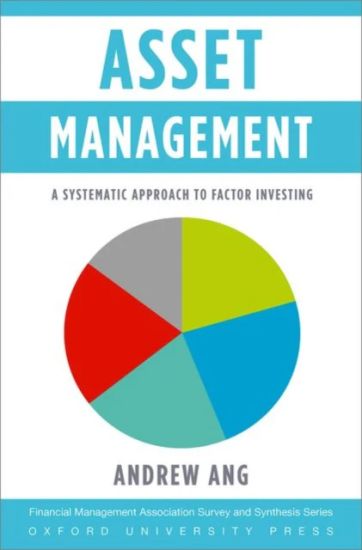
Asset Management

Asset Management

Andrew Ang

Oxford University Press Inc
2014
sidottu
Stocks and bonds? Real estate? Hedge funds? Private equity? If you think those are the things to focus on in building an investment portfolio, Andrew Ang has accumulated a body of research that will prove otherwise. In his new book Asset Management: A Systematic Approach to Factor Investing, Ang upends the conventional wisdom about asset allocation by showing that what matters aren't asset class labels but the bundles of overlapping risks they represent. Making investments is like eating a healthy diet, Ang says: you've got to look through the foods you eat to focus on the nutrients they contain. Failing to do so can lead to a serious case of malnutrition-for investors as well as diners. The key, in Ang's view, is bad times, and the fact that every investor's bad times are somewhat different. The notion that bad times are paramount is the guiding principle of the book, which offers a new approach to the age-old problem of where do you put your money? Years of experience, both as a finance professor and as a consultant, have led Ang to see that the traditional approach, with its focus on asset classes, is too crude and ultimately too costly to serve investors adequately. He focuses instead on "factor risks," the peculiar sets of hard times that cut across asset classes, and that must be the focus of our attention if we are to weather market turmoil and receive the rewards that come with doing so. Optimally harvesting factor premiums-on our own or by hiring others-requires identifying your particular set of hard times, and exploiting the difference between them and those of the average investor. Clearly written yet chock-full of the latest research and data, Asset Management will be indispensable reading for trustees, professional money managers, smart private investors, and business students who want to understand the economics behind factor risk premiums, harvest them efficiently in their portfolios, and embark on the search for true alpha.
The Efficient Market Theory and Evidence

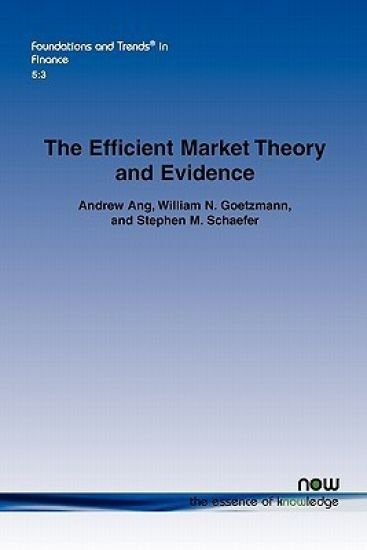
The Efficient Market Theory and Evidence

Andrew Ang; William N. Goetzmann; Stephen M. Schaefer

now publishers Inc
2011
nidottu
The efficient market theory asserts that the price of a security reflects all available information about its fundamental value. A consequence of the theory is that it is impossible to consistently beat the market and speculation must be a loser's game. Hence, an indexing strategy is bound to eventually beat a strategy that uses active management; where active management is characterized as trading that seeks to exploit mispriced assets. The Efficient Market Theory and Evidence reviews the extensive theoretical and empirical literature on the efficient markets hypothesis (EMH). The authors base their review on the implications of the EMH for the practice of active investment management. Beginning with a brief discussion of current efficient market theory, the authors present the theoretical foundation and discuss the recent empirical evidence on efficiency as it pertains to a range of different markets - not simply the large, liquid public securities markets but also the private capital markets. The book suggests that while tests of the theory on prices have produced violations suggestive of the potential for active management to add value to a multi-asset portfolio, but finding consistent out-performing active managers is difficult. Since the most recent versions of the EMH emphasize the comparative advantages of specialized arbitrageurs due to better information, skill, lower trading costs, and better access to financing, the balance between indexation and active management is a choice that depends on beliefs about the existence and potential of manager skill, the pricing opportunities afforded within a given market, the time preferences and risk aversion of the investor.