Kirjojen hintavertailu – 12 903 724 kirjaa ja 27 kauppaa

Kirjailija

Andrew C. Isenberg

Kirjat ja teokset yhdessä paikassa: 5 kirjaa, julkaisuja vuosilta 2006–2025, suosituimpiin kuuluu Mining California. Vertaile teosten hintoja ja tarkista saatavuus suomalaisista kirjakaupoista.

Nimi esiintyy myös muodoissa: Andrew C Isenberg

5 kirjaa

Kirjojen julkaisuvuodet: 2006–2025.

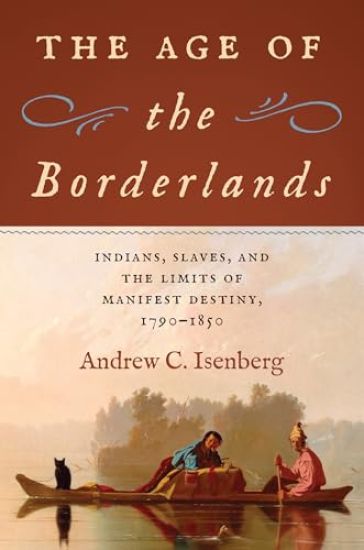
The Age of the Borderlands

The Age of the Borderlands

Andrew C. Isenberg

THE UNIVERSITY OF NORTH CAROLINA PRESS
2025
sidottu

Halvin toimitettuna 44,30 €

In The Age of the Borderlands, acclaimed historian Andrew C. Isenberg offers a new history of manifest destiny that breaks from triumphalist narratives of US territorial expansion. Isenberg takes readers to the contested borders of Spanish Florida, Missouri, New Mexico, California, Texas, and Minnesota at critical moments in the early to mid-nineteenth century, demonstrating that the architects of American expansion faced significant challenges from the diverse groups of people inhabiting each region. In other words, while the manifest destiny paradigm begins with an assumption of US strength, the government and the agents it dispatched to settle and control the frontier had only a weak presence. Tracing the interconnected histories of Indians, slaves, antislavery reformers, missionaries, federal agents, and physicians, Isenberg shows that the United States was repeatedly forced to accommodate the presence of other colonial empires and powerful Indigenous societies. Anti-expansionists in the borderlands welcomed the precarity of the government's power: The land on which they dwelled was a grand laboratory where they could experiment with their alternative visions for American society. Examining the borderlands offers an understanding not just about frontier spaces but about the nature of the early American state— ambitiously expansionist but challenged by its native and imperial competitors.
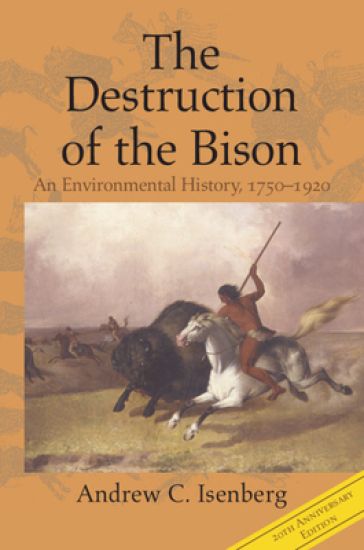
The Destruction of the Bison

The Destruction of the Bison

Andrew C. Isenberg

Cambridge University Press
2020
pokkari
For the last twenty years, The Destruction of the Bison has been an essential work in environmental history. Andrew C. Isenberg offers a concise analysis of the near-extinction of the North American bison population from an estimated 30 million in 1800 to fewer than 1000 a century later. His wide-ranging, interdisciplinary study carefully considers the multiple causes, cultural and ecological, of the destruction of the species. The twentieth-anniversary edition includes a new foreword connecting this seminal work to developments in the field – notably new perspectives in Native American history and the rise of transnational history – and placing the story of the bison in global context. A new afterword extends the study to the twenty-first century, underlining the continued importance of this ground-breaking text for current, and future, students and scholars.
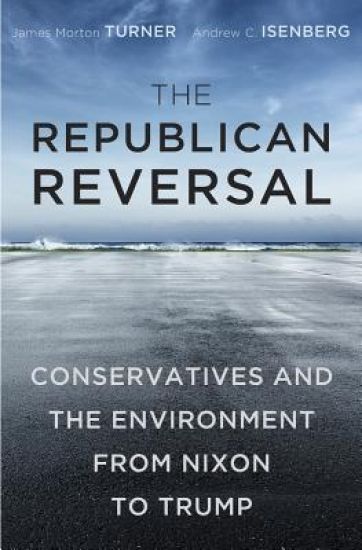
The Republican Reversal

The Republican Reversal

James Morton Turner; Andrew C. Isenberg

Harvard University Press
2018
sidottu
Not long ago, Republicans could take pride in their party’s tradition of environmental leadership. In the late 1960s and early 1970s, the GOP helped to create the Environmental Protection Agency, extend the Clean Air Act, and protect endangered species. Today, as Republicans denounce climate change as a “hoax” and seek to dismantle the environmental regulatory state they worked to build, we are left to wonder: What happened? In The Republican Reversal, James Morton Turner and Andrew C. Isenberg show that the party’s transformation began in the late 1970s, with the emergence of a new alliance of pro-business, libertarian, and anti-federalist voters. This coalition came about through a concerted effort by politicians and business leaders, abetted by intellectuals and policy experts, to link the commercial interests of big corporate donors with states’-rights activism and Main Street regulatory distrust. Fiscal conservatives embraced cost-benefit analysis to counter earlier models of environmental policy making, and business tycoons funded think tanks to denounce federal environmental regulation as economically harmful, constitutionally suspect, and unchristian, thereby appealing to evangelical views of man’s God-given dominion of the Earth. As Turner and Isenberg make clear, the conservative abdication of environmental concern stands out as one of the most profound turnabouts in modern American political history, critical to our understanding of the GOP’s modern success. The Republican reversal on the environment is emblematic of an unwavering faith in the market, skepticism of scientific and technocratic elites, and belief in American exceptionalism that have become the party’s distinguishing characteristics.
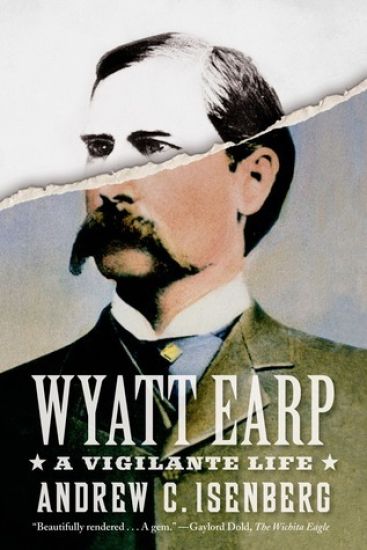
Wyatt Earp

Wyatt Earp

Andrew C. Isenberg

Hill Wang Inc.,U.S.
2014
pokkari
As Andrew C. Isenberg shows in Wyatt Earp: A Vigilante Life, the Hollywood Earp is largely a fiction created by Earp himself, whose life was characterized not by an unflinching devotion to law and order but by inconstancy, defiance of authority, and repeated self-invention. The Earp played on - screen by Henry Fonda and Burt Lancaster is stubbornly duty bound; in actuality, Earp led a life of impulsive law-breaking and shifting identities. When he wasn't wearing a badge, he was variously a thief, a brothel bouncer, a gambler, and a confidence man. He spent his last decades in Los Angeles, where his plastic identity and his penchant for reinvention freely lent themselves to Hollywood mythmaking. Befriending Western silent-film actors and directors, he presented himself to them as a lawman singularly committed to justice. Having tried and failed over the course of his life to invent a better future for himself, in the end Earp invented a better past. Though Earp, who died in 1929, did not live to see it, Hollywood's embrace of him as a paragon of law and order was his last and undoubtedly greatest confidence game.
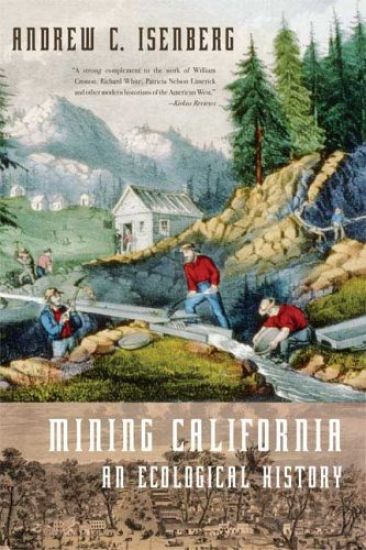
Mining California

Mining California

Andrew C Isenberg

Hill Wang Inc.,U.S.
2006
pokkari
An environmental History of California during the Gold Rush Between 1849 and 1874 almost $1 billion in gold was mined in California. With little available capital or labor, here's how: high-pressure water cannons washed hillsides into sluices that used mercury to trap gold but let the soil wash away; eventually more than three times the amount of earth moved to make way for the Panama Canal entered California's rivers, leaving behind twenty tons of mercury every mile rivers overflowed their banks and valleys were flooded, the land poisoned. In the rush to wealth, the same chain of foreseeable consequences reduced California's forests and grasslands. Not since William Cronon's" Nature's Metropolis" has a historian so skillfully applied John Muir's insight "When we try to pick out anything by itself, we find it hitched to everything else in the universe" to the telling of the history of the American West. Beautifully told, this is western environmental history at its finest."