Kirjojen hintavertailu – 12 859 819 kirjaa ja 27 kauppaa

Kirjailija

Andrew Chester

Kirjat ja teokset yhdessä paikassa: 4 kirjaa, julkaisuja vuosilta 1994–2012, suosituimpiin kuuluu Messiah and Exaltation. Vertaile teosten hintoja ja tarkista saatavuus suomalaisista kirjakaupoista.

4 kirjaa

Kirjojen julkaisuvuodet: 1994–2012.

Future Hope and Present Reality

Future Hope and Present Reality

Andrew Chester

Mohr Siebeck
2012
sidottu
This book is the first of a two-volume work with the overall title "Future Hope and Present Reality". These volumes had their origin in the Speaker's Lectures that Andrew Chester gave in Oxford; their main focus is central themes in biblical eschatology, and especially the apparent contradictions between what is hoped for in the future and what is experienced in the present: the stark discrepancy, that is, between the world as it is and the world as it should be. In this first volume, as the subtitle "Eschatology and Transformation in the Hebrew Bible" indicates, the author is concerned with the Hebrew Bible (or Old Testament; the second will be on the New Testament). He deals, successively, with central eschatological themes and the deep tensions they involve: divine threats of an absolute end (to human life and to the world itself), and divine promises of blessing and transformation, along with the theological questions inevitably raised by these - both in themselves and in relation to each other; the whole phenomenon of prophecy, and the problems it involves - not least, whether it can be taken seriously, in face of the contradictions and failures it manifests. He discusses the sheer discrepancy between ideal and reality in traditions relating to kingship, along with the tensions inherent in the emergence of messianic hope; death, as representing the end of any relationship with God, along with hope that goes beyond death - in relation both to the individual and also the nation; and, finally, visions of a transformed and paradisal world, and whether these can bear any relation to reality. It is argued that the Hebrew Bible can be seen to offer genuine grounds for hope, but that these can have any cogency only if the problems involved are really engaged with.
Messiah and Exaltation

Messiah and Exaltation

Andrew Chester

JCB Mohr (Paul Siebeck)
2007
sidottu

Halvin toimitettuna 253,80 €

Andrew Chester focuses on Jewish messianic hope, intermediary figures, and visionary traditions of human transformation, particularly in the Second Temple period, and analyzes their significance for the origin and development of New Testament Christology. He brings together five previously published essays on these themes: these include two long chapters, one on Jewish messianic and mediatorial traditions in relation to Pauline Christology, the other on messianism and eschatology in early Judaism and Christianity, plus one on messiah and Temple in Sibylline Oracles 3-5. Two further essays, on the significance of Torah in the messianic age, and on resurrection, transformation and early Christology, have been extensively revised. There are also three substantial new chapters, all of which engage closely with recent scholarly debate. The first, on the origin of Christology, argues for the significance of Jewish visionary traditions of human transformation for understanding how 'high' Christology came about at such an early stage within the New Testament. The second discusses the complex questions of the definition, scope and nature of Jewish messianism, especially in relation to the Hebrew Bible and the more-recently available Qumran evidence, and their significance for the New Testament. The third is concerned with what Paul means by the 'law of Christ', and the wider issues raised by this.
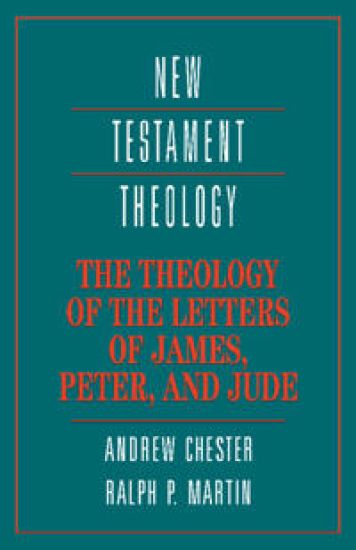
The Theology of the Letters of James, Peter, and Jude

The Theology of the Letters of James, Peter, and Jude

Andrew Chester; Ralph P. Martin

Cambridge University Press
1994
pokkari
The letters of James, Peter, and Jude have been greatly neglected within the Christian tradition: James, because it seems both to attack Paul’s gospel and also to lack any coherent, overall argument or theology of its own; Peter and Jude because they lack the specificity of the Pauline letters and because the personalities of the authors are hardly direct and immediate. Andrew Chester argues that James is more theologically significant than is usually considered the case, and has a distinctive role to play in the contemporary discussion of the Christian faith. He sets James in context and discusses its main themes, exploring its significance especially for issues of power, justice and Christian living. Ralph P. Martin similarly stresses the importance of 1 and 2 Peter and Jude and demonstrates how they cast light on Jewish Christianity in its early development and show how the post-apostolic church used the memory of Peter.