Kirjojen hintavertailu – 12 859 819 kirjaa ja 27 kauppaa

Kirjailija

Andrew D. Mitchell

Kirjat ja teokset yhdessä paikassa: 5 kirjaa, julkaisuja vuosilta 2008–2021, suosituimpiin kuuluu Non-Discrimination and the Role of Regulatory Purpose in International Trade and Investment Law. Vertaile teosten hintoja ja tarkista saatavuus suomalaisista kirjakaupoista.

5 kirjaa

Kirjojen julkaisuvuodet: 2008–2021.

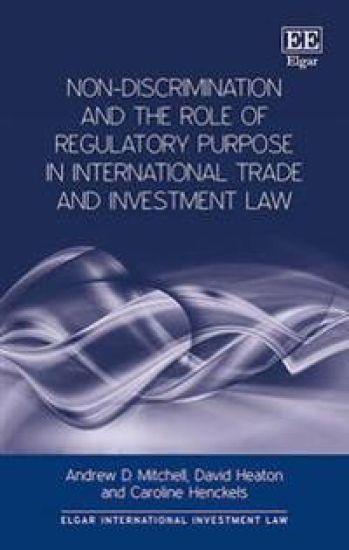
Non-Discrimination and the Role of Regulatory Purpose in International Trade and Investment Law

Non-Discrimination and the Role of Regulatory Purpose in International Trade and Investment Law

Andrew D. Mitchell; David Heaton; Caroline Henckels

Edward Elgar Publishing Ltd
2016
sidottu
Non-discrimination requirements, such as most-favored nation and national treatment obligations, are central to both international trade law and international investment law. Significant inconsistencies between the fields are evident, however, in the way adjudicators have treated key elements of the test for discrimination. This book surveys and criticizes the manner in which tribunals have employed the concept of regulatory purpose in determining whether discrimination has occurred. The authors of this book propose a new definition of regulatory purpose that assists in framing the test for unlawful discrimination in both fields of law. It provides a systematic and structured analysis of how regulatory purpose should - and should not - be used in applying non-discrimination norms. Throughout, the book compares and contrasts trade and investment law, drawing out several parallels and suggesting areas in which one legal system might answer or shed light on questions arising in the other. With its comprehensive and up-to-date analysis of trade and investment jurisprudence, this book will appeal to practitioners and academics in the fields of trade and investment law. Lawyers and adjudicators will find it a useful source of ideas and proposals to inform their arguments and decisions. For government officials, it will be informative when considering the optimal way to structure measures that may affect the interests of foreign traders or investors. It will also provide a useful survey of the literature for academics, as well as a springboard for further comparison of international trade and investment law.
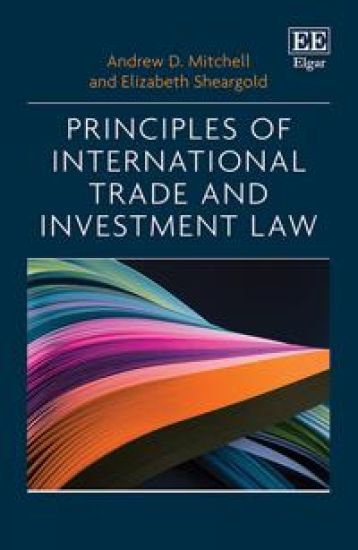
Principles of International Trade and Investment Law

Principles of International Trade and Investment Law

Andrew D. Mitchell; Elizabeth Sheargold

Edward Elgar Publishing Ltd
2021
sidottu
This carefully crafted book discusses a wide range of important legal principles such as procedural fairness and reasonableness in the context of international trade and investment law. Using comparative methodology, the authors examine how those principles are reflected in treaties and how they are employed by adjudicators resolving disputes. Contributing to a growing and important body of scholarship, Principles of International Trade and Investment Law provides critical analysis of important topics in international economic law, including cross-border data transfers and prudential regulation. By identifying commonalities and divergences in how the two regimes treat key legal concepts, such as necessity testing and non-discrimination, the book provides insight into international trade and investment law while also furthering our understanding of the broader fields of international economic law and public international law. Examining how these key principles are interpreted and used in international economic law, this book will be welcomed by academics and practitioners interested in international investment and trade law as well as researchers in the international public law field.
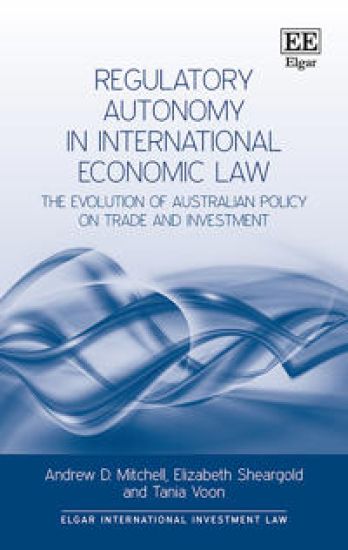
Regulatory Autonomy in International Economic Law

Regulatory Autonomy in International Economic Law

Andrew D. Mitchell; Elizabeth Sheargold; Tania Voon

Edward Elgar Publishing Ltd
2017
sidottu
Regulatory Autonomy in International Economic Law provides the first extensive legal analysis of Australia's trade and investment treaties in the context of their impact on national regulatory autonomy. This thought-provoking study offers compelling lessons for not only Australia but also countries around the globe in relation to pressing current problems, including the uncertain future of the World Trade Organization and widespread concerns about the legitimacy of investor-State dispute settlement. Through a critical exploration of evolving patterns of treaty practice, the authors address the complex relationship between international economic law and a State's regulatory autonomy in the key areas of intellectual property, services, and investment. This insightful investigation highlights problems of inconsistency across treaties, limited transparency and consultation in the negotiation of treaties, and increasing restrictions on policy space in intellectual property protection. These factors are all crucial in preserving a country's ability to pursue policy objectives such as protecting public health and the environment while capturing the benefits of international trade and foreign investment. This discerning book will prove instrumental to scholars and practitioners in the fields of international trade law, international investment law, public international law, and intellectual property. It will also appeal to government agencies and international organisations working in these areas or in matters of public health or the environment.
Legal Principles in WTO Disputes

Legal Principles in WTO Disputes

Andrew D. Mitchell

Cambridge University Press
2011
pokkari
Principles play a crucial role in any dispute settlement system, and the World Trade Organization (WTO) is no exception. However, WTO Panels and the Appellate Body have been too timid in using principles, sometimes avoiding their use when appropriate and at other times using them without fully acknowledging that they are doing so. Perhaps more worryingly, these bodies often fail to delve deeply enough into principles. They tend to overlook key questions such as the legal basis for using a given principle, whether the principle is being used in an interpretative manner or as applicable law and the meaning of the principle in public international law. This book establishes a framework for addressing these questions. The use of such a framework should allay fears and misconceptions about the use of principles and ensure that they are used in a justifiable manner, improving the quality of dispute settlement in the WTO.
Legal Principles in WTO Disputes

Legal Principles in WTO Disputes

Andrew D. Mitchell

Cambridge University Press
2008
sidottu
Principles play a crucial role in any dispute settlement system, and the World Trade Organization (WTO) is no exception. However, WTO Panels and the Appellate Body have been too timid in using principles, sometimes avoiding their use when appropriate and at other times using them without fully acknowledging that they are doing so. Perhaps more worryingly, these bodies often fail to delve deeply enough into principles. They tend to overlook key questions such as the legal basis for using a given principle, whether the principle is being used in an interpretative manner or as applicable law and the meaning of the principle in public international law. This book establishes a framework for addressing these questions. The use of such a framework should allay fears and misconceptions about the use of principles and ensure that they are used in a justifiable manner, improving the quality of dispute settlement in the WTO.