Kirjojen hintavertailu – 12 859 819 kirjaa ja 27 kauppaa

Kirjailija

Andrew J. Bacevich

Kirjat ja teokset yhdessä paikassa: 12 kirjaa, julkaisuja vuosilta 2003–2026, suosituimpiin kuuluu Atrocities of the Mind. Vertaile teosten hintoja ja tarkista saatavuus suomalaisista kirjakaupoista.

12 kirjaa

Kirjojen julkaisuvuodet: 2003–2026.

Atrocities of the Mind

Atrocities of the Mind

Dwight Macdonald; Andrew J. Bacevich

THE UNIVERSITY OF CHICAGO PRESS
2026
nidottu
This collection features Dwight Macdonald’s prophetic essays on politics, art, and violence in twentieth-century America. What does extreme violence do to human values? Does the concept of collective guilt make sense in assessing responsibility for genocide? Has modern mechanized society forever destroyed the possibility of peaceful resistance through art and civil disobedience? Atrocities of the Mind presents anew Dwight Macdonald, one of America’s foremost literary journalists and political activists, grappling with the hard questions of his time—and ours. In this collection, Macdonald writes about major events—the Holocaust, the atomic bombing of Hiroshima, Gandhi’s assassination, the Vietnam War, and social phenomena such as mass shootings, campus protests, and police brutality—with clear-sighted and buoyant prose. He writes incisively about the cinema of Alfred Hitchcock and Roman Polanski. Macdonald praises Dorothy Day’s pacifism, passes around an antiwar petition in the Rose Garden of the White House, and spurs the Johnson administration’s War on Poverty with “Our Invisible Poor.” Norman Mailer memorably called Macdonald “a man with whom one might seldom agree but could never disrespect because he always told the truth as he saw the truth—a man therefore of the most incorruptible integrity.” In an America today that is reeling from political violence, Macdonald’s truth-telling reminds us how we got here and who we might still become.
Atrocities of the Mind

Atrocities of the Mind

Dwight Macdonald; Andrew J. Bacevich

THE UNIVERSITY OF CHICAGO PRESS
2026
sidottu
This collection features Dwight Macdonald’s prophetic essays on politics, art, and violence in twentieth-century America. What does extreme violence do to human values? Does the concept of collective guilt make sense in assessing responsibility for genocide? Has modern mechanized society forever destroyed the possibility of peaceful resistance through art and civil disobedience? Atrocities of the Mind presents anew Dwight Macdonald, one of America’s foremost literary journalists and political activists, grappling with the hard questions of his time—and ours. In this collection, Macdonald writes about major events—the Holocaust, the atomic bombing of Hiroshima, Gandhi’s assassination, the Vietnam War, and social phenomena such as mass shootings, campus protests, and police brutality—with clear-sighted and buoyant prose. He writes incisively about the cinema of Alfred Hitchcock and Roman Polanski. Macdonald praises Dorothy Day’s pacifism, passes around an antiwar petition in the Rose Garden of the White House, and spurs the Johnson administration’s War on Poverty with “Our Invisible Poor.” Norman Mailer memorably called Macdonald “a man with whom one might seldom agree but could never disrespect because he always told the truth as he saw the truth—a man therefore of the most incorruptible integrity.” In an America today that is reeling from political violence, Macdonald’s truth-telling reminds us how we got here and who we might still become.
On Shedding an Obsolete Past

On Shedding an Obsolete Past

Andrew J. Bacevich

Haymarket Books
2022
pokkari
On Shedding an Obsolete Past provides a much-needed and comprehensive critique of recent US national security policies in both the Trump and Biden administrations. These policy decisions have produced a series of costly disappointments and outright failures that have destroyed the lives of hundreds of thousands around the world and cost US taxpayers astronomical sums of money. Bacevich provides urgent and critical insights into how these failures occurred and what needs to be done to prevent similar failures in the future. He reminds us that, by understanding the past, we can alter our current trajectory and transform the world for the better.
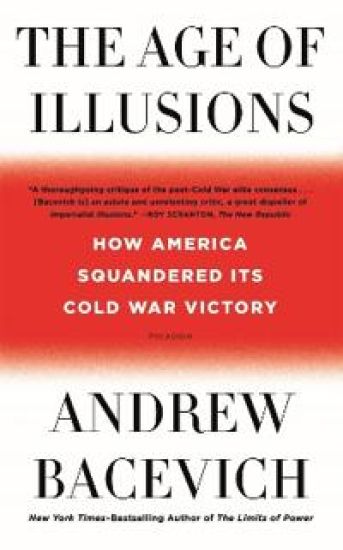
The Age of Illusions

The Age of Illusions

Andrew J. Bacevich

Picador USA
2021
nidottu
In the decades that followed, American leaders put that claim to the test. They embraced globalisation as a putative source of unprecedented wealth, embarked on wide-ranging military campaigns to export American values, and redefined the very meaning of freedom. Meanwhile, they placed all their bets on the White House fulfilling the promise of their Cold War triumph: unequaled prosperity, lasting peace, and absolute freedom. In The Age of Illusions, bestselling author Andrew Bacevich takes us from that moment of seemingly ultimate victory to the age of Trump, recounting an epic tale of folly and delusion. Writing with his usual eloquence and vast knowledge, he explains how within a quarter of a century the United States ended up with gaping inequality, permanent war, moral confusion, and an increasingly angry and alienated population, as well as, of course, the strangest president in American history.
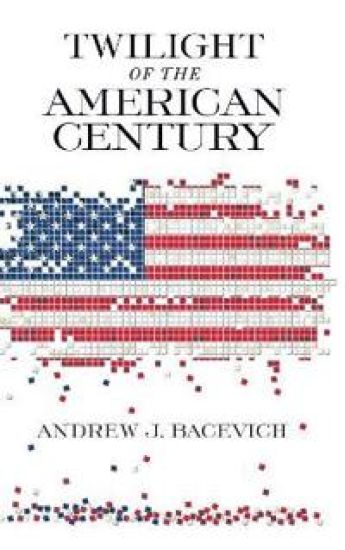
Twilight of the American Century

Twilight of the American Century

Andrew J. Bacevich

University of Notre Dame Press
2018
sidottu
Andrew Bacevich is a leading American public intellectual, writing in the fields of culture and politics with particular attention to war and America's role in the world. Twilight of the American Century is a collection of his selected essays written since 9/11. In these essays, Bacevich critically examines the U. S. response to the events of September 2001, as they have played out in the years since, radically affecting the way Americans see themselves and their nation's place in the world. Bacevich is the author of nearly a dozen books and contributes to a wide variety of publications, including Foreign Affairs, The Nation, Commonweal, Harper's, and the London Review of Books. His op-eds have appeared in the New York Times, Washington Post, and the Wall Street Journal, among other newspapers. Prior to becoming an academic, he was a professional soldier. His experience as an Army officer informs his abiding concern regarding the misuse of American military power and the shortcomings of the U. S. military system. As a historian, he has tried to see the past differently, thereby making it usable to the present. Bacevich combines the perspective of a scholar with the background of a practitioner. His views defy neat categorization as either liberal or conservative. He belongs to no "school." His voice and his views are distinctive, provocative, and refreshing. Those with a focus on political and cultural developments and who have a critical interest in America's role in the world will be keenly interested in this book.
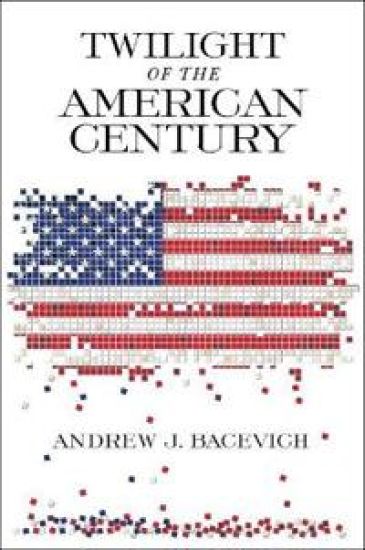
Twilight of the American Century

Twilight of the American Century

Andrew J. Bacevich

University of Notre Dame Press
2018
nidottu
Andrew Bacevich is a leading American public intellectual, writing in the fields of culture and politics with particular attention to war and America's role in the world. Twilight of the American Century is a collection of his selected essays written since 9/11. In these essays, Bacevich critically examines the U. S. response to the events of September 2001, as they have played out in the years since, radically affecting the way Americans see themselves and their nation's place in the world. Bacevich is the author of nearly a dozen books and contributes to a wide variety of publications, including Foreign Affairs, The Nation, Commonweal, Harper's, and the London Review of Books. His op-eds have appeared in the New York Times, Washington Post, and the Wall Street Journal, among other newspapers. Prior to becoming an academic, he was a professional soldier. His experience as an Army officer informs his abiding concern regarding the misuse of American military power and the shortcomings of the U. S. military system. As a historian, he has tried to see the past differently, thereby making it usable to the present. Bacevich combines the perspective of a scholar with the background of a practitioner. His views defy neat categorization as either liberal or conservative. He belongs to no "school." His voice and his views are distinctive, provocative, and refreshing. Those with a focus on political and cultural developments and who have a critical interest in America's role in the world will be keenly interested in this book.
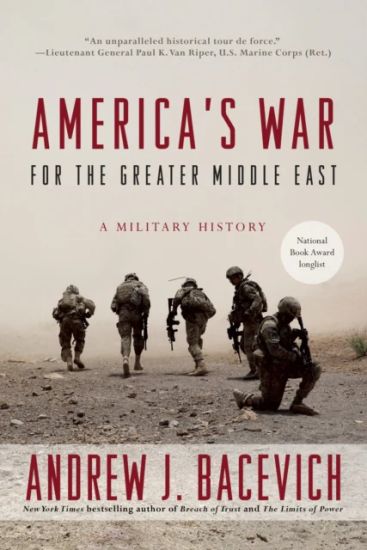
America's War for the Greater Middle East

America's War for the Greater Middle East

Andrew J. Bacevich

Random House Inc
2017
pokkari

Halvin toimitettuna 20,30 €

LONGLISTED FOR THE NATIONAL BOOK AWARD - A searing reassessment of U. S. military policy in the Middle East over the past four decades from retired army colonel and New York Times bestselling author Andrew J. Bacevich, with a new afterword by the author From the end of World War II until 1980, virtually no American soldiers were killed in action while serving in the Greater Middle East. Since 1990, virtually no American soldiers have been killed in action anywhere else. What caused this shift? Andrew J. Bacevich, one of the country's most respected voices on foreign affairs, offers an incisive critical history of this ongoing military enterprise--now more than thirty years old and with no end in sight. During the 1980s, Bacevich argues, a great transition occurred. As the Cold War wound down, the United States initiated a new conflict--a War for the Greater Middle East--that continues to the present day. The long twilight struggle with the Soviet Union had involved only occasional and sporadic fighting. But as this new war unfolded, hostilities became persistent. From the Balkans and East Africa to the Persian Gulf and Central Asia, U. S. forces embarked upon a seemingly endless series of campaigns across the Islamic world. Few achieved anything remotely like conclusive success. Instead, actions undertaken with expectations of promoting peace and stability produced just the opposite. As a consequence, phrases like "permanent war" and "open-ended war" have become part of everyday discourse. Connecting the dots in a way no other historian has done before, Bacevich weaves a compelling narrative out of episodes as varied as the Beirut bombing of 1983, the Mogadishu firefight of 1993, the invasion of Iraq in 2003, and the rise of ISIS in the present decade. Understanding what America's costly military exertions have wrought requires seeing these seemingly discrete events as parts of a single war. It also requires identifying the errors of judgment made by political leaders in both parties and by senior military officers who share responsibility for what has become a monumental march to folly. This Bacevich unflinchingly does. A twenty-year army veteran who served in Vietnam, Andrew J. Bacevich brings the full weight of his expertise to this vitally important subject. America's War for the Greater Middle East is a bracing after-action report from the front lines of history. It will fundamentally change the way we view America's engagement in the world's most volatile region. Praise for America's War for the Greater Middle East"Bacevich is thought-provoking, profane and fearless. . . . His] call for Americans to rethink their nation's militarized approach to the Middle East is incisive, urgent and essential."--The New York Times Book Review "Bacevich's magnum opus . . . a deft and rhythmic polemic aimed at America's failures in the Middle East from the end of Jimmy Carter's presidency to the present."--Robert D. Kaplan, The Wall Street Journal "A critical review of American policy and military involvement . . . Those familiar with Bacevich's work will recognize the clarity of expression, the devastating directness and the coruscating wit that characterize the writing of one of the most articulate and incisive living critics of American foreign policy."--The Washington Post " A] monumental new work."--The Huffington Post "An unparalleled historical tour de force certain to affect the formation of future U. S. foreign policy."--Lieutenant General Paul K. Van Riper, U. S. Marine Corps (Ret.)
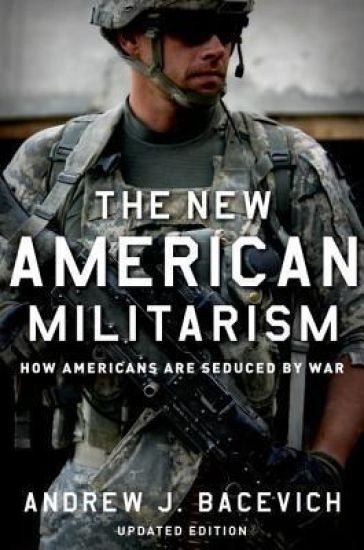
The New American Militarism

The New American Militarism

Andrew J. Bacevich

Oxford University Press Inc
2013
nidottu
In this provocative book, Andrew Bacevich warns of a dangerous dual obsession that has taken hold of Americans, both conservatives and liberals alike. It is a marriage of militarism and utopian ideology, of unprecedented military might wed to a blind faith in the universality of American values. This mindset, Bacevich warns, invites endless war and the ever-deepening militarization of U. S. policy. It promises not to perfect but to pervert American ideals and to accelerate the hollowing out of American democracy. In The New American Militarism, Bacevich examines the origins and implications of this misguided enterprise. He shows how American militarism emerged as a reaction to the Vietnam War, when various groups in American society -soldiers, politicians on the make, intellectuals, strategists, Christian evangelicals, even purveyors of pop culture-came to see the revival of military power and the celebration of military values as the antidote to all the ills besetting the country as a consequence of Vietnam and the 1960s. The upshot, acutely evident in the aftermath of 9/11, has been a revival of vast ambitions, this time coupled with a pronounced affinity for the sword. Bacevich urges Americans to restore a sense of realism and a sense of proportion to U. S. policy. He proposes, in short, to bring American purposes and American methods-especially with regard to the role of the military-back into harmony with the nation's founding ideals. For this edition, Bacevich has written a new Afterword in which he considers how American militarism has changed in the past five years. He explores in particular how this ideology has functioned under Barack Obama, who ran for president on a campaign based on "Hope for change and for a new beginning. Despite such rhetoric, Bacevich powerfully suggests, the attitudes and arrangements giving rise to the new American militarism remain intact and inviolable as ever.
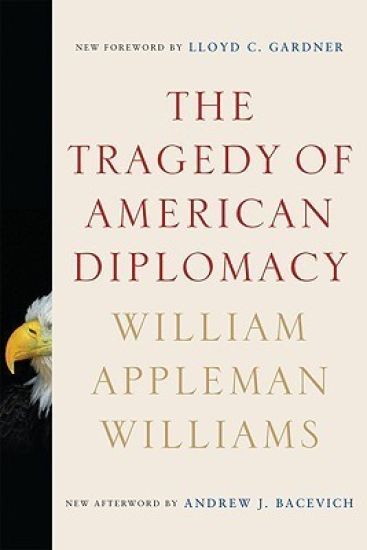
The Tragedy of American Diplomacy

The Tragedy of American Diplomacy

William Appleman Williams; Andrew J. Bacevich; Lloyd C. Gardner

WW Norton Co
2012
nidottu
This incisive interpretation of American foreign policy ranks as a classic in American thought. First published in 1959, the book offered an analysis of the wellsprings of American foreign policy that shed light on the tensions of the Cold War and the deeper impulses leading to the American intervention in Vietnam. William Appleman Williams brilliantly explores the ways in which ideology and political economy intertwined over time to propel American expansion and empire in the nineteenth and twentieth centuries. The powerful relevance of Williams’s interpretation to world politics has only been strengthened by recent events in Central Asia and the Persian Gulf. Williams allows us to see that the interests and beliefs that once sent American troops into Texas and California, or Latin America and East Asia, also propelled American forces into Iraq.
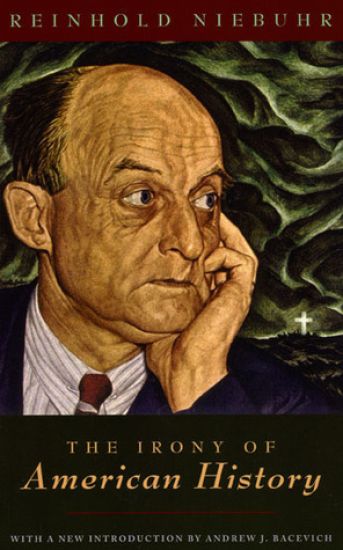
The Irony of American History

The Irony of American History

Reinhold Niebuhr; Andrew J. Bacevich

University of Chicago Press
2008
nidottu

Halvin toimitettuna 29,70 €

Forged during the tumultuous but triumphant postwar years when America came of age as a world power, "The Irony of American History" is more relevant now than ever before. Cited by politicians as diverse as Hillary Clinton and John McCain, Niebuhr's masterpiece on the incongruity between personal ideals and political reality is both an indictment of American moral complacency and a warning against the arrogance of virtue. Impassioned, eloquent, and deeply perceptive, Niebuhr's wisdom will cause readers to rethink their assumptions about right and wrong, war and peace.
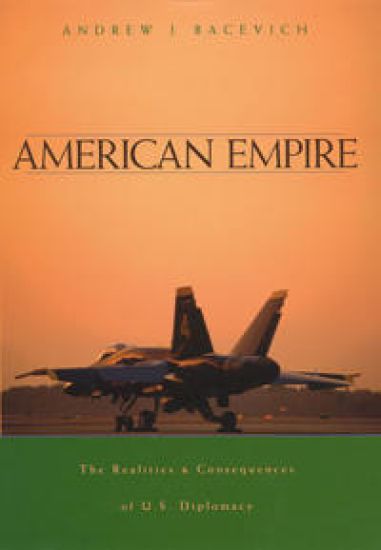
American Empire

American Empire

Andrew J. Bacevich

Harvard University Press
2004
nidottu
In a challenging, provocative book, Andrew Bacevich reconsiders the assumptions and purposes governing the exercise of American global power. Examining the presidencies of George H. W. Bush and Bill Clinton--as well as George W. Bush's first year in office--he demolishes the view that the United States has failed to devise a replacement for containment as a basis for foreign policy. He finds instead that successive post-Cold War administrations have adhered to a well-defined "strategy of openness." Motivated by the imperative of economic expansionism, that strategy aims to foster an open and integrated international order, thereby perpetuating the undisputed primacy of the world's sole remaining superpower. Moreover, openness is not a new strategy, but has been an abiding preoccupation of policymakers as far back as Woodrow Wilson. Although based on expectations that eliminating barriers to the movement of trade, capital, and ideas nurtures not only affluence but also democracy, the aggressive pursuit of openness has met considerable resistance. To overcome that resistance, U. S. policymakers have with increasing frequency resorted to force, and military power has emerged as never before as the preferred instrument of American statecraft, resulting in the progressive militarization of U. S. foreign policy. Neither indictment nor celebration, American Empire sees the drive for openness for what it is--a breathtakingly ambitious project aimed at erecting a global imperium. Large questions remain about that project's feasibility and about the human, financial, and moral costs that it will entail. By penetrating the illusions obscuring the reality of U. S. policy, this book marks an essential first step toward finding the answers.
The Imperial Tense

The Imperial Tense

Andrew J. Bacevich

Ivan R Dee, Inc
2003
pokkari
Does the United States today preside over a global empire? America's emergence as the world's dominant power in the 1990s nurtured the perception—initially more pronounced abroad than at home—that with the passing of the cold war the United States had indeed become an imperial republic. Some observers, convinced that American power is necessarily benign, welcome that new reality. Others are not so sure. In The Imperial Tense, Andrew Bacevich has drawn together a stimulating collection of arguments on a subject of compelling current importance. Since September 11 and the ensuing “war on terror,” President Bush's sweeping rhetoric and national security strategy has affirmed the imperial nature of American foreign policy, provoking concerns over where those ambitions may lead. What is the nature and scope of the American empire? What are its prospects and challenges? Is American power adequate for the task of managing a global imperium? And what of will—are the American people prepared to pay the price that the preservation of that empire may demand? The Imperial Tense offers cogent reflections on these and related questions by leading scholars and commentators, including Mr. Bacevich (who has also written the Introduction), James Chace, Stanley Hoffmann, Charles Krauthammer, Charles Maier, David Rieff, Deepak Lal, John Milbank, Jonathan Freedland, Peter Bender, Martin Walker, Perry Anderson, Jedediah Purdy, G. John Ikenberry, Stephen Books, William Wohlworth, David Marquand, David North, Gabriel Ash, Ivan Eland, and Victor Davis Hanson.