Kirjojen hintavertailu – 12 859 827 kirjaa ja 27 kauppaa

Kirjailija

Andrew Jamison

Kirjat ja teokset yhdessä paikassa: 9 kirjaa, julkaisuja vuosilta 1995–2013, suosituimpiin kuuluu Seeds of the Sixties. Vertaile teosten hintoja ja tarkista saatavuus suomalaisista kirjakaupoista.

9 kirjaa

Kirjojen julkaisuvuodet: 1995–2013.

Seeds of the Sixties

Seeds of the Sixties

Andrew Jamison; Ron Eyerman

University of California Press
1995
pokkari
'The Sixties'. The powerful images conveyed by those two words have become an enduring part of American cultural and political history. But where did Sixties radicalism come from? Who planted the intellectual seeds that brought it into being? These questions are answered with striking clarity in Andrew Jamison and Ron Eyerman's book. The result is a combination of history and biography that vividly portrays an entire culture in transition. The authors focus on specific individuals, each of whom in his or her distinctive way carried the ideas of the 1930s into the decades after World War II, and each of whom shared in inventing a new kind of intellectual partisanship. They begin with C. Wright Mills, Hannah Arendt, and Erich Fromm and show how their work linked the 'old left' of the Thirties to the 'new left' of the Sixties. Lewis Mumford, Rachel Carson, and Fairfield Osborn laid the groundwork for environmental activism; Herbert Marcuse, Margaret Mead, and Leo Szilard articulated opposition to the postwar 'scientific-technological state'. Alternatives to mass culture were proposed by Allen Ginsberg, James Baldwin, and Mary McCarthy; and Saul Alinsky, Dorothy Day, and Martin Luther King, Jr., made politics personal. This is an unusual book, written with an intimacy that brings to life both intellect and emotion. The portraits featured here clearly demonstrate that the transforming radicalism of the Sixties grew from the legacy of an earlier generation of thinkers. With a deep awareness of the historical trends in American culture, the authors show us the continuing relevance these partisan intellectuals have for our own age. 'In a time colored by 'political correctness' and the ascendancy of market liberalism, it is well to remember the partisan intellectuals of the 1950s. They took sides and dissented without becoming dogmatic. May we be able to say the same about ourselves' - from Chapter 7.

The Making of Green Engineers

The Making of Green Engineers

Andrew Jamison

Springer International Publishing AG
2013
nidottu
This book discusses the ways in which engineering educators are responding to the challenges that confront their profession. On the one hand, there is an overarching sustainability challenge: the need for engineers to relate to the problems brought to light in the debates about environmental protection, resource depletion, and climate change. There are also a range of societal challenges that are due to the permeation of science and technology into ever more areas of our societies and everyday lives, and finally, there are the intrinsic scientific and technological challenges stemming from the emergence of new fields of "technosciences" that mix science and technology in new combinations. In the book, the author discusses and exemplifies three contending response strategies on the part of engineers and engineering educators: a commercial strategy that links scientists and engineers into networks or systems of innovation; an academic strategy that reasserts the traditional values of science and engineering; and an integrative strategy that aims to combine scientific knowledge and engineering skills with cultural understanding and social responsibility by fostering what the author terms a "hybrid imagination." Professor Jamison combines scholarly analysis with personal reflections drawing on over forty years of experience as a humanist teaching science and engineering students about the broader social, political and cultural contexts of their fields. The book has been written as part of the Program of Research on Opportunities and Challenges in Engineering Education in Denmark (PROCEED), funded by the Danish Strategic Research Council, for which Professor Jamison has served as coordinator.
A Hybrid Imagination

A Hybrid Imagination

Andrew Jamison; Steen Hyldgaard Christensen; Lars Botin

Springer International Publishing AG
2011
nidottu
This book presents a cultural perspective on scientific and technological development. As opposed to the "story-lines" of economic innovation and social construction that tend to dominate both the popular and scholarly literature on science, technology and society (or STS), the authors offer an alternative approach, devoting special attention to the role played by social and cultural movements in the making of science and technology. They show how social and cultural movements, from the Renaissance of the late 15th century to the environmental and global justice movements of our time, have provided contexts, or sites, for mixing scientific knowledge and technical skills from different fields and social domains into new combinations, thus fostering what the authors term a "hybrid imagination." Such a hybrid imagination is especially important today, as a way to counter the competitive and commercial "hubris" that is so much taken for granted in contemporary science and engineering discourses and practices with a sense of cooperation and social responsibility. The book portrays the history of science and technology as an underlying tension between hubris -- literally the ambition to "play god" on the part of many a scientist and engineer and neglect the consequences - and a hybrid imagination, connecting scientific "facts" and technological "artifacts" with cultural understanding. The book concludes with chapters on the recent transformations in the modes of scientific and technological production since the Second World War and the contending approaches to "greening" science and technology in relation to the global quest for sustainable development. The book is based on a series of lectures that were given by Andrew Jamison at the Technical University of Denmark in 2010 and draws on the authors' many years of experience in teaching non-technical, or contextual knowledge, to science and engineering students. The book has been written as part of the Program of Research on Opportunities and Challenges in Engineering Education in Denmark (PROCEED) supported by the Danish Strategic Research Council from 2010 to 2013. Table of Contents: Introduction / Perceptions of Science and Technology / Where Did Science and Technology Come From? / Science, Technology and Industrialization / Science, Technology and Modernization / Science, Technology and Globalization / The Greening of Science and Technology
Hubris and Hybrids

Hubris and Hybrids

Mikael Hård; Andrew Jamison

Routledge
2005
sidottu
Human societies have not always taken on new technology in appropriate ways. Innovations are double-edged swords that transform relationships among people, as well as between human societies and the natural world. Only through successful cultural appropriation can we manage to control the hubris that is fundamental to the innovative, enterprising human spirit; and only by becoming hybrids, combining the human and the technological, will we be able to make effective use of our scientific and technological achievements. This broad cultural history of technology and science provides a range of stories and reflections about the past, discussing areas such as film, industrial design, and alternative environmental technologies, and including not only European and North American, but also Asian examples, to help resolve the contradictions of contemporary high-tech civilization.
Hubris and Hybrids

Hubris and Hybrids

Mikael Hård; Andrew Jamison

Routledge
2005
nidottu
Human societies have not always taken on new technology in appropriate ways. Innovations are double-edged swords that transform relationships among people, as well as between human societies and the natural world. Only through successful cultural appropriation can we manage to control the hubris that is fundamental to the innovative, enterprising human spirit; and only by becoming hybrids, combining the human and the technological, will we be able to make effective use of our scientific and technological achievements. This broad cultural history of technology and science provides a range of stories and reflections about the past, discussing areas such as film, industrial design, and alternative environmental technologies, and including not only European and North American, but also Asian examples, to help resolve the contradictions of contemporary high-tech civilization.
The Making of Green Knowledge

The Making of Green Knowledge

Andrew Jamison

Cambridge University Press
2001
sidottu
The Making of Green Knowledge provides a wide ranging introduction to the politics of the environment and the development of environmental knowledge. Focusing in particular on the quest in recent years for more sustainable forms of socio-economic development, it attempts to place environmental politics within a broad historical perspective, and examines the different political strategies and cultural practices that have emerged. The Making of Green Knowledge is a uniquely personal exploration of the relationship between sustainable development, public participation, and cultural transformation. Through a highly accessible mix of theory, practical analysis and personal reflection it seeks to bring the making of green knowledge to life.
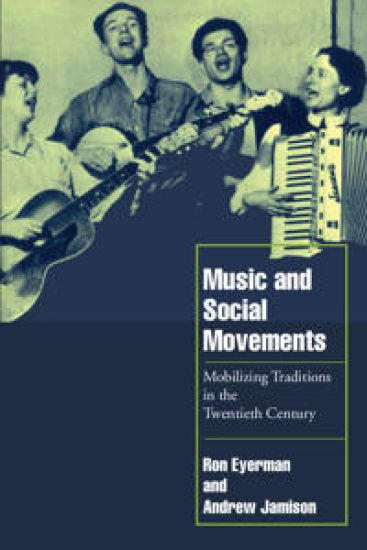
Music and Social Movements

Music and Social Movements

Eyerman Ron; Andrew Jamison

Cambridge University Press
1998
pokkari
Building on their studies of sixties culture and theory of cognitive praxis, Ron Eyerman and Andrew Jamison examine the mobilization of cultural traditions and formulation of new collective identities through the music of activism. They combine a sophisticated theoretical argument with historical-empirical studies of nineteenth-century populists and twentieth-century labour and ethnic movements, focusing on the interrelations between music and social movements in the United States and the transfer of those experiences to Europe. Specific chapters examine folk and country music, black music, music of the 1960s movements, and music of the Swedish progressive movement. This highly readable book is among the first to link the political sociology of social movements to cultural theory.