Kirjojen hintavertailu – 12 859 818 kirjaa ja 27 kauppaa
Kirjailija
Andrew P. Owsiak
Kirjat ja teokset yhdessä paikassa: 6 kirjaa, julkaisuja vuosilta 2019–2025, suosituimpiin kuuluu International Conflict Management. Vertaile teosten hintoja ja tarkista saatavuus suomalaisista kirjakaupoista.
As a rule, countries consider clearly defined international borders to be paramount for their survival and prosperity. Most borders gain definition peacefully and, once they do, these definitions stick (i.e., the border remains settled). The failure to define borders, however, produces protracted, geopolitical, militarized competitions (or rivalries) between neighboring countries. Rider and Owsiak model this failure as a particular type of bargaining problem - namely, bargaining over territory that affects the distribution of power between neighbouring states significantly - that undermines efforts to resolve border disagreements peacefully. Countries must then overcome this bargaining problem or risk falling into a protracted rivalry, which then needs to be addressed with more resources. The authors develop a theory of how borders settle. They then explore the consequences of the failure to settle, theoretically connecting it to the onset of rivalries. This leads to the process that helps rivals overcome the bargaining problem, resolve their border disagreement, and terminate their rivalry.
As a rule, countries consider clearly defined international borders to be paramount for their survival and prosperity. Most borders gain definition peacefully and, once they do, these definitions stick (i.e., the border remains settled). The failure to define borders, however, produces protracted, geopolitical, militarized competitions (or rivalries) between neighboring countries. Rider and Owsiak model this failure as a particular type of bargaining problem - namely, bargaining over territory that affects the distribution of power between neighbouring states significantly - that undermines efforts to resolve border disagreements peacefully. Countries must then overcome this bargaining problem or risk falling into a protracted rivalry, which then needs to be addressed with more resources. The authors develop a theory of how borders settle. They then explore the consequences of the failure to settle, theoretically connecting it to the onset of rivalries. This leads to the process that helps rivals overcome the bargaining problem, resolve their border disagreement, and terminate their rivalry.
International conflict has long plagued the world, and it continues to do so. With many interstate and civil disputes experiencing no third-party attempts at conflict management, how can the international community mitigate the effects of and ultimately end such violence? Why, in so many cases, are early, “golden opportunities” for conflict management missed? In this book, J. Michael Greig, Andrew P. Owsiak, and Paul F. Diehl introduce the varied approaches and factors that promote the de-escalation and the peaceful management of conflict across the globe—from negotiation, mediation, arbitration, and adjudication to peace operations, sanctions, and military or humanitarian intervention. The history, characteristics and agents of each approach are examined in depth, using a wide range of case studies to illustrate successes and failures on the ground. Finally, the book investigates how the various tools interact—both logically and sequentially—to produce beneficial or deleterious effects.
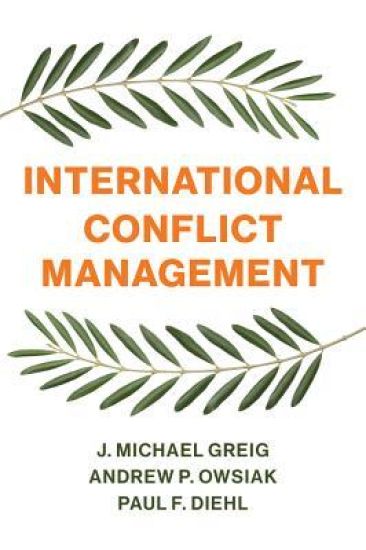
International conflict has long plagued the world, and it continues to do so. With many interstate and civil disputes experiencing no third-party attempts at conflict management, how can the international community mitigate the effects of and ultimately end such violence? Why, in so many cases, are early, “golden opportunities” for conflict management missed? In this book, J. Michael Greig, Andrew P. Owsiak, and Paul F. Diehl introduce the varied approaches and factors that promote the de-escalation and the peaceful management of conflict across the globe—from negotiation, mediation, arbitration, and adjudication to peace operations, sanctions, and military or humanitarian intervention. The history, characteristics and agents of each approach are examined in depth, using a wide range of case studies to illustrate successes and failures on the ground. Finally, the book investigates how the various tools interact—both logically and sequentially—to produce beneficial or deleterious effects.