Kirjojen hintavertailu – 12 903 724 kirjaa ja 27 kauppaa

Kirjailija

Andrew Pepper

Kirjat ja teokset yhdessä paikassa: 11 kirjaa, julkaisuja vuosilta 2000–2019, suosituimpiin kuuluu Bloody Winter. Vertaile teosten hintoja ja tarkista saatavuus suomalaisista kirjakaupoista.

11 kirjaa

Kirjojen julkaisuvuodet: 2000–2019.

Unwilling Executioner

Unwilling Executioner

Andrew Pepper

Oxford University Press
2019
nidottu
What gives crime fiction its distinctive shape and form? What makes it such a compelling vehicle of social and political critique? Unwilling Executioner argues that the answer lies in the emerging genre's complex and intimate relationship with the bureaucratic state and modern capitalism, and the contradictions that ensue once the state assumes control of the criminal justice system. This study offers a dramatic new interpretation of the genre's emergence and evolution over a three hundred year period and as a genuinely transnational phenomenon. From its roots in the tales of criminality circulated widely in Paris and London in the early eighteenth century, this book examines the extraordinary richness, diversity, and complexity of the genre's subsequent thematizations of crime and policing—moving from France and Britain and from continental Europe and the United States to other parts of the globe. In doing so it offers new ways of reading established crime novelists like Gaboriau, Doyle, Hammett, and Simenon, beyond their national contexts and an impulse to characterize their work as either straightforwardly 'radical' or 'conservative'. It also argues for the centrality of writers like Defoe, Gay, Godwin, Vidocq, Morrison, and more recently Manchette, Himes, and Sjöwall and Wahlöö to a project where crime and policing are rooted, and shown to be rooted, in the social and economic conditions of their time. These are all deeply political writers even if their novels exhibit no interest in directly promoting political causes or parties. The result is an agile, layered, and far-reaching account of the crime story's ambivalent relationship to the justice system and its move to complicate our understanding of what crime is and how society is policed and for whose benefit.
Unwilling Executioner

Unwilling Executioner

Andrew Pepper

Oxford University Press
2016
sidottu
What gives crime fiction its distinctive shape and form? What makes it such a compelling vehicle of social and political critique? Unwilling Executioner argues that the answer lies in the emerging genre's complex and intimate relationship with the bureaucratic state and modern capitalism, and the contradictions that ensue once the state assumes control of the criminal justice system. This study offers a dramatic new interpretation of the genre's emergence and evolution over a three hundred year period and as a genuinely transnational phenomenon. From its roots in the tales of criminality circulated widely in Paris and London in the early eighteenth century, this book examines the extraordinary richness, diversity and complexity of the genre's subsequent thematizations of crime and policing--moving from France and Britain and from continental Europe and the United States to other parts of the globe. In doing so it offers new ways of reading established crime novelists like Gaboriau, Doyle, Hammett, and Simenon, beyond their national contexts and an impulse to characterize their work as either straightforwardly 'radical' or 'conservative'. It also argues for the centrality of writers like Defoe, Gay, Godwin, Vidocq, Morrison, and more recently Manchette, Himes, and Sjöwall and Wahlöö to a project where crime and policing are rooted, and shown to be rooted, in the social and economic conditions of their time. These are all deeply political writers even if their novels exhibit no interest in directly promoting political causes or parties. The result is an agile, layered, and far-reaching account of the crime story's ambivalent relationship to the justice system and its move to complicate our understanding of what crime is and how society is policed and for whose benefit.
Bloody Winter

Bloody Winter

Andrew Pepper

Weidenfeld Nicolson
2012
pokkari
The troubled head of the Detective Branch returns, in an intriguing case of kidnap, rebellion and murder... The body of a vagrant is discovered in a ditch in County Tipperary. Knox, a young Irish policeman with divided loyalties is told that the landowner wants the case dealt with swiftly and quietly. However, when Knox examines the corpse, he realises that this supposed vagrant was wearing a Savile Row suit . . . Three months earlier, Detective Inspector Pyke was investigating a kidnapping in Wales. The crime seems to be linked to a group of rebels, but Pyke soon suspects the case is not as clear cut as it seems. What are the links between the rebellion in Wales and the unrest in Ireland - and has Pyke finally bitten off more than he can chew?
The Revenge Of Captain Paine

The Revenge Of Captain Paine

Andrew Pepper

Weidenfeld Nicolson
2012
pokkari
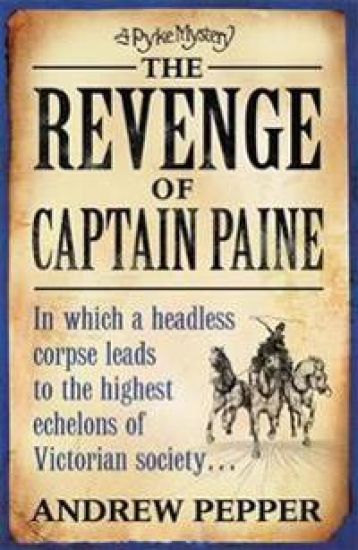
Terrific second novel set in the criminal underworld of pre-Victorian England from the author of THE LAST DAYS OF NEWGATEIt is 1835, and with the birth of the Industrial Revolution, railway fever sweeps the country. Pyke is uneasy with the luxury his aristocratic marriage has brought him, and when he is unofficially asked to investigate a decapitation, he can not resist the chance to resuscitate the old skills he learned on the streets. But with the industrial world comes a new and faceless enemy: men who have money and power, and who will stop at nothing in their pursuit of both. For Pyke, with his young wife and child and an elevated place in society to protect, the stakes have suddenly become alarmingly high. From the sweat shops of the east end to the palace of the Queen-in-waiting; from the elegant drawing rooms of the newly rich, to the blood-spattered backrooms of London's taverns, Pyke's investigation stirs up a hornets' nest of trouble. As the death toll rises, an alluring woman from his past returns, and Pyke must draw on all of his resources if he is to protect his family, and survive.
The Detective Branch

The Detective Branch

Andrew Pepper

Weidenfeld Nicolson
2011
pokkari
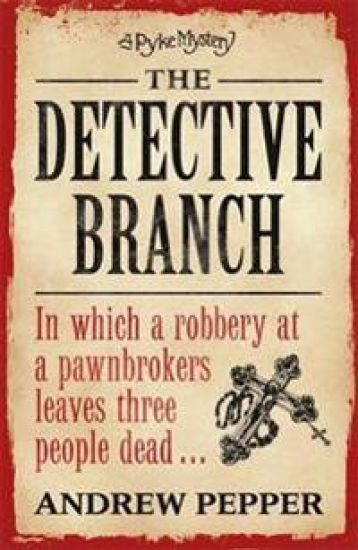
Pyke joins the newly formed Detective Branch of the Metropolitan police in a tale of corruption and murder set in the dangerous backstreets of 19th-century London... Drury Lane, 1844. A robbery has been committed at a pawnbroker's, leaving three people dead. The man called in to investigate is Pyke, head of the Metropolitan Police's newly formed Detective Branch at Scotland Yard. Pyke must find the culprit and quickly, especially as the identity of one of the victims threatens to expose his own criminal past. A valuable religious artefact appears to have motivated the robbery but when the main suspect commits suicide in police custody, the investigation falters. Then the rector of a wealthy parish is brutally murdered and Pyke spots a connection. His suspicions lead him to a dissolute former Catholic priest, rumours of devil worship, and an old case that no one wants him to investigate. With time running out and the murderer threatening to kill again, Pyke must face up to forces within the police and the church who would prefer the secrets of the past to remain buried for ever ...
The Last Days of Newgate

The Last Days of Newgate

Andrew Pepper

Weidenfeld Nicolson
2011
pokkari
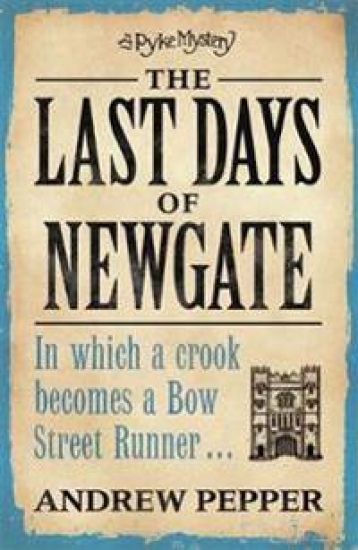
'A story of high intrigue and low politics, brutal murder and cunning conspiracies . . . tangy and rambunctious stuff!' Observer 'Gripping and atmospheric' Daily Express'Enjoyably disturbing . . . likely to leave the reader clamouring for more' TLSSt Giles, London, 1829: three people have been brutally murdered and the city simmers with anger and political unrest. Pyke, sometime Bow Street Runner, sometime crook, finds himself accidentally embroiled in the murder investigation but quickly realises that he has stumbled into something more sinister and far-reaching. In his pursuit of the murderer, Pyke ruffles the feathers of some powerful people and, falsely accused of murder himself, he soon faces a death sentence and the gallows. Imprisoned, and with only his uncle and the headstrong, aristocratic daughter of his greatest enemy to help, Pyke must engineer his escape, find the real killer and untangle the web of intrigue that has been spun around him. A story of intrigue, conspiracy and murder set in 19th-century Britain for fans of Antonia Hodgson, Ripper Street and Patrick Easter.'The novel drips with all the atmospheric details of a pre-Victorian murder mystery - "pea-soupers", dingy lanterns and laudanum' The Times'Pyke ia an intriguingly unfathomable character' Financial Times'Pyke is violent, vengeful and conflicted in the best tradition of detectives. His story takes in grisly murder and torture, and uses 1800s London in the same way that hard-boiled fiction uses Los Angeles as a mirror of a corrupt society' Time Out
American History Contemporary Hollywood Film

American History Contemporary Hollywood Film

Trevor McCrisken; Andrew Pepper

Rutgers University Press
2005
nidottu
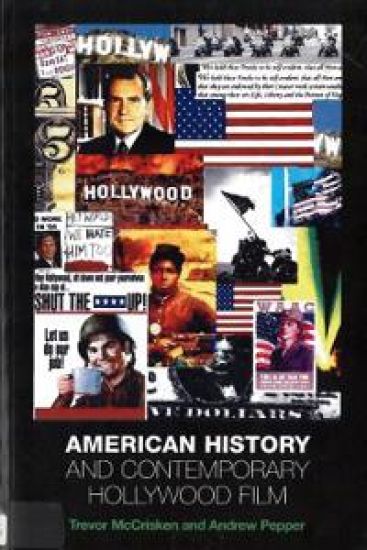
Hollywood has always been fascinated by America's past, but never more so than in the past fifteen years. Bringing exciting new perspectives to how and why Hollywood has sought to repicture American history, this book offers analysis of more than twenty mainstream contemporary films, including The Patriot, Amistad, Glory, Ride with the Devil, Cold Mountain, Saving Private Ryan, The Thin Red Line, Pearl Harbor, U-571, Platoon, Born on the Fourth of July, Heaven and Earth, JFK, Nixon, Malcolm X, Ali, Black Hawk Down, and Three Kings. Both authoritative and engaging, American History and Contemporary Hollywood Film is the first book to comprehensively explore the post-cold war period of filmmaking, and to navigate the complex ways that film mediates history-sometimes challenging or questioning, but more frequently reaffirming traditional interpretations. The authors consider why such films are becoming increasingly integral to the ambitions of a globally focused American film industry. Structured by historical periods, chapters cover significant events and eras such as the American Revolution, slavery and the Civil War, World War II, the sixties and seventies, civil rights and black nationalism, the Vietnam War, and post-cold war global conflicts. The lessons learned from the examples will be illuminating for general readers and college students alike.
American History and Contemporary Hollywood Film

American History and Contemporary Hollywood Film

Trevor McCrisken; Andrew Pepper

Edinburgh University Press
2005
nidottu
Hollywood has a growing fascination with America's past. This is evidenced in the release of a rash of films of this genre in the past 25 years. This book offers an analysis of how and why contemporary Hollywood films have sought to mediate American history. It is the first book to explore, comprehensively, the post-Cold War period of film-making, and to consider whether or how far contemporary films have begun to unravel the unifying myths of earlier films and periods. It also considers why such films are becoming increasingly integral to the ambitions of a globally-focused American film industry. The relationship between film and history - the way in which film mediates history and vice versa - is a complex one. In this book, the authors work from two main assumptions. First, that films revision events to challenge or, perhaps more typically, to reaffirm traditional historical interpretations. Second, that this process can only be understood in the context of contemporary debates about identity politics, America's role in world affairs, and the globalisation of the American film business. The book is structured by historical periods and includes chapters on: * The American Revolution (Revolution, The Patriot) * Slavery (Roots, Amistad) * The Civil War (Gettysburg,Glory,Ride with the Devil, Cold Mountain) * World War II (Saving Private Ryan, Thin Red Line, Pearl Harbor) * Oliver Stone and the Decade of Trauma (Platoon, Born on the Fourth of July, Heaven and Earth, Nixon) * Civil Rights and Black Nationalism (Panther, Mississippi Burning, The Hurricane, Malcolm X, Ali) * American Interventionism (Three Kings, Black Hawk Down) Key Features: * Unique: the only book to provide comprehensive analysis of the relationship between film and American history in the post-Cold War era * Topical: explores the relationship between cinema, representation and national identity * Accessible: analyses a broad range of popular, mainstream films which engage with well-known historical events * Uses cultural theory to help consider the complex relationship between film and history * Engages with the contentious issue of the extent to which film distorts/ revisions historical 'truths'
American History and Contemporary Hollywood Film

American History and Contemporary Hollywood Film

Trevor McCrisken; Andrew Pepper

Edinburgh University Press
2005
sidottu
Hollywood has a growing fascination with America's past. This is evidenced in the release of a rash of films of this genre in the past 25 years. This book offers an analysis of how and why contemporary Hollywood films have sought to mediate American history. It is the first book to explore, comprehensively, the post-Cold War period of film-making, and to consider whether or how far contemporary films have begun to unravel the unifying myths of earlier films and periods. It also considers why such films are becoming increasingly integral to the ambitions of a globally-focused American film industry. The relationship between film and history - the way in which film mediates history and vice versa - is a complex one. In this book, the authors work from two main assumptions. First, that films revision events to challenge or, perhaps more typically, to reaffirm traditional historical interpretations. Second, that this process can only be understood in the context of contemporary debates about identity politics, America's role in world affairs, and the globalisation of the American film business. The book is structured by historical periods and includes chapters on: * The American Revolution (Revolution, The Patriot) * Slavery (Roots, Amistad) * The Civil War (Gettysburg,Glory,Ride with the Devil, Cold Mountain) * World War II (Saving Private Ryan, Thin Red Line, Pearl Harbor) * Oliver Stone and the Decade of Trauma (Platoon, Born on the Fourth of July, Heaven and Earth, Nixon) * Civil Rights and Black Nationalism (Panther, Mississippi Burning, The Hurricane, Malcolm X, Ali) * American Interventionism (Three Kings, Black Hawk Down) Key Features: * Unique: the only book to provide comprehensive analysis of the relationship between film and American history in the post-Cold War era * Topical: explores the relationship between cinema, representation and national identity * Accessible: analyses a broad range of popular, mainstream films which engage with well-known historical events * Uses cultural theory to help consider the complex relationship between film and history * Engages with the contentious issue of the extent to which film distorts/ revisions historical 'truths'
The Contemporary American Crime Novel

The Contemporary American Crime Novel

Andrew Pepper

Edinburgh University Press
2000
nidottu
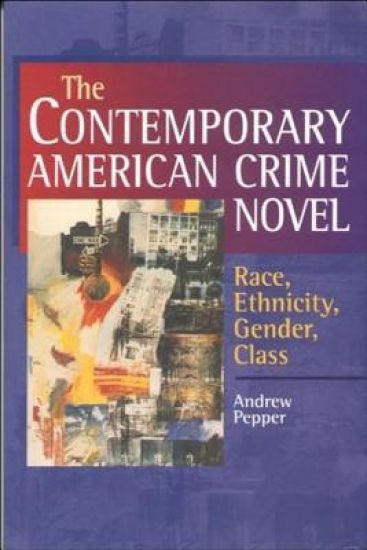
As America's ethnic and racial character undergoes explosive transformation, its crime fictions trace, contest and celebrate the changes. The Contemporary American Crime Novel is an exciting book that offers a comprehensive overview of recent developments in American crime fiction, exploring America's dynamic, fragmented multicultural landscape and how this changing landscape has, in the process, transformed the codes and conventions of the crime novel. Mapping the genre's ideological complexities and unreconcilable tensions, its preference for uncovering, contesting and yet also reinforcing traditional relations of domination and subordination, and its vision of a morally-impaired, conflict-riven society on the verge of disintegration, The Contemporary American Crime Novel considers the emergence of African-American, female, gay, lesbian, Latino- and Asian-American crime writers alongside contemporary developments in white, male hard-boiled crime fiction. While race and ethnicity are the main focus on the book, class, gender, sexuality and region are taken into account as 'complicating factors' in the construction of identity. Authors featured include James Ellroy, James Lee Burke, Sara Paretsky, Barbara Wilson, Chester Himes, Walter Mosley, Faye Kellerman, Alex Abella and Chang-Rae Lee. Steering an informed course between the dogmas of left-wing political correctness and right-wing jingoism, the book is an engaging and accessible attempt to rescue the American crime novel from its celebrants and detractors and provide a new reading that explores the genre's growing popularity and foregrounds its ambiguities and complexities. The book will provide a lively and provocative introduction to key debates on the study of the genre, the question of multiculturalism and the theorising of race and ethnicity in the United States.