Kirjojen hintavertailu – 12 903 724 kirjaa ja 27 kauppaa

Kirjailija

Andrew R. L. Cayton

Kirjat ja teokset yhdessä paikassa: 4 kirjaa, julkaisuja vuosilta 1989–2021, suosituimpiin kuuluu Frontier Indiana. Vertaile teosten hintoja ja tarkista saatavuus suomalaisista kirjakaupoista.

Nimi esiintyy myös muodoissa: Andrew R L Cayton

4 kirjaa

Kirjojen julkaisuvuodet: 1989–2021.

Ohio

Ohio

Andrew R L Cayton

Ohio State University Press
2021
pokkari
As the state of Ohio prepares to celebrate its bicentennial in 2003, Andrew R. L. Cayton offers an account of ways in which diverse citizens have woven its history. Ohio: The History of a People, centers around the many stories Ohioans have told about life in their state. The founders of Ohio in 1803 believed that its success would depend on the development of a public culture that emphasized what its citizens had in common with each other. But for two centuries the remarkably diverse inhabitants of Ohio have repeatedly asserted their own ideas about how they and their children should lead their lives. The state's public culture has consisted of many voices, sometimes in conflict with each other. Using memoirs, diaries, letters, novels, and paintings, Cayton writes Ohio's history as a collective biography of its citizens. Ohio, he argues, lies at the intersection of the stories of James Rhodes and Toni Morrison, Charles Ruthenberg and Lucy Webb Hayes, Carl Stokes and Alice Cary, Sherwood Anderson and Pete Rose. It lies in the tales of German Jews in Cincinnati, Italian and Polish immigrants in Cleveland, Southern blacks and white Appalachians in Youngstown. Ohio is the mingled voices of farm families, steelworkers, ministers, writers, schoolteachers, reformers, and football coaches. Ohio, in short, is whatever its citizens have imagined it to be.
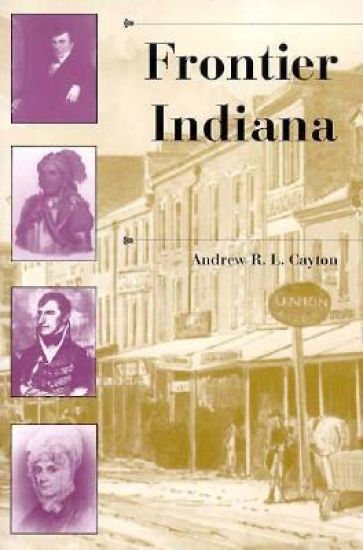
Frontier Indiana

Frontier Indiana

Andrew R. L. Cayton

Indiana University Press
1998
pokkari
Frontier Indiana Andrew R. L. Cayton "The research and scholarship that went into the work are excellent; so good, in fact, that the book should be on the required text list for all Transappalachian frontier courses." —History Cayton's lively new history of the frontier period in Indiana puts the focus on people, on how they lived, how they viewed their world, and what motivated them. Here are the stories of Sieur de Vincennes, John Francis Hamtramck, Little Turtle, Anna Tuthill Symmes Harrison, Tenskwatawa, Calvin Fletcher—along with many more familiar (and not so familiar) early Hoosiers. Sales territory is worldwide A History of the Trans-Appalachian Frontier 1996; 360 pages, 20 b&w photos, 2 maps, index, 6 x 9 cloth0-253-33048-3$39.95 L / £28.50 paper0-253-21217-0$18.95 t / £13.50
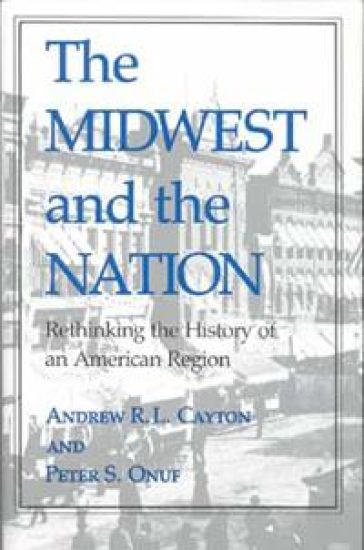
The Midwest and the Nation

The Midwest and the Nation

Andrew R. L. Cayton; Peter S. Onuf

Indiana University Press
1990
sidottu
"Cayton and Onuf have tried to recapture a central place for region in our thinking while, at the same time, incorporating into their analysis the latest scholarship on gender, political behavior, etc. Theirs is a fine blending of the old and the new: old scholarship and new directions." —Malcolm J. Rohrbough "This is an ambitious work that . . . truly beongs on the 'must do' reading list of all midwestern and American historians." —American Historical Review " . . . an impressive interpretive work that will command the attention of regional historians and national scholars alike." —Illinois Historical Journal " . . . an excellent extended historiographic essay that seeks not only to locate the significance of the region created by the early land ordinance but also to raise issues for the historical examination of other regions of the country." —South Dakota History "What makes this book especially interesting and valuable is that it is informed by the post-modern scholar's view that knowledge can never be objective and eternally true; rather, it is subjective and socially constructed, shaped by the political, social, intellectual, and economic environments in which it is formed." —Western Illinois Regional Studies "The book's review of scholarship about the region is exhaustive, as well as brisk and lucid." —American Studies International " . . . a rigorous intellecutal analysis of the region's most important historiography." —Gateway Heritage " . . . an excellent book . . . " —The Annals of Iowa "What is impressive about this densely written work is the number of secondary works incorporated into the text and the importance of the authors' thesis of the considerable influence of happenings in the Midwest of the nineteenth century." —North Dakota History "There is . . . much to be praised in this book, and it will be frequently used and discussed by scholars of the early Midwest." —Journal of American History
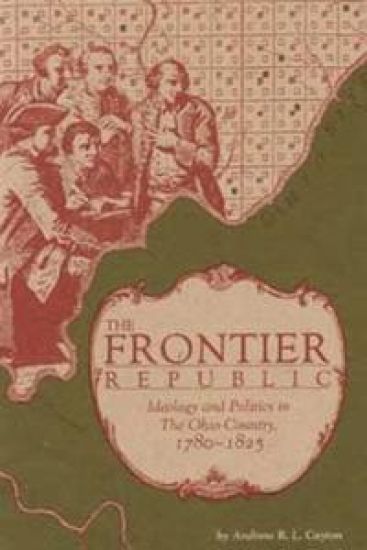
Frontier Republic

Frontier Republic

Andrew R. L. Cayton

Kent State University Press
1989
nidottu
Conflict invariably characterizes the period following any revolution, and post-revolutionary America was no exception. After the unity inspired by opposition to a common enemy dissipates, revolutionary movements generally splinter into different groups that compete with each other for the right to shape the values and structures of the new society. The Frontier Republic examines the form these conflicts took in the settlement of the Ohio Country, as thousands of Americans streamed onto the lands west of the Appalachians. These settlers had experienced revolution and migration: now the process of creating new communities and a new state in the Northwest Territory forced them to deliberate on, and define, what these upheavals had accomplished. At issue was the very nature of human society and the role of government in it. Jeffersonian Republican ideals of individual liberty and local sovereignty were at odds with the Federalist vision of a well-ordered society and political control on the national level. Disagreements arose over such topics as rights of squatters, establishment of authority of the national government, the statehood movement, and the location of the new state’s capital. The effects of the Panic of 1819 and the need for internal improvements changed the early focus on individualism to an understanding of Ohio’s place in an interdependent society. Although this first generation of settlers failed to resolve their disputes completely, they ensured that the ideological foundation of nineteenth-century Ohio would be a synthesis of their conflicting revolutionary visions of the future of the United States.