Kirjojen hintavertailu – 12 859 829 kirjaa ja 27 kauppaa

Kirjailija

Andrew Roberts

Kirjat ja teokset yhdessä paikassa: 78 kirjaa, julkaisuja vuosilta 2003–2026, suosituimpiin kuuluu The Enduring Crown Commonwealth. Vertaile teosten hintoja ja tarkista saatavuus suomalaisista kirjakaupoista.

78 kirjaa

Kirjojen julkaisuvuodet: 2003–2026.

The Great Commanders of the Medieval World 454-1582AD
What qualities made Attila the Hun a strategist of genius? How did Henry V of England achieve victory at Agincourt for the loss of a few hundred of his men, when the mounted French knights suffered casualties in the thousands? Why was Hernán Cortés able to lead a ragged band of men to bring down the extraordinary power of the Aztec empire? The answers to these and a myriad other fascinating questions can be found in Great Commanders of the Medieval World, a sumptuous chronological survey of the 25 greatest commanders of the medieval world. Compiled by an distinguished team of historians (including such names as Jonathan Sumption, Felipe Fernández-Armesto and John Julius Norwich) working under the general editorship of Andrew Roberts, Great Commanders of the Medieval World is an authoritative and beautifully illustrated account of the lives and careers of the 25 greatest military commanders of the period, from William the Conqueror to Genghis Khan, from the Black Prince to Tamerlaine, and from Joan of Arc to Süleyman the Magnificent. Every commander is profiled in a concise and informative 3000-word article which not only brings its subject vividly to life via a lively, fact-driven narrative, but also analyses and assesses his tactical and strategic gifts. As accessible and informative as it is rigorous and scholarly, Great Commanders of the Medieval World is the perfect introduction to its subject for the layperson - but also a stimulating and thought-provoking read for those with greater knowledge of military history. With its companion volumes, focusing on the great commanders of the ancient, early modern and modern eras, it forms an indispensable guide to the greatest generals the world has seen.
The Great Commanders of the Ancient World 1479BC - 453AD

The Great Commanders of the Ancient World 1479BC - 453AD

Andrew Roberts

Quercus Publishing
2011
pokkari

Halvin toimitettuna 19,30 €

Which was the most brilliant of Hannibal's three crushing defeats of Roman armies? What tactics did Julius Caesar employ to defeat Pompey at Pharsalus? How was Alexander the Great able to command sufficient loyalty from his troops to lead them across half of the Asian landmass in search of new territories to conquer? The answers to these and a myriad other fascinating questions can be found in Great Commanders of the Ancient World, a sumptuous chronological survey of the 50 greatest commanders of the ancient world. Compiled by an distinguished team of historians (including such names as Robin Lane Fox, Tom Holland and John Julius Norwich) working under the general editorship of Andrew Roberts, Great Commanders of the Ancient World is an authoritative and beautifully illustrated account of the lives and careers of the 25 greatest military commanders of the period, from Julius Caesar to Judas Maccabeus, from Sun Tzu to Scipio Africanus, and from Thucydides to Trajan. Every commander is profiled in a concise and informative 3000-word article which not only brings its subject vividly to life via a lively, fact-driven narrative, but also analyses and assesses his tactical and strategic gifts. As accessible and informative as it is rigorous and scholarly, Great Commanders of the Ancient World is the perfect introduction to its subject for the layperson - but also a stimulating and thought-provoking read for those with greater knowledge of military history. With its companion volumes, focusing on the great commanders of the medieval, early modern and modern eras, it forms an indispensable guide to the greatest generals the world has seen.
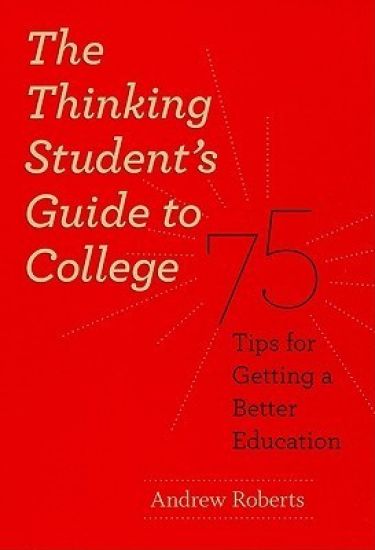
The Thinking Student's Guide to College

The Thinking Student's Guide to College

Andrew Roberts

University of Chicago Press
2010
nidottu
Each fall, thousands of eager freshmen descend on college and university campuses expecting the best education imaginable: inspiring classes taught by top-ranked professors, academic advisors who will guide them to a prestigious job or graduate school, and an environment where learning flourishes outside the classroom as much as it does in lecture halls. Unfortunately, most of these freshmen soon learn that academic life is not what they imagined. Glasses are taught by overworked graduate students and adjuncts rather than seasoned faculty members, undergrads receive minimal attention from advisors or administrators, and potentially valuable campus resources remain outside their grasp. Andrew Roberts' "Thinking Student's Guide to College" helps students take charge of their university experience by providing a blueprint they can follow to achieve their educational goals - whether at public or private schools, large research universities, or small liberal arts colleges. An inside look penned by a professor at Northwestern University, this book offers concrete tips on choosing a college, selecting classes, deciding on a major, interacting with faculty, and applying to graduate school. Here, Roberts exposes the secrets of the ivory tower to reveal what motivates professors, where to find loopholes in university bureaucracy, and, most importantly, how to get a personalized education. Based on interviews with faculty and cutting-edge educational research, "The Thinking Student's Guide to College" is a necessary handbook for students striving to excel academically, creatively, and personally during their undergraduate years.
The Thinking Student's Guide to College

The Thinking Student's Guide to College

Andrew Roberts

University of Chicago Press
2010
sidottu
Each fall, thousands of eager freshmen descend on college and university campuses expecting the best education imaginable: inspiring classes taught by top-ranked professors, academic advisors who will guide them to a prestigious job or graduate school, and an environment where learning flourishes outside the classroom as much as it does in lecture halls. Unfortunately, most of these freshmen soon learn that academic life is not what they imagined. Classes are taught by overworked graduate students and adjuncts rather than seasoned faculty members, undergrads receive minimal attention from advisors or administrators, and potentially valuable campus resources remain outside their grasp. Andrew Roberts' "Thinking Student's Guide to College" helps students take charge of their university experience by providing a blueprint they can follow to achieve their educational goals - whether at public or private schools, large research universities, or small liberal arts colleges. An inside look penned by a professor at Northwestern University, this book offers concrete tips on choosing a college, selecting classes, deciding on a major, interacting with faculty, and applying to graduate school. Here, Roberts exposes the secrets of the ivory tower to reveal what motivates professors, where to find loopholes in university bureaucracy, and, most importantly, how to get a personalized education. Based on interviews with faculty and cutting-edge educational research, "The Thinking Student's Guide to College" is a necessary handbook for students striving to excel academically, creatively, and personally during their undergraduate years.
Hitler and Churchill

Hitler and Churchill

Andrew Roberts

Weidenfeld Nicolson
2010
pokkari
'His book is timely and a triumph. Roberts manages to convey all the reader needs to know about two men to whom battalions of biographies have been devoted' EVENING STANDARDAdolf Hitler and Winston Churchill were two totally opposite leaders - both in what they stood for and in the way in which they seemed to lead. Award-winning historian Andrew Roberts examines their different styles of leadership and draws parallels with rulers from other eras. He also looks at the way Hitler and Churchill estimated each other as leaders, and how it affected the outcome of the war. In a world that is as dependent on leadership as any earlier age, HITLER AND CHURCHILL asks searching questions about our need to be led. In doing so, Andrew Roberts forces us to re-examine the way that we look at those who take decisions for us.
Krigens storm

Krigens storm

Andrew Roberts

Cappelen Damm
2010
sidottu
Hvorfor tapte Hitler krigen? Denne boken er en annerledes fremstilling av den andre verdenskrig, der forfatteren Andrew Roberts undersøker om aksemaktene kunne ha seiret med en annen strategi og beslutningsprosess. De tyske generalene som etter 1945 la all skyld på Hitlers lederskap, hadde de rett, eller ble han bare en syndebukk for alt som gikk galt? I arbeidet med Krigens storm har Roberts besøkt mange av de sentrale slagmarkene i Russland, Frankrike, Italia, Tyskland og det fjerne Østen. Boken bygger også på flere viktige og tidligere upubliserte dokumenter. Historier om ulike aktører på begge sider viser hvordan de kom frem til sine avgjørelser. Også de mange ukjente individene som med ekstraordinært mot og selvoppofrelse kastet seg inn i den grusomme krigen, får sine historier fortalt. Med sans for detaljer skildrer forfatteren krigen på land, til vanns og i luften. Dette er den perfekte boken for den som vil følge de militære operasjonene på det strategiske plan, og på slagmarken. Boken er utstyrt med et rikt bilde- og kartmateriale.
The Storm of War

The Storm of War

Andrew Roberts

Penguin Books Ltd
2010
pokkari
From the author of Masters and Commanders, Andrew Roberts' The Storm of War: A New History of the Second World War has been hailed as the finest single-volume account of this epic conflict. The Second World War lasted for 2,174 days and claimed the lives of over 50 million people. Why did it take the course that it did? Why did the Axis lose? And could they, with a different strategy, have won? Ranging from the Western front to North Africa, from the Baltic to the Far East, he brings the story of the war - and those who fought it - into focus as never before. 'One of the greatest historians of our time ... His masterpiece' Oliver Marre, Observer 'An undoubted triumph. This, simply, is the best one-volume history of the Second World War currently available' Laurence Rees 'Magnificent ... Stylish penmanship, gritty research and lucid reasoning, coupled with poignant and haunting detours into private lives ruined and shortened' Economist 'Moving, thought-provoking, enlightening' Roger Moorhouse, Independent 'An exceptional accomplishment ... the definitive single-volume history of the war ... Essential' Peter Watts, Time Out 'In what might be his best book yet, Roberts gives us the war as seen from the other side of the hill - the German Reich' Nigel Jones, Sunday Telegraph Andrew Roberts's Masters and Commanders was one of the most acclaimed, bestselling history books of 2008. His previous books include Salisbury: Victorian Titan (1999), which won the Wolfson History Prize and the James Stern Silver Pen Award for Non-Fiction, Hitler and Churchill: Secrets of Leadership (2003), which coincided with four-part BBC2 history series.
The Quality of Democracy in Eastern Europe

The Quality of Democracy in Eastern Europe

Andrew Roberts

Cambridge University Press
2009
sidottu
How does democracy work in the new democracies of Eastern Europe? Do the people actually rule as one would expect in a democracy or do the legacies of communism and the constraints of the transition weaken popular control? This book presents a framework for conceptualizing and measuring democratic quality and applies this framework to multiple countries and policy areas in the region. It defines democratic quality as the degree to which citizens are able to hold leaders accountable for their performance and keep policy close to their preferences. Its surprising conclusion, drawn from large-N statistical analyses and small-N case studies, is that citizens exercise considerable control over their rulers in Eastern European democracies. Despite facing difficult economic circumstances and an unfavorable inheritance from communism, these countries rapidly constructed relatively high-quality democracies.
Masters and Commanders

Masters and Commanders

Andrew Roberts

Penguin Books Ltd
2009
pokkari
Andrew Roberts's Masters and Commanders: The Military Geniuses who led the West to Victory in WWII tells the story of how four great leaders fought each other over how best to fight Hitler. During the Second World War the master strategy of the West was shaped by four titanic figures: Winston Churchill and Franklin Roosevelt, and their respective military commanders - General Sir Alan Brooke and General George C. Marshall. Each man was tough-willed and strong minded. And each was certain he knew best how to achieve victory. Drawing on previously unpublished material, including for the first time verbatim reports of Churchill's War Cabinet meetings, Andrew Roberts's acclaimed history recreates with vivid immediacy the fiery debates and political maneuverings, the rebuffs and the charm, the explosive rows and dramatic reconciliations, as the masters and commanders of the Western Alliance fought each other over the best way to fight Adolf Hitler. 'History as it should be written; a gripping narrative' Michael Gove, Mail on Sunday Books of the Year 'Scintillating historical writing on the whole rich panorama of Britain and the US at war' Martin Gilbert, Evening Standard 'A compelling analysis of American and British military strategy during the war. He also tells a profoundly human story' Laurence Rees, Sunday Times 'A masterpiece' Christopher Silvester, Daily Express 'Britain's finest contemporary military historian' Economist Books of the Year Andrew Roberts is a biographer and historian of international renown whose previous books include Salisbury: Victorian Titan (1999), which won the Wolfson History Prize and the James Stern Silver Pen Award for Non-Fiction; Napoleon and Wellington (2001); Hitler and Churchill: Secrets of Leadership (2003), which coincided with four-part BBC2 history series, and A History of the English-Speaking Peoples Since 1900 (2005).
A History of the English-Speaking Peoples Since 1900
A magisterial history inspired by Winston Churchill's famous opus, A History of the English-Speaking Peoples Since 1900 is an engrossing account of the twentieth century, with a unique perspective on our turbulent times. In 1900, where Churchill ended the fourth volume of his History of the English-Speaking Peoples, the United States had not yet emerged onto the world scene as a great power. Yet the coming century was to belong to the English-speaking peoples, who successively and successfully fought the Kaiser's Germany, Axis aggression and Soviet Communism, and who are now struggling against Islamic fundamentalist terrorism. Andrew Roberts's History proves especially invaluable as the United States today looks to other parts of the English-speaking world as its best, closest and most dependable allies.
Waterloo

Waterloo

Andrew Roberts

HarperPerennial
2006
nidottu

Halvin toimitettuna 15,00 €

An exciting retelling of one of the moments that shook the world – Waterloo, one of the truly decisive battles of history. In ‘Waterloo’, Roberts provides not only a fizzing account of one of the most significant forty-eight hour periods of all time, but also a startling interrogation into the methodology of history – is it possible to create an accurate picture from a single standpoint? What we can say for certain about the battle is that it ended forever one of the great personal epics. The career of Napoleon was brought to a shuddering halt on the evening of 18 June 1815. Interwoven in the clear-cut narrative are exciting revelations brought to light by recent research: accident rather than design led to the crucial cavalry debacle that lost the battle. Amongst the all-too-human explanation for the blunder that cost Napoleon his throne, Roberts sets the political, strategic and historical scene, and finally shows why Waterloo was such an important historical punctuation mark. The generation after Waterloo saw the birth of the modern era: ghastly as the carnage here was, henceforth the wars of the future were fought with infinitely more ghastly methods of trenches, machine-guns, directed starvation, concentration camps, and aerial bombardment. By the time of the Great War, chivalry was utterly dead. The honour of bright uniform and tangible spirit of élan met their final dance at Waterloo.
Waterloo: June 18, 1815: The Battle for Modern Europe
June 18, 1815, was one of the most momentous days in world history, marking the end of twenty-two years of French Revolutionary and Napoleonic Wars. On the bloody battlefield of Waterloo, the Emperor Napoleon and his hastily formed legions clashed with the Anglo-Allied armies led by the Duke of Wellington -- the only time the two greatest military strategists of their age faced each other in combat. With precision and elegance, Andrew Roberts sets the political, strategic, and historical scene, providing a breathtaking account of each successive stage of the battle while also examining new evidence that reveals exactly how Napoleon was defeated. Illuminating, authoritative, and engrossing, Waterloo is a masterful work of history.
From Good King Wenceslas to the Good Soldier Švejk

From Good King Wenceslas to the Good Soldier Švejk

Andrew Roberts

Central European University Press
2005
nidottu
Roberts' book follows in the tradition of recent scholarship that seeks to emphasize the importance of popular culture and the wealth of knowledge that can be gained through an analysis of the daily lives and practices of individuals. Focusing on popular songs, movie stars, famous athletes, traditional dishes, and children's games that are second nature to every Czech, Roberts' work serves as an introduction to Czech popular culture. This dictionary is a sizeable achievement as it offers an English readership an invaluable source of information to a rich body of material that has thus far remained ephemeral. The six hundred entries are cross-referenced and allow readers to pursue particular topics in greater depth. Written in a readable style this work is easily accessible to a wide readership.
Eminent Churchillians

Eminent Churchillians

Andrew Roberts

Weidenfeld Nicolson
2004
pokkari
A controversial account of the Churchill years by a bestselling historian.'The best sort of history - revealing, gossipy and acidulous' OBSERVERThis highly praised book by the Wolfson History Prize-winning author of SALISBURY tackles six aspects of Churchilliana and uncovers a plethora of disturbing facts about wartime and post-war Britain. His revelations include: - The case for the impeachment of Lord Mountbatten- The Nazi sympathies of Sir Arthur Bryant, hitherto considered a 'patriotic historian'- The British establishment's doubt about Churchill's role after Dunkirk- The appeasement of the trade unions in Churchill's Indian summer- The inside story of black immigration in the early 1950s- The anti-Churchill stance adopted by the Royal Family in 1940
Napoleon and Wellington

Napoleon and Wellington

Andrew Roberts

Orion Publishing Co
2003
pokkari

Halvin toimitettuna 21,70 €

A dual biography of the greatest opposing generals of their age who ultimately became fixated on one another, by a bestselling historian. 'Thoroughly enjoyable, beautifully written and meticulously researched' Observer