Kirjailija
Andrew Stables
Kirjat ja teokset yhdessä paikassa: 12 kirjaa, julkaisuja vuosilta 2008–2020, suosituimpiin kuuluu Semiotic Theory of Learning. Vertaile teosten hintoja ja tarkista saatavuus suomalaisista kirjakaupoista.
12 kirjaa
Kirjojen julkaisuvuodet: 2008–2020.
This book examines “New Localism' – exploring how communities have turned towards more local concerns: my street, my town, my state, as an expression of dissatisfaction with globalization. It details the ideas that have created a political force that academics have often misunderstood and provides a template for further investigation with a strong focus on how to harness the motivations behind such changes for the benefit of individuals, communities and the more-than-human environment. The book discusses human progress, both individual and collective, in terms of the interactions of the local and the global, the specific and the universal, and the concrete and the abstract. It also considers how forms of social progress can be understood and reconfigured in the context of the rejection of certain aspects of liberal intelligentsia orthodoxy over recent years. Developing his arguments with specific reference to the evolving, political landscape, the author helpsreaders to understand major events such as the Trump presidency and the British vote to leave the EU from a fully semiotic perspective. He also explains how educational processes can use and respond to such events in ways that are locally grounded but nevertheless not at odds with more abstract formulations of progress such as sustainability and social justice.
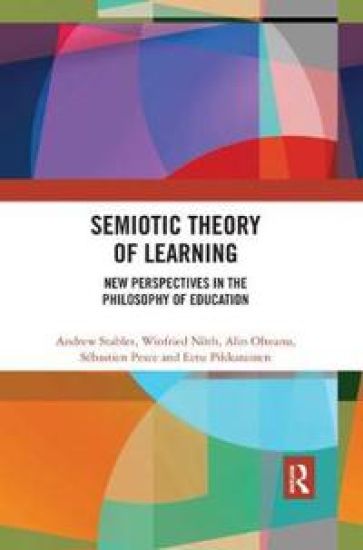
Semiotic Theory of Learning
Andrew Stables; Winfried Nöth; Alin Olteanu; Sébastien Pesce; Eetu Pikkarainen
Routledge
2020
nidottu
Semiotic Theory of Learning asks what learning is and what brings it about, challenging the hegemony of psychological and sociological constructions of learning in order to develop a burgeoning literature in semiotics as an educational foundation. Drawing on theoretical research and its application in empirical studies, the book attempts to avoid the problematization of the distinction between theory and practice in semiotics. It covers topics such as signs, significance and semiosis; the ontology of learning; the limits of learning; ecosemiotics; ecology and sexuality. The book is written by five of the key figures in the semiotics field, each committed to the belief that living is a process of interaction through acts of signification with a signifying environment. While the authors are agreed on the value of semiotic frameworks, the book aims not to present an entirely coherent line in every respect, but rather to reflect ongoing scholarship and debates in the area. In light of this, the book offers a range of possible interpretations of major semiotic theorists, unsettling assumptions while offering a fresh, and still developing, series of perspectives on learning from academics grounded in semiotics. Semiotic Theory of Learning is a timely and valuable text that will be of great interest to academics, researchers and postgraduates working in the fields of educational studies, semiotics, psychology, philosophy, applied linguistics and media studies.
This book was published in 2003. Certain social and cultural changes have problematized many of the assumptions that underpinned educational thinking in the 20th century. These can be grouped under three broad headings: individualization, globalization and the ecological challenge. Each of these has potentially profound implications for education that have been little explored. Rising to the challenge, this volume examines individualization in relation to changing attitudes to childhood and the positioning and identity development of students within educational "markets". It discusses globalization from several crucial perspectives, including the reduced sovereignty of the nation state and the problematizing of notions of distance and proximity. The ever-increasing environmental crisis is considered in terms of the possibilities for education for sustainable development. The author adopts a pragmatic approach, exploring the supremacy of individual and collective "readings" of the world and divulging his views on whether education is capable of determining the future in predefined ways.
This book examines “New Localism' – exploring how communities have turned towards more local concerns: my street, my town, my state, as an expression of dissatisfaction with globalization. It details the ideas that have created a political force that academics have often misunderstood and provides a template for further investigation with a strong focus on how to harness the motivations behind such changes for the benefit of individuals, communities and the more-than-human environment. The book discusses human progress, both individual and collective, in terms of the interactions of the local and the global, the specific and the universal, and the concrete and the abstract. It also considers how forms of social progress can be understood and reconfigured in the context of the rejection of certain aspects of liberal intelligentsia orthodoxy over recent years. Developing his arguments with specific reference to the evolving, political landscape, the author helpsreaders to understand major events such as the Trump presidency and the British vote to leave the EU from a fully semiotic perspective. He also explains how educational processes can use and respond to such events in ways that are locally grounded but nevertheless not at odds with more abstract formulations of progress such as sustainability and social justice.

Presenting qualitative and quantative findings from the unique, multi-disciplinary project, Design Matters?, this timely book explores the complex relationship between school design and practice to consider how environmental aspects impact on the day-to-day perceptions, actions and behaviours of pupils, teachers, leaders and professionals within the school community. Exploring debates and issues from a number of different professional and academic perspectives, School Design Matters results from a rich collaboration between schools, architects, engineers, educationalists and policymakers to consider what an inspiring teaching and learning environment might look like. Case studies and first-hand student and teacher experience allow analysis of the ways in which environmental factors might transform pedagogy, shape patterns of leadership, improve student engagement and enhance social interactions within and beyond the school community. Experts in their fields, authors acknowledge the significance of sociocultural contexts, reference relevant policy, and tackle the tensions, dilemmas and contradictions which frequently arise as schools and professionals in the design and construction sectors collaborate in the creation of buildings which fulfil the needs of diverse, invested parties. Offering a uniquely holistic approach to understanding the ways in which design may contribute, shape and mediate teaching and learning, this comprehensive text will be essential reading for educationalists, architects, policymakers and professionals involved in the design, construction and use of school buildings.
Semiotic Theory of Learning
Andrew Stables; Winfried Nöth; Alin Olteanu; Sébastien Pesce; Eetu Pikkarainen
Routledge
2018
sidottu
Semiotic Theory of Learning asks what learning is and what brings it about, challenging the hegemony of psychological and sociological constructions of learning in order to develop a burgeoning literature in semiotics as an educational foundation. Drawing on theoretical research and its application in empirical studies, the book attempts to avoid the problematization of the distinction between theory and practice in semiotics. It covers topics such as signs, significance and semiosis; the ontology of learning; the limits of learning; ecosemiotics; ecology and sexuality. The book is written by five of the key figures in the semiotics field, each committed to the belief that living is a process of interaction through acts of signification with a signifying environment. While the authors are agreed on the value of semiotic frameworks, the book aims not to present an entirely coherent line in every respect, but rather to reflect ongoing scholarship and debates in the area. In light of this, the book offers a range of possible interpretations of major semiotic theorists, unsettling assumptions while offering a fresh, and still developing, series of perspectives on learning from academics grounded in semiotics. Semiotic Theory of Learning is a timely and valuable text that will be of great interest to academics, researchers and postgraduates working in the fields of educational studies, semiotics, psychology, philosophy, applied linguistics and media studies.
This book was published in 2003. Certain social and cultural changes have problematized many of the assumptions that underpinned educational thinking in the 20th century. These can be grouped under three broad headings: individualization, globalization and the ecological challenge. Each of these has potentially profound implications for education that have been little explored. Rising to the challenge, this volume examines individualization in relation to changing attitudes to childhood and the positioning and identity development of students within educational "markets". It discusses globalization from several crucial perspectives, including the reduced sovereignty of the nation state and the problematizing of notions of distance and proximity. The ever-increasing environmental crisis is considered in terms of the possibilities for education for sustainable development.
Edusemiotics addresses an emerging field of inquiry, educational semiotics, as a philosophy of and for education. Using "sign" as a unit of analysis, educational semiotics amalgamates philosophy, educational theory and semiotics. Edusemiotics draws on the intellectual legacy of such philosophers as John Dewey, Charles Sanders Peirce, Gilles Deleuze and others across Anglo-American and continental traditions. This volume investigates the specifics of semiotic knowledge structures and processes, exploring current dilemmas and debates regarding self-identity, learning, transformative and lifelong education, leadership and policy-making, and interrogating an important premise that still haunts contemporary educational philosophy: Cartesian dualism. In defiance of substance dualism and the fragmentation of knowledge that still inform education, the book offers a unifying paradigm for education as edusemiotics and emphasises ethical education in compliance with the semiotic unity between knowledge and action. Chapters contain accessible discussions in the context of educational philosophy and theory, crossing the borders between logic, art, and science together with a provocative theoretical critique. Recently awarded a PESA book award for its contribution to the philosophy of education, Edusemiotics will appeal to an academic readership in education, philosophy and cultural studies, while also being an inspiring resource for students.
Childhood and the Philosophy of Education
Andrew Stables
Continuum Publishing Corporation
2011
nidottu
Philosophical accounts of childhood have tended to derive from Plato and Aristotle, who portrayed children (like women, animals, slaves, and e mob) as unreasonable and incomplete in terms of lacking formal and final causes and ends. Despite much rhetoric concerning either the sinfulness or purity of children (as in Puritanism and Romanticism respectively), the assumption that children are marginal has endured. Modern theories, including recent interpretations of neuroscience, have re-enforced this sense of children's incompleteness. This fascinating monograph seeks to overturn this philosophical tradition. It develops instead a fully semiotic perspective, arguing that in so far as children are no more or less interpreters of the world than adults, they are no more or less reasoning agents. This, the book shows, has radical implications, particularly for the question of how we seek to educate children. One Aristotelian legacy is the unquestioned belief that societies must educate the young irrespective of the latter's wishes. Another is that childhood must be grown out of and left behind.
Childhood and the Philosophy of Education
Andrew Stables
Continuum International Publishing Group Ltd.
2008
sidottu
Philosophical accounts of childhood have tended to derive from Plato and Aristotle, who portrayed children (like women, animals, slaves, and the mob) as unreasonable and incomplete in terms of lacking formal and final causes and ends. Despite much rhetoric concerning either the sinfulness or purity of children (as in Puritanism and Romanticism respectively), the assumption that children are marginal has endured. Modern theories, including recent interpretations of neuroscience, have re-enforced this sense of children's incompleteness. This fascinating monograph seeks to overturn this philosophical tradition. It develops instead a "fully semiotic" perspective, arguing that in so far as children are no more or less interpreters of the world than adults, they are no more or less reasoning agents. This, the book shows, has radical implications, particularly for the question of how we seek to educate children. One Aristotelian legacy is the unquestioned belief that societies must educate the young irrespective of the latter's wishes. Another is that childhood must be grown out of and left behind. Thus adults, as well as children, are impeded by the incompleteness thesis. The study will examine critically the bases for the beliefs that more and more compulsory education is necessarily a social good, and that adulthood should be conceived as an entirely separate realm from childhood.