

Kirjailija
Andrzej Nowak
Kirjat ja teokset yhdessä paikassa: 13 kirjaa, julkaisuja vuosilta 1998–2026, suosituimpiin kuuluu Russian Empires: Deaths and Transfigurations. Vertaile teosten hintoja ja tarkista saatavuus suomalaisista kirjakaupoista.
13 kirjaa
Kirjojen julkaisuvuodet: 1998–2026.

The Forgotten Appeasement of 1920 examines a turning point in East European history: the summer of 1920, when Lenin’s Soviet Russia decided to challenge the Versailles system and launch a military attack on the continent. The outcome of this attack might have been the occupation of all of Poland and East Central Europe, and a Red Army sweep further west. This book probes the British–Soviet negotiations and diplomatic operations behind the scenes. Professor Nowak uses hitherto unexamined documents from Russian and British archives to show how (and why) top British politicians were ready to accept a new Russian imperial control over the whole of Eastern Europe. Nowak unravels this previously untold story of that first and forgotten appeasement, stopped only by the Polish military victory over the Red Army. His excellent historical craftsmanship and new sources contribute to the book’s quality, filling up a lacuna in contemporary historiography. This book will appeal to researchers of geopolitical affairs and the Great Powers, the history of Poland, and the political mentality of Western elites. It will also be of interest to university students and tutors, scholars of history and international relations and – thanks to the book’s brisk and fascinating narrative – amateur historians and history aficionados.

Das Vergessene Appeasement Von 1920: Lloyd George, Lenin Und Polen
Andrzej Nowak
de Gruyter Oldenbourg
2024
sidottu
Es war ein Wendepunkt in der osteurop ischen Geschichte, als die junge Sowjetunion unter Lenin im Sommer 1920 beschloss, das Versailler System herauszufordern und einen milit rischen Angriff auf den Kontinent zu beginnen. Das h tte in der Folge die Besetzung ganz Polens und Ostmitteleuropas und ein Vordringen der Roten Armee weiter nach Westen bedeuten k nnen. Der Band beleuchtet die britisch-sowjetischen Verhandlungen und diplomatischen Operationen hinter den Kulissen. Andrzej Nowak analysiert auf der Basis bislang unbekannter Dokumente aus russischen und britischen Archiven, warum britische Spitzenpolitiker bereit waren, die imperiale Kontrolle ber ganz Osteuropa durch Russland zu akzeptieren. Es ist die Geschichte eines bislang vergessenen Appeasements, das nur durch den Sieg des polnischen Milit rs ber die Rote Armee aufgehalten wurde. Das Buch richtet sich an Forscher der Geopolitik und der Gro m chte, der Geschichte Polens und der politischen Mentalit t westlicher Eliten. Andere potenzielle Lesergruppen werden Universit tsstudenten und -dozenten, Geschichtswissenschaftler und internationale Beziehungen sowie - dank der lebhaften und faszinierenden Erz hlung des Buches - Amateurhistoriker und Geschichtsinteressierte sein.
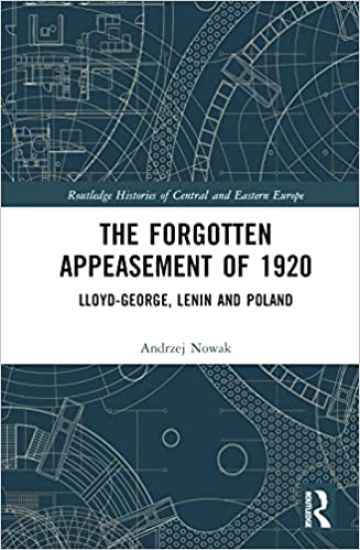
The Forgotten Appeasement of 1920 examines a turning point in East European history: the summer of 1920, when Lenin’s Soviet Russia decided to challenge the Versailles system and launch a military attack on the continent. The outcome of this attack might have been the occupation of all of Poland and East Central Europe, and a Red Army sweep further west. This book probes the British–Soviet negotiations and diplomatic operations behind the scenes. Professor Nowak uses hitherto unexamined documents from Russian and British archives to show how (and why) top British politicians were ready to accept a new Russian imperial control over the whole of Eastern Europe. Nowak unravels this previously untold story of that first and forgotten appeasement, stopped only by the Polish military victory over the Red Army. His excellent historical craftsmanship and new sources contribute to the book’s quality, filling up a lacuna in contemporary historiography. This book will appeal to researchers of geopolitical affairs and the Great Powers, the history of Poland, and the political mentality of Western elites. It will also be of interest to university students and tutors, scholars of history and international relations and – thanks to the book’s brisk and fascinating narrative – amateur historians and history aficionados.

An Introduction to Socio-Finance
Jørgen Vitting Andersen; Andrzej Nowak
Springer-Verlag Berlin and Heidelberg GmbH Co. K
2016
nidottu
This introductory text is devoted to exposing the underlying nature of price formation in financial markets as a predominantly sociological phenomenon that relates individual decision-making to emergent and co-evolving social and financial structures. Two different levels of this sociological influence are considered: First, we examine how price formation results from the social dynamics of interacting individuals, where interaction occurs either through the price or by direct communication. Then the same processes are revisited and examined at the level of larger groups of individuals. In this book, models of both levels of socio-finance are presented, and it is shown, in particular, how complexity theory provides the conceptual and methodological tools needed to understand and describe such phenomena. Accordingly, readers are first given a broad introduction to the standard economic theory of rational financial markets and will come to understand its shortcomings with the help of concrete examples. Complexity theory is then introduced in order to properly account for behavioral decision-making and match the observed market dynamics. This book is conceived as a primer for newcomers to the field, as well as for practitioners seeking new insights into the field of complexity science applied to socio-economic systems in general, and financial markets and price formation in particular.

Attracted to Conflict: Dynamic Foundations of Destructive Social Relations
Robin R. Vallacher; Peter T. Coleman; Andrzej Nowak; Lan Bui-Wrzosinska; Larry Liebovitch; Katharina Kugler; Andrea Bartoli
Springer-Verlag Berlin and Heidelberg GmbH Co. K
2015
nidottu
Conflict is inherent in virtually every aspect of human relations, from sport to parliamentary democracy, from fashion in the arts to paradigmatic challenges in the sciences, and from economic activity to intimate relationships. Yet, it can become among the most serious social problems humans face when it loses its constructive features and becomes protracted over time with no obvious means of resolution. This book addresses the subject of intractable social conflict from a new vantage point. Here, these types of conflict represent self-organizing phenomena, emerging quite naturally from the ongoing dynamics in human interaction at any scale—from the interpersonal to the international. Using the universal language and computational framework of nonlinear dynamical systems theory in combination with recent insights from social psychology, intractable conflict is understood as a system locked in special attractor states that constrain the thoughts and actions of the parties to the conflict. The emergence and maintenance of attractors for conflict can be described by means of formal models that incorporate the results of computer simulations, experiments, field research, and archival analyses. Multi-disciplinary research reflecting these approaches provides encouraging support for the dynamical systems perspective. Importantly, this text presents new views on conflict resolution. In contrast to traditional approaches that tend to focus on basic, short-lived cause-effect relations, the dynamical perspective emphasizes the temporal patterns and potential for emergence in destructive relations. Attractor deconstruction entails restoring complexity to a conflict scenario by isolating elements or changing the feedback loops among them. The creation of a latent attractor trades on the tendency toward multi-stability in dynamical systems and entails the consolidation of incongruent (positive) elements into a coherent structure. In the bifurcation scenario, factors are identified that can change the number and types of attractors in a conflict scenario. The implementation of these strategies may hold the key to unlocking intractable conflict, creating the potential for constructive social relations.

An Introduction to Socio-Finance
Jørgen Vitting Andersen; Andrzej Nowak
Springer-Verlag Berlin and Heidelberg GmbH Co. K
2013
sidottu
This introductory text is devoted to exposing the underlying nature of price formation in financial markets as a predominantly sociological phenomenon that relates individual decision-making to emergent and co-evolving social and financial structures. Two different levels of this sociological influence are considered: First, we examine how price formation results from the social dynamics of interacting individuals, where interaction occurs either through the price or by direct communication. Then the same processes are revisited and examined at the level of larger groups of individuals. In this book, models of both levels of socio-finance are presented, and it is shown, in particular, how complexity theory provides the conceptual and methodological tools needed to understand and describe such phenomena. Accordingly, readers are first given a broad introduction to the standard economic theory of rational financial markets and will come to understand its shortcomings with the help of concrete examples. Complexity theory is then introduced in order to properly account for behavioral decision-making and match the observed market dynamics. This book is conceived as a primer for newcomers to the field, as well as for practitioners seeking new insights into the field of complexity science applied to socio-economic systems in general, and financial markets and price formation in particular.

Attracted to Conflict: Dynamic Foundations of Destructive Social Relations
Robin R. Vallacher; Peter T. Coleman; Andrzej Nowak; Lan Bui-Wrzosinska; Larry Liebovitch; Katharina Kugler; Andrea Bartoli
Springer-Verlag Berlin and Heidelberg GmbH Co. K
2013
sidottu
Conflict is inherent in virtually every aspect of human relations, from sport to parliamentary democracy, from fashion in the arts to paradigmatic challenges in the sciences, and from economic activity to intimate relationships. Yet, it can become among the most serious social problems humans face when it loses its constructive features and becomes protracted over time with no obvious means of resolution. This book addresses the subject of intractable social conflict from a new vantage point. Here, these types of conflict represent self-organizing phenomena, emerging quite naturally from the ongoing dynamics in human interaction at any scale—from the interpersonal to the international. Using the universal language and computational framework of nonlinear dynamical systems theory in combination with recent insights from social psychology, intractable conflict is understood as a system locked in special attractor states that constrain the thoughts and actions of the parties to the conflict. The emergence and maintenance of attractors for conflict can be described by means of formal models that incorporate the results of computer simulations, experiments, field research, and archival analyses. Multi-disciplinary research reflecting these approaches provides encouraging support for the dynamical systems perspective. Importantly, this text presents new views on conflict resolution. In contrast to traditional approaches that tend to focus on basic, short-lived cause-effect relations, the dynamical perspective emphasizes the temporal patterns and potential for emergence in destructive relations. Attractor deconstruction entails restoring complexity to a conflict scenario by isolating elements or changing the feedback loops among them. The creation of a latent attractor trades on the tendency toward multi-stability in dynamical systems and entails the consolidation of incongruent (positive) elements into a coherent structure. In the bifurcation scenario, factors are identified that can change the number and types of attractors in a conflict scenario. The implementation of these strategies may hold the key to unlocking intractable conflict, creating the potential for constructive social relations.

Social Entrepreneurship: Theory and Practice is about the creative ways in which social entrepreneurs solve pressing and insurmountable social problems. Theories of social change are presented to help demystify the 'magic' of making an immense, yet durable and irreversible, social impact. Utilizing case studies drawn from various fields and all over the world, the authors document how social entrepreneurs foster bottom-up change that empowers people and societies. They also review the specific personality traits of social entrepreneurs and introduce the new kind of leadership they represent. This book will be valuable to undergraduate, graduate and postgraduate students, while remaining accessible to non-academic readers thanks to its clear language, illustrative case studies and guidelines on how to become a successful social entrepreneur.

Social Entrepreneurship: Theory and Practice is about the creative ways in which social entrepreneurs solve pressing and insurmountable social problems. Theories of social change are presented to help demystify the 'magic' of making an immense, yet durable and irreversible, social impact. Utilizing case studies drawn from various fields and all over the world, the authors document how social entrepreneurs foster bottom-up change that empowers people and societies. They also review the specific personality traits of social entrepreneurs and introduce the new kind of leadership they represent. This book will be valuable to undergraduate, graduate and postgraduate students, while remaining accessible to non-academic readers thanks to its clear language, illustrative case studies and guidelines on how to become a successful social entrepreneur.

Dynamical Grammar explores the consequences for language acquisition, language evolution, and linguistic theory of taking the underlying architecture of the language faculty to be that of a dynamical system. The authors investigate whether it is possible for a complex adaptive system to identify the categories, structures, and rules of a language given access only to instances of grammatical utterances of that language. The linguistic tradition says that this is impossible, but there is a growing body of literature in psychology and computer science arguing that grammar can be uncovered using purely statistical techniques applied to the distribution of forms in a string of words. The book goes on to discuss whether a learner requires information about structure that goes beyond the information that is contained in the meaning. Does the learner have to have knowledge of grammar per se prior to language acquisition, as has been traditionally assumed? The authors ask whether it is possible to adequately describe and explain linguistic phenomena if we restrict ourselves to the relatively impoverished apparatus that we require for language acquisition. They explore the consequences of adopting a radical form of minimalism to try to reconcile the linguistic facts with the book's perspective of language acquisition. Culicover and Nowak investigate to what extent it is possible to account for language variation in dynamical terms, as a consequence of the behaviour of the complex social network in which languages and the properties of languages are acquired by learners through interactions with other speakers over time.

This text explores the consequences for language acquisition, language evolution and linguistic theory of taking the underlying architecture of the language faculty to be that of a dynamical system. The authors investigate whether it is possible for a complex adaptive system to identify the categories, structures and rules of a language given access only to instances of grammatical utterances of that language. The linguistic tradition says that this is impossible, but there is a growing body of literature in psychology and computer science arguing that grammar can be uncovered using purely statistical techniques applied to the distribution of forms in a string of words. The book goes on to discuss whether a learner requires information about structure that goes beyond the information that is contained in the meaning. Does the learner have to have knowledge of grammar per se prior to language acquisition, as has been traditionally assumed? The authors ask whether it is possible to adequately describe and explain linguistic phenomena if we restrict ourselves to the relatively impoverished apparatus that we require for language acquisition. They explore the consequences of adopting a radical form of minimalism to try to reconcile the linguistic facts with the book's perspective of language acquisition. Culicover and Nowak investigate to what extent it is possible to account for language variation in dynamical terms, as a consequence of the behaviour of the complex social network in which languages and the properties of languages are acquired by learners through interactions with other speakers over time.

Traditional approaches to social psychology have proven highly successful in identifying causal mechanisms underlying human thought and behavior. With the recent advent of the dynamical approach, it is now possible to assemble sets of such mechanisms into coherent systems. This book uses innovative concepts and tools to illuminate the processes by which individuals, groups, and societies evolve and change in a systemic, self-sustaining manner, at times seemingly independent of external influences. Readers learn how the dynamical approach facilitates novel predictions and insights into such social psychological phenomena as attitudes, social judgment, goal-directed behavior, attraction, and relationships. Featuring a wealth of charts and figures derived from original research and computer simulations, the volume is grounded in classic and contemporary theories of social psychology.