Kirjojen hintavertailu – 12 903 725 kirjaa ja 27 kauppaa

Kirjailija

Angela Franks

Kirjat ja teokset yhdessä paikassa: 4 kirjaa, julkaisuja vuosilta 2005–2025, suosituimpiin kuuluu Body and Identity. Vertaile teosten hintoja ja tarkista saatavuus suomalaisista kirjakaupoista.

4 kirjaa

Kirjojen julkaisuvuodet: 2005–2025.

Body and Identity

Body and Identity

Angela Franks

UNIVERSITY OF NOTRE DAME PRESS
2025
sidottu

Halvin toimitettuna 78,10 €

Angela Franks provides a sweeping intellectual history of identity, particularly in terms of how identity relates to the body, with an emphasis on the importance of Christianity to this understanding. Modern questions about our bodies and how we see ourselves are often complex and problematic. To better answer these contemporary questions and navigate "identity politics," Angela Franks seeks to provide a better understanding of identity. She begins by giving three basic meanings of the term: identity through time, the "true" or authentic self, and our awareness of ourselves. She engages with thinkers from antiquity to present day and investigates the decisive developments that Christianity provided. Within Christianity came a new awareness of the distinctive individuality of each person—the "true self"—called by God in a way that often breaks away from the "solid" or fixed structures of identity formation, such as family, class, and nation. This more "liquid" idea of identity continues to evolve in modern times, though without its theistic emphasis on God's call. The result is a purely liquid self that consists of consciousness and activity, but without a grounded self that is either the object or the subject of consciousness. This is the empty self we have today, one that is given much more to do and less to be. A comprehensive history of identity, Body and Identity brings the theological history of the self to the forefront in order to address the empty self and how identity is defined today.
Growing Into God

Growing Into God

John Gavin; Angela Franks

THE CATHOLIC UNIVERSITY OF AMERICA PRESS
2025
nidottu
Many studies of spiritual development exist under the heading of "Christian Perfection." However, John Gavin revisits such topics as asceticism, prayer, sacraments, virtues, and spiritual combat through scriptural and patristic texts that present the Christian life as one of growth from spiritual infancy to a particular fulfillment or end (telos): divinized humanity as formed and revealed in Jesus Christ. Thus, though Christian maturity does incorporate such things as physical and cognitive development, its true distinction lies in its gifted, supernatural end that does not exclude human freedom. Part One establishes the pillars of Christian maturity – form and finality; virtue and character; vocation and mission – and explores the opposition to maturation in the form of demonic infantilism. Part Two examines the means of maturity given to us in the life of the Church: the Scriptures, the Mysteries (Sacraments), and asceticism. Finally, Part Three reviews four figures of Christian adulthood: the Witness, the Teacher, the Servant, and the Fool. A concluding chapter applies the insights from the previous chapters to our modern world to see in what ways our times need to "grow up." Growing into God includes a variety of early Christian voices: Irenaeus of Lyons, Origen of Alexandria, Gregory of Nazianzus, Gregory of Nyssa, Basil of Caesarea, Augustine of Hippo, Ambrose of Milan, John Cassian, Dionysius the Areopagite, Mark the Monk, John Moschos, Maximus the Confessor, Symeon the Holy Fool, and others. Their collective insights, all the fruits of great learning and the contemplation of God's Word, describe a wondrous figure: the mature saint transformed by union with the Father, Son, and Spirit.
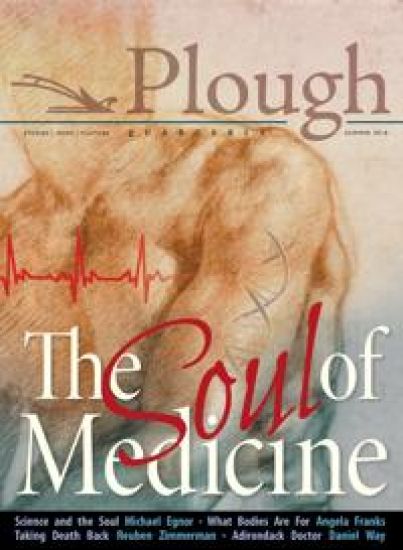
Plough Quarterly No. 17- The Soul of Medicine

Plough Quarterly No. 17- The Soul of Medicine

Stephanie Sadaa; John M. Perkins; Sarah Williams; Mark Schloneger; Angela Franks; Clare Stober; Daniel Way; Michael Egnor; Reuben Zimmerman; Nicanor Austriaco; Augustine of Hippo; Teresa de Cartagena

Plough Publishing House
2018
pokkari
We need a vision of how medicine might serve the good of the whole human person: the body’s health, but also the health of that “piece of divinity in us.” Medicine, so long as you don’t need it, is a tangential part of life, just one more profession among others. Until that is, a loved one suffers an accident or falls sick. Then, suddenly, medicine is quite literally, a matter of life or death. Medicine is also big business. Doctors have been reclassified as “service providers,” and patients are “clients.” Such commercialism breeds false incentives and inequalities, even in nations. We need a vision of how medicine might serve the good of the whole human person: the body’s health, but also the health of that “piece of divinity in us.” We need love and reverence for humans as they are, not humans as technology may someday engineer them to be. Jesus, the healer from Nazareth, showed what it means to love the imperfect, the frail, the average. The glory of the medical profession is that it is dedicated to these works of mercy. In today’s money-driven healthcare industry, such tasks are often poorly rewarded. Yet they’re at the heart of medicine’s original mission. Also in this issue: original poetry by Suzanne Harlan Heyd; reviews of new books by Barbara Ehrenreich, Ryan T. Anderson, Beth Macy, and David R. Montgomery and Anne Biklé; and art by Tim Lowly, Michelangelo, Julian Peters, Wanjin Gim, Scott Goldsmith, Jan Mostaert, Suleiman Mansour, Cécile Massie, Peter Doig, Erin Hanson, and Jason Landsel. Plough Quarterly features stories, ideas, and culture for people eager to put their faith into action. Each issue brings you in-depth articles, interviews, poetry, book reviews, and art to help you put Jesus’ message into practice and find common cause with others.