Kirjojen hintavertailu – 12 903 725 kirjaa ja 27 kauppaa
Kirjailija
Angela J. Hattery
Kirjat ja teokset yhdessä paikassa: 19 kirjaa, julkaisuja vuosilta 2001–2026, suosituimpiin kuuluu The Social Dynamics of Family Violence. Vertaile teosten hintoja ja tarkista saatavuus suomalaisista kirjakaupoista.
The Social Dynamics of Family Violence explores family violence through the life course, from child abuse and neglect to intimate partner violence and elder abuse. Paying close and special attention to the social nature and institutional causes of family violence, authors Angela J. Hattery and Earl Smith draw readers' attention to the ways that social inequality, especially gender inequality, contribute to tensions and explosive tendencies in family settings. As awareness, perspectives, and issues around gender-based and family violence evolve, so does the field, and the revised fourth edition of this textbook exposes faculty, students, and future practitioners and researchers to cutting-edge debates and new approaches to addressing violence within the family. Students learn about individual preventative measures while also being invited to question the systems and structures that create the conditions under which family violence continues to remain highly prevalent. A new chapter in this edition focuses closely on the public health dimensions of family violence and discusses the different theoretical frames and prevention and intervention approaches emanating from this perspective. The authors discuss other new developments and areas of focus, including brain injury and sexual and domestic violence as well as abolitionist discourses and approaches to thinking about, and responding to, family violence. With these newer discussions complementing the text’s foundation in theory and methods and its notable coverage of violence within different families and intimate relationships, the fourth edition of The Social Dynamics of Family Violence is an essential reference for any course examining the sociology of family violence.


Based on ethnographic observations and interviews with prisoners, correctional officers, and civilian staff conducted in solitary confinement units, Way Down in the Hole explores the myriad ways in which daily, intimate interactions between those locked up twenty-four hours a day and the correctional officers charged with their care, custody, and control produce and reproduce hegemonic racial ideologies. Smith and Hattery explore the outcome of building prisons in rural, economically depressed communities, staffing them with white people who live in and around these communities, filling them with Black and brown bodies from urban areas and then designing the structure of solitary confinement units such that the most private, intimate daily bodily functions take place in very public ways. Under these conditions, it shouldn’t be surprising, but is rarely considered, that such daily interactions produce and reproduce white racial resentment among many correctional officers and fuel the racialized tensions that prisoners often describe as the worst forms of dehumanization. Way Down in the Hole concludes with recommendations for reducing the use of solitary confinement, reforming its use in a limited context, and most importantly, creating an environment in which prisoners and staff co-exist in ways that recognize their individual humanity and reduce rather than reproduce racial antagonisms and racial resentment. Way Down the Hole Video 1 (https://youtu.be/UuAB63fhge0)Way Down the Hole Video 2 (https://youtu.be/TwEuw1cTrcQ)Way Down the Hole Video 3 (https://youtu.be/bOcBv_UnHIs?)Way Down the Hole Video 4 (https://youtu.be/cx_l1S8D77c)
The Social Dynamics of Family Violence explores family violence throughout the life course, from child abuse and neglect to intimate partner violence and elder abuse. Paying special attention to the social character and institutional causes of family violence, Hattery and Smith ask students to consider how social inequality, especially gender inequality, contributes to tensions and explosive tendencies in family settings. Students learn about individual preventative measures and are also invited to question the justice of our current social structure, with implications for social policy and reorganization. Hattery and Smith also examine violence against women globally and relate this to violence in the United States. Unique coverage of same-sex and multicultural couples, as well as of theory and methods, make this text an essential element of any course considering the sociology of family violence.

What do the Catholic Church, college sports, Hollywood, prisons, the military, fraternities and politics have in common? All have extraordinarily high rates of sexual and intimate partner violence and child sexual abuse. Sexual and intimate partner violence is part of the landscape that women and children live with. Women and children are subjected to high levels of sexual and intimate partner violence and in the era of #metoo, Gender, Power and Violence provides a nuanced analysis of the ways in which the organizational structure of an institution, like a college campus or Hollywood, can create an environment ripe for sexual and intimate partner violence and even child sexual abuse. Gender, Power, and Violence looks at the problem of sexual and intimate partner violence through cases, observing the role that institutions play in facilitating and perpetuating gender based violence, and provides a more complex understanding about the ways in which institutional structures create an environment that facilitates and perpetuates gender based violence. Angela J. Hattery and Earl Smith touch on current events that have highlighted the pervasiveness of gender based violence across the institutions they interrogate throughout the book, but also in the entertainment industry, the government, and television journalism. Gender, Power, and Violence gives the reader a better understanding of what factors shape who will be perpetrators, who will be victims, and how organizations respond (or not) when sexual or intimate partner violence or child sexual abuse is reported. It also offers recommendations for transforming these institutions so that they are safe for women and children of all genders.
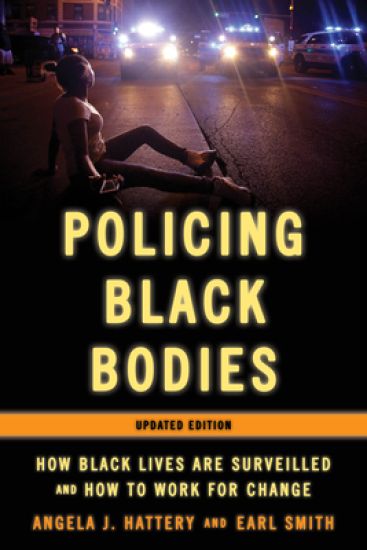
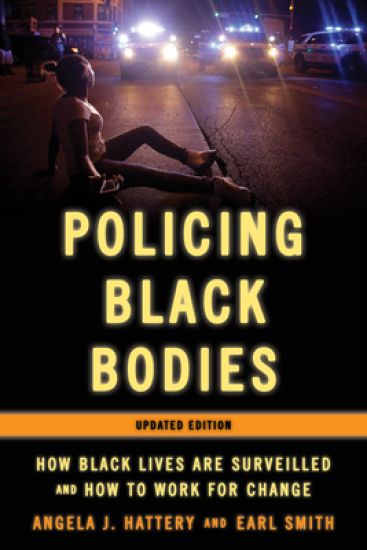
From Trayvon Martin to Freddie Gray, the stories of police violence against Black people are too often in the news. In Policing Black Bodies Angela J. Hattery and Earl Smith make a compelling case that the policing of Black bodies goes far beyond these individual stories of brutality. They connect the regulation of African American people in many settings, including the public education system and the criminal justice system, into a powerful narrative about the myriad ways Black bodies are policed. Policing Black Bodies goes beyond chronicling isolated incidents of injustice to look at the broader systems of inequality in our society—how they’re structured, how they harm Black people, and how we can work for positive change. The book discusses the school-to-prison pipeline, mass incarceration and the prison boom, the unique ways Black women and trans people are treated, wrongful convictions and the challenges of exoneration, and more. Each chapter of the book opens with a true story, explains the history and current state of the issue, and looks toward how we can work for change. The book calls attention to the ways class, race, and gender contribute to injustice, as well as the perils of colorblind racism—that by pretending not to see race we actually strengthen, rather than dismantle, racist social structures. Policing Black Bodies is a powerful call to acknowledge injustice and work for change.
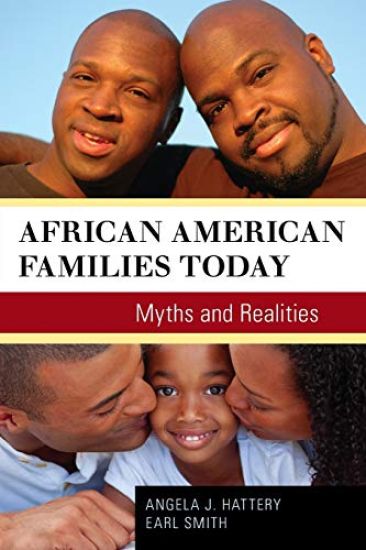
From teen pregnancy and single parenting to athletics and HIV/AIDS, myths about African American families abound. This provocative book by two acclaimed scholars of race and ethnicity debunks many common myths about black families in America, sharing stories and drawing on the latest research to show the realities. African American Families Today examines the wellbeing of African American families around topics including marriage, health, education, incarceration, wealth, and more. Authors Angela J. Hattery and Earl Smith show that even though the election of the first African American president, Barack Obama, has been symbolically important for African Americans, his presidency has not had a measurable impact on the daily lives of African American families. As the book shows, racial inequality persists—we’re clearly not in a “postracial” society.
"If you do the crime you gotta do the time." This adage reflects the overall attitude most Americans have about crime and the criminal justice system. Implicit in this adage is the notion that once "the time" is done, the individual is free to re-enter society and resume a normal life. In Prisoner Re-entry and Social Capital, authors Earl Smith and Angela J. Hattery challenge this myth. Prisoner Re-entry and Social Capital takes as its starting point interviews with twenty-five men and women during the summer of 2008 about their experiences with re-entering the "free world" after a period of incarceration. By analyzing the experiences of these men and women, Smith and Hattery look in depth at the factors that inhibit successful re-entry and illustrate some successes and failures. The book examines individual characteristics that inhibit successful re-entry such as addiction and sex offender status as well as the unique challenges faced by women. Uniquely, Smith and Hattery focus on the role that social capital plays as one of the most important factors that shapes the re-entry experience. Today, one of the most pressing issues facing scholars, those who work in the criminal justice system, and the citizenry as a whole is the extraordinarily high rate of recidivism. These interviews and analyses provide a deeper and more precise understanding of the biases faced by re-entry felons in the labor market and work to address the key barriers to re-entry in hopes to aid in their elimination.
'If you do the crime you gotta do the time.' This adage reflects the overall attitude most Americans have about crime and the criminal justice system. Implicit in this adage is the notion that once 'the time' is done, the individual is free to re-enter society and resume a normal life. In Prisoner Re-entry and Social Capital, authors Earl Smith and Angela J. Hattery challenge this myth. Prisoner Re-entry and Social Capital takes as its starting point interviews with twenty-five men and women during the summer of 2008 about their experiences with re-entering the 'free world' after a period of incarceration. By analyzing the experiences of these men and women, Smith and Hattery look in depth at the factors that inhibit successful re-entry and illustrate some successes and failures. The book examines individual characteristics that inhibit successful re-entry such as addiction and sex offender status as well as the unique challenges faced by women. Uniquely, Smith and Hattery focus on the role that social capital plays as one of the most important factors that shapes the re-entry experience. Today, one of the most pressing issues facing scholars, those who work in the criminal justice system, and the citizenry as a whole is the extraordinarily high rate of recidivism. These interviews and analyses provide a deeper and more precise understanding of the biases faced by re-entry felons in the labor market and work to address the key barriers to re-entry in hopes to aid in their elimination.
Until recently, domestic violence, as it has been referred to, was a problem to be dealt with inside the family. In this ground-breaking work, Hattery's unique approach provides a detailed theoretical discussion of race, class, and gender-effects on intimate partner violence and a thoughtful discussion of the interactions of these factors.
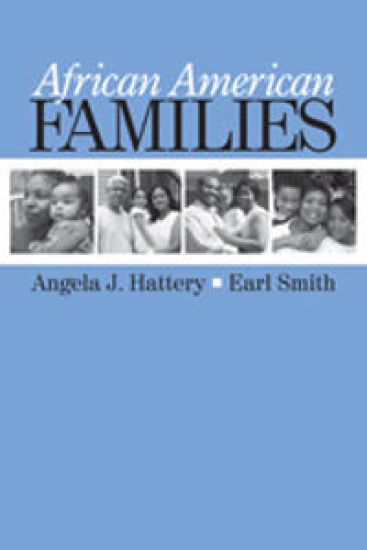
"Bravo to the authors! They have done an excellent job addressing the issues that are critical to community members, policy makers and interventionists concerned with Black families in the context of our nation."—Michael C. Lambert, University of Missouri, Colombia"African American Families is a timely work. The strength of this text lies in the depth of coverage, clarity, and the ability to combine secondary sources, statistics and qualitative data to reveal the plight of African Americans in society."—Edward Opoku-Dapaah, Winston-Salem State University"African American Families is both engaging and challenging and is perhaps one of the most important works I have read in many years. This book will most certainly move the discourse of the socio-economic conditions of black families forward, beyond the boundaries already set by other books in the market. African American Families is an excellent book whose time has come, and one that I would most definitely adopt." —Lateef O. Badru, University of LouisvilleAfrican American Families provides a systematic sociological study of contemporary life for families of African descent living in the United States. Analyzing both quantitative and qualitative data, authors Angela J. Hattery and Earl Smith identify the structural barriers that African Americans face in their attempts to raise their children and create loving, healthy, and raise the children of the next generation. Key Features:Uses the lens provided by the race, class, and gender paradigm: Examples illustrate the ways in which multiple systems of oppression interact with patterns of self-defeating behavior to create barriers that deny many African Americans access to the American dream. Addresses issues not fully or adequately addressed in previous books on Black families: These issues include personal responsibility and disproportionately high rates of incarceration, family violence, and chronic illnesses like HIV/AIDS. Brings statistical data to life: The authors weave personal stories based on interviews they've conducted into the usual data from scholarly(?) literature and from U. S. Census Bureau reports. Provides several illustrations from Hurricane Katrina: A contemporary analysis of a recent disaster demonstrates many of the issues presented in the book such as housing segregation and predatory lending practices. Offers extensive data tables in the appendices: Assembled in easy-to-read tables, students are given access to the latest national agencies data from agencies including the U. S. Census Bureau, Centers for Disease Control, and Bureau of Justice Statistics. Intended Audience:This is an ideal textbook for advanced undergraduate and graduate courses such as African American Families, Sociology of the Family, Contemporary Families, and Race and Ethnicity in the departments of Human Development and Family Studies, Sociology, African American Studies, and Black Studies.
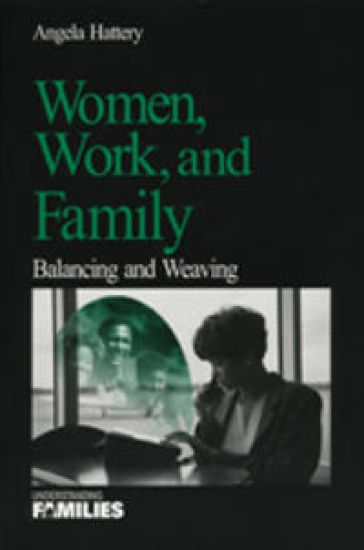
"Hattery's book is an important contribution to this literature. The book is engaging and is well written. I would recommend this book and encourage Hattery to continue examination of this construct." - Psychology of Women Quarterly Women, Work, and Family: Balancing and Weaving is a fascinating examination of the extraordinary juggling skills of working mothers who balance their obligations to both work and family. Angela Hattery goes beyond a mere description of women's conflicts of interest and seeks to understand the decision-making process through which they accomplish this balancing. Through intensive interviews with 30 married women, all with children under 2 years of age, Hattery uncovers a remarkable range of ways in which these women weave together the complex strands of their lives. The data in the volume are examined from a number of theoretical standpoints, including structural theory, motherhood theory, and feminist theory. A key variable that runs through the data is economic need, which has an obvious effect on work patterns. Women, Work, and Family will make a major contribution to family studies and will illuminate the difficult choices that women make within the family/work context.