Kirjojen hintavertailu – 12 903 725 kirjaa ja 27 kauppaa

Kirjailija

Anjan Chakrabarti

Kirjat ja teokset yhdessä paikassa: 8 kirjaa, julkaisuja vuosilta 2003–2026, suosituimpiin kuuluu Rethinking Marxism. Vertaile teosten hintoja ja tarkista saatavuus suomalaisista kirjakaupoista.

8 kirjaa

Kirjojen julkaisuvuodet: 2003–2026.

Rethinking Marxism

Rethinking Marxism

Anjan Chakrabarti; Anup Dhar

TAYLOR FRANCIS LTD
2026
sidottu
This comprehensive collection examines Marxist theory through contemporary Indian economic and social contexts. The work provides critical analysis of class formation, working class conditions, and labor relations in postcolonial India. Twenty-one chapters explore capitalism, primitive accumulation, economic development, and informal sector dynamics. The collection includes postcolonial critique of economic dualism, analysis of state formation and nationalism, and examination of postcapitalist alternatives and also includes: Comprehensive examination of Marxist theory through contemporary Indian economic and social contexts Critical analysis of class formation, working class conditions, and labor relations in postcolonial India Theoretical framework for understanding capitalism, primitive accumulation, and economic development Postcolonial critique of economic dualism and informal sector dynamics in developing economies Analysis of state formation, nationalism, and imperialism in the context of neoliberal globalization This title has been co-published with Aakar Books. T&F does not sell or distribute the print edition in South Asia (Bangladesh, Bhutan, India, Maldives, Nepal, Pakistan and Sri Lanka).
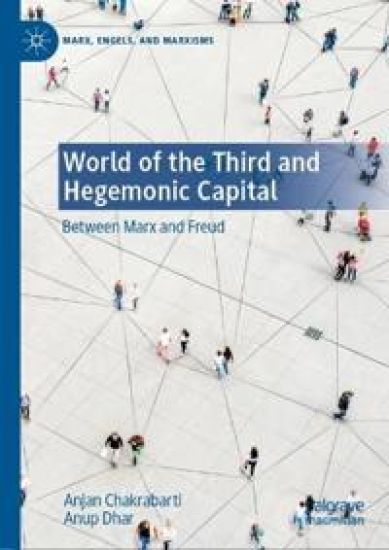
World of the Third and Hegemonic Capital

World of the Third and Hegemonic Capital

Anjan Chakrabarti; Anup Dhar

Springer International Publishing AG
2024
nidottu
This book brings together Marxian philosophy and Lacanian psychoanalysis to argue that the hegemonic form of global capital is founded on the foreclosure of class and world of the third. The authors counterpose the world of the third to the mainstream notion of the third world, seen as a lacking other in desperate need of aid and development. Thus, for them, the hegemonic form of global capital is engendered through the foregrounding of the poor, victim third world and the foreclosure of the non-capitalist world of the third. Building on what they characterize as an ab-original reading of Marxian historical materialism and the Lacanian real, the authors seek to conceptualize a counter-hegemonic revolutionary subject as a basis for postcapitalist alternatives to the hegemonic form of global capital.
World of the Third and Hegemonic Capital

World of the Third and Hegemonic Capital

Anjan Chakrabarti; Anup Dhar

Springer International Publishing AG
2023
sidottu
This book brings together Marxian philosophy and Lacanian psychoanalysis to argue that the hegemonic form of global capital is founded on the foreclosure of class and world of the third. The authors counterpose the world of the third to the mainstream notion of the third world, seen as a lacking other in desperate need of aid and development. Thus, for them, the hegemonic form of global capital is engendered through the foregrounding of the poor, victim third world and the foreclosure of the non-capitalist world of the third. Building on what they characterize as an ab-original reading of Marxian historical materialism and the Lacanian real, the authors seek to conceptualize a counter-hegemonic revolutionary subject as a basis for postcapitalist alternatives to the hegemonic form of global capital.
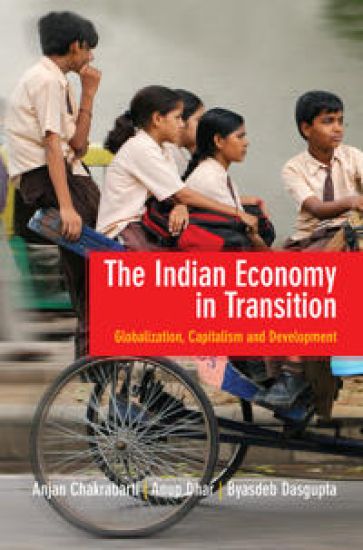
The Indian Economy in Transition

The Indian Economy in Transition

Anjan Chakrabarti; Anup K. Dhar; Byasdeb Dasgupta

Cambridge University Press
2015
sidottu
Taking the period following the advent of liberalization, this book explains the transition of the Indian economy against the backdrop of development. If the objective is to explore the new economic map of India, then the distinct contributions in the book could be seen as twofold. The first is the analytical frame whereby the authors deploy a unique Marxist approach consisting of the initial concepts of class process and the developing countries to address India's economic transition. The second contribution is substantive whereby the authors describe India's economic transition as epochal, materializing out of the new emergent triad of neo-liberal globalization, global capitalism and inclusive development. This is how the book theorizes the structural transformation of the Indian economy in the twenty-first century. Through this framework, it interrogates and critiques the given debates, ideas and policies about the economic development of a developing nation.
Dislocation and Resettlement in Development

Dislocation and Resettlement in Development

Anjan Chakrabarti; Anup Kumar Dhar

Routledge
2011
nidottu
Challenging the more conventional approaches to dislocation and resettlement that are the usual focus of discussion on the topic, this book offers a unique theory of dislocation in the form of primitive accumulation. Interrogating the ‘reformist-managerial’ and ‘radical-movementist’ approaches, it historicizes and politicizes the event of dislocation as a moment to usher in capitalism through the medium of development. Such a framework offers alternative avenues to rethinking dislocation and resettlement, and indeed the very idea of development. Arguing that dislocation should not be seen as a necessary step towards achieving progress - as it is claimed in the development discourse - the authors show that dislocation emerges as a socio-political constituent of constructing capitalism. This book will be of interest to academics working on Development Studies, especially on issues relating to the political economy of development and globalization.
Dislocation and Resettlement in Development

Dislocation and Resettlement in Development

Anjan Chakrabarti; Anup Kumar Dhar

Routledge
2009
sidottu
Challenging the more conventional approaches to dislocation and resettlement that are the usual focus of discussion on the topic, this book offers a unique theory of dislocation in the form of primitive accumulation. Interrogating the ‘reformist-managerial’ and ‘radical-movementist’ approaches, it historicizes and politicizes the event of dislocation as a moment to usher in capitalism through the medium of development. Such a framework offers alternative avenues to rethinking dislocation and resettlement, and indeed the very idea of development. Arguing that dislocation should not be seen as a necessary step towards achieving progress - as it is claimed in the development discourse - the authors show that dislocation emerges as a socio-political constituent of constructing capitalism. This book will be of interest to academics working on Development Studies, especially on issues relating to the political economy of development and globalization.
Transition and Development in India

Transition and Development in India

Anjan Chakrabarti; Stephen Cullenberg

Routledge
2003
sidottu
According to Nehru, the transition from a backward agricultural society to a modern industrialized society was the only road for India to progress. So, for the past few decades, India has focused its transitional development around movement away from a state-controlled economy toward that of a free market economy. Transition and Development in India challenges the current basis of this theory of development, laying the groundwork for an entirely new Marxist approach to transition that should apply not just to India, but to all developing nations.
Transition and Development in India

Transition and Development in India

Anjan Chakrabarti; Stephen Cullenberg

Routledge
2003
nidottu
According to Nehru, the transition from a backward agricultural society to a modern industrialized society was the only road for India to progress. So, for the past few decades, India has focused its transitional development around movement away from a state-controlled economy toward that of a free market economy. Transition and Development in India challenges the current basis of this theory of development, laying the groundwork for an entirely new Marxist approach to transition that should apply not just to India, but to all developing nations.