

Kirjailija
Anna Beckers
Kirjat ja teokset yhdessä paikassa: 5 kirjaa, julkaisuja vuosilta 2015–2024, suosituimpiin kuuluu Digitale Aktanten, Hybride, Schwärme. Vertaile teosten hintoja ja tarkista saatavuus suomalaisista kirjakaupoista.
5 kirjaa
Kirjojen julkaisuvuodet: 2015–2024.

Three Liability Regimes for Artificial Intelligence
Anna Beckers; Gunther Teubner
BLOOMSBURY PUBLISHING PLC
2023
nidottu
Halvin toimitettuna 70,10 €
This book proposes three liability regimes to combat the wide responsibility gaps caused by AI systems – vicarious liability for autonomous software agents (actants); enterprise liability for inseparable human-AI interactions (hybrids); and collective fund liability for interconnected AI systems (crowds). Based on information technology studies, the book first develops a threefold typology that distinguishes individual, hybrid and collective machine behaviour. A subsequent social science analysis specifies the socio-digital institutions related to this threefold typology. Then it determines the social risks that emerge when algorithms operate within these institutions. Actants raise the risk of digital autonomy, hybrids the risk of double contingency in human-algorithm encounters, crowds the risk of opaque interconnections. The book demonstrates that the law needs to respond to these specific risks, by recognising personified algorithms as vicarious agents, human-machine associations as collective enterprises, and interconnected systems as risk pools – and by developing corresponding liability rules. The book relies on a unique combination of information technology studies, sociological institution and risk analysis, and comparative law. This approach uncovers recursive relations between types of machine behaviour, emergent socio-digital institutions, their concomitant risks, legal conditions of liability rules, and ascription of legal status to the algorithms involved.

Three Liability Regimes for Artificial Intelligence
Anna Beckers; Gunther Teubner
BLOOMSBURY PUBLISHING PLC
2022
sidottu
This book proposes three liability regimes to combat the wide responsibility gaps caused by AI systems – vicarious liability for autonomous software agents (actants); enterprise liability for inseparable human-AI interactions (hybrids); and collective fund liability for interconnected AI systems (crowds). Based on information technology studies, the book first develops a threefold typology that distinguishes individual, hybrid and collective machine behaviour. A subsequent social science analysis specifies the socio-digital institutions related to this threefold typology. Then it determines the social risks that emerge when algorithms operate within these institutions. Actants raise the risk of digital autonomy, hybrids the risk of double contingency in human-algorithm encounters, crowds the risk of opaque interconnections. The book demonstrates that the law needs to respond to these specific risks, by recognising personified algorithms as vicarious agents, human-machine associations as collective enterprises, and interconnected systems as risk pools – and by developing corresponding liability rules. The book relies on a unique combination of information technology studies, sociological institution and risk analysis, and comparative law. This approach uncovers recursive relations between types of machine behaviour, emergent socio-digital institutions, their concomitant risks, legal conditions of liability rules, and ascription of legal status to the algorithms involved.
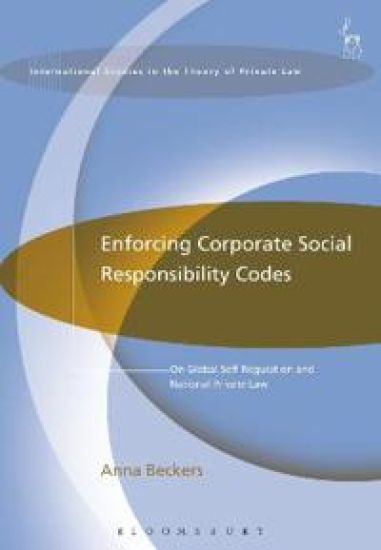
Corporate social responsibility codes are guidelines that companies voluntarily develop and publish with the objective of showing the public their commitment to respect human rights, to improve fundamental workplace standards worldwide and to protect the natural environment. These corporate codes have become a crucial element in the regulatory architecture for globally operating companies. By focusing on the characteristics of the codes, their effects on society and their legal consequences, this book seeks to provide a comprehensive analysis of corporate codes and the law. Enforcing Corporate Social Responsibility Codes develops proposals on the relationship between global corporate self-regulation and the national private law systems. It uses methods of comparative law and sociological jurisprudence to argue that national private law can, and in fact should, enforce these codes as genuine legal obligations. The author formulates legal policy recommendations for English and German private law that indicate how the proposed legal enforcement could be realised in practice. The dissertation on which this book is based was awarded the second prize in the humanities category of the Deutscher Studienpreis (German Thesis Award) by the Koerber Foundation in November 2015.
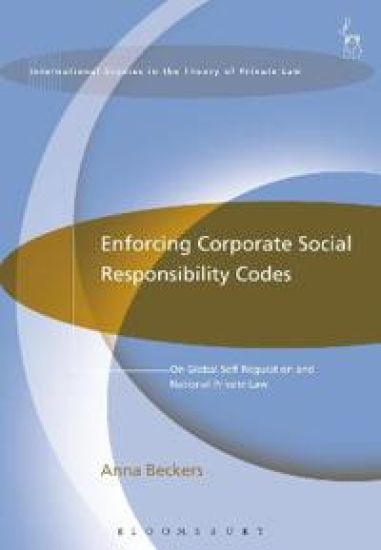
Corporate social responsibility codes are guidelines that companies voluntarily develop and publish with the objective of showing the public their commitment to respect human rights, to improve fundamental workplace standards worldwide and to protect the natural environment. These corporate codes have become a crucial element in the regulatory architecture for globally operating companies. By focusing on the characteristics of the codes, their effects on society and their legal consequences, this book seeks to provide a comprehensive analysis of corporate codes and the law. Enforcing Corporate Social Responsibility Codes develops proposals on the relationship between global corporate self-regulation and the national private law systems. It uses methods of comparative law and sociological jurisprudence to argue that national private law can, and in fact should, enforce these codes as genuine legal obligations. The author formulates legal policy recommendations for English and German private law that indicate how the proposed legal enforcement could be realised in practice. The dissertation on which this book is based was awarded the second prize in the humanities category of the Deutscher Studienpreis (German Thesis Award) by the Koerber Foundation in November 2015.