Kirjojen hintavertailu – 12 903 724 kirjaa ja 27 kauppaa

Kirjailija

Anne Dodd

Kirjat ja teokset yhdessä paikassa: 4 kirjaa, julkaisuja vuosilta 2002–2017, suosituimpiin kuuluu Hardy, A: Aelfric's Abbey. Vertaile teosten hintoja ja tarkista saatavuus suomalaisista kirjakaupoista.

4 kirjaa

Kirjojen julkaisuvuodet: 2002–2017.

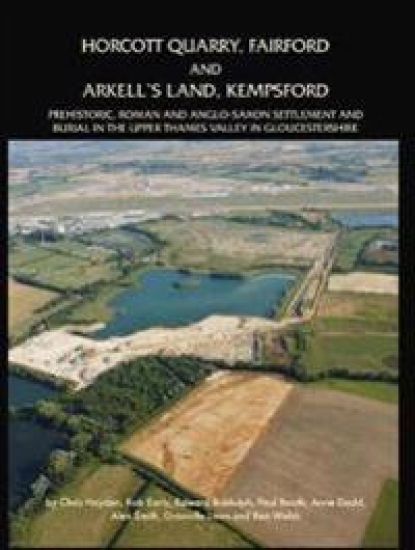
Horcott Quarry, Fairford and Arkell’s Land, Kempsford

Horcott Quarry, Fairford and Arkell’s Land, Kempsford

Chris Hayden; Rob Early; Edward Biddulph; Paul Booth; Anne Dodd; Alex Smith; Granville Laws; Ken Welsh

Oxford University School of Archaeology
2017
sidottu
Excavations in advance of gravel quarrying in the Upper Thames Valley at Horcott Quarry, Fairford, and nearby Arkell’s Land, Kempsford, revealed contrasting pictures. At Horcott, on the second terrace, there was periodic activity from the early Mesolithic onwards. A major earlier Iron Age settlement contained roundhouses and at least 135 four-post structures, suggesting an exceptional focus on grain storage. An early–middle Roman farmstead incorporated a small stone-founded building, while from c AD 250–350 a large cemetery lay in an adjacent enclosure. Two further groups of burials were contemporary with a substantial Anglo-Saxon settlement including a timber hall and 33 sunken-featured buildings. By contrast, at Arkell’s Land, on the first gravel terrace, activity on a significant scale only began in the later 1st century AD. It comprised enclosures, field systems and trackways, with the most intensive settlement, as at Horcott, in the middle Roman period. The site was probably linked to an adjacent estate centre at Claydon Pike. There was no post-Roman occupation.

The Archaeology of the Gravel Terraces of the Upper and Middle Thames

The Archaeology of the Gravel Terraces of the Upper and Middle Thames

George Lambrick; Mark Robinson; Anne Dodd

Oxford University School of Archaeology
2009
sidottu
In common with other volumes in the Thames Through Time series, this account of the Thames Valley in the millennium and a half before the Roman conquest seeks to examine change in human society from a thematic point of view. The geographical and chronological framework for this volume is established in Chapters 1 and 2, but thereafter we have tried to get away from the traditional, somewhat artificial pigeon-holes of 'periods' 'ages' 'eras' and 'phases' to look much harder at how change in human society actually works. In a period when the 20th century has come to dominate secondary school history and much popular TV, the notion that the first foundations of modern society can be traced back more than 3000 years may seem a rather surprising proposition. But some fundamental patterns of settlement and landuse, political boundaries, human impact on the environment, and even the specific use and form of a few places can be traced back to late prehistoric times despite millennia of subsequent change - even though otherwise we may now have very little in common with those remote ancestors. Exploring these issues on a thematic basis should help us to gain a better understanding of how human society evolves and also of how people have altered their natural environment, providing a better long term perspective on what we are doing to the planet.