Kirjojen hintavertailu – 12 903 725 kirjaa ja 27 kauppaa

Kirjailija

Annette Becker

Kirjat ja teokset yhdessä paikassa: 10 kirjaa, julkaisuja vuosilta 2003–2022, suosituimpiin kuuluu Gender in Conflicts. Vertaile teosten hintoja ja tarkista saatavuus suomalaisista kirjakaupoista.

10 kirjaa

Kirjojen julkaisuvuodet: 2003–2022.

Gender in Conflicts

Gender in Conflicts

Theodore Zev Weiss; Christina von Braun; Jurgen Zimmerer; Annette Becker; Kate Brown; Omer Bartov; Na'ama Shik; Elizabeth R. Baer; Dori Laub

Lit Verlag
2007
nidottu
Gender order is one domain in which claims to power are demarcated in societies based on a religious codex as well as in secular societies such as nation-states. Gender order especially becomes the area in which conflicts are carried out when a society experiences transition or clashes with another society. At a time when Israel and Palestine face an escalation of their conflict and Germany is undergoing profound changes, renowned scholars discuss the implications on the gender order from their individual vantage points. The transdisciplinary articles focus on Gender in the context of Knowledge, Arts and Representation, Memory and Scripture, Political Transition, and Life Sciences. "Ulrike Auga" is assistant professor at Humboldt University, Berlin (Germany). "Christina von Braun" is the head of the Chair for Cultural History and Gender at Humboldt University, Berlin.
Messengers of Disaster

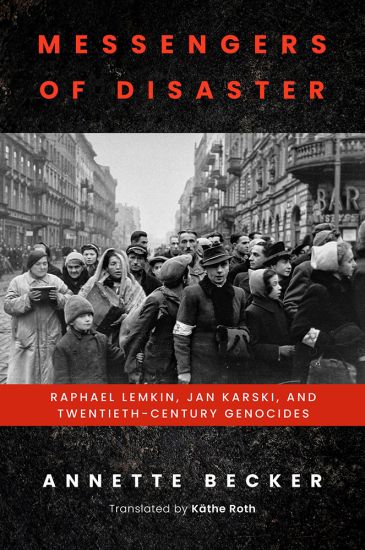
Messengers of Disaster

Annette Becker

UNIVERSITY OF WISCONSIN PRESS
2022
sidottu
Leading up to World War II, two Polish men witnessed the targeted extermination of Jews under Adolf Hitler and the German Reich before the reality of the Holocaust was widely known. Raphael Lemkin, a Jewish lawyer who coined the term "genocide," and Jan Karski, a Catholic member of the Polish resistance, independently shared this knowledge with Winston Churchill and Franklin D. Roosevelt. Having heard false rumors of wartime atrocities before, the leaders met the messengers with disbelief and inaction, leading to the eventual murder of more than six million people. Messengers of Disaster draws upon little-known texts from an array of archives, including the International Committee of the Red Cross in Geneva and the International Tracing Service in Bad Arolsen. Carrying the knowledge of disaster took a toll on Lemkin and Karski, but their work prepared the way for the United Nations to unanimously adopt the first human rights convention in 1948 and influenced the language we use to talk about genocide today. Annette Becker's detailed study of these two important figures illuminates how distortions of fact can lead people to deny knowledge of what is happening in front of their own eyes.
Cote À Côte: Berry-Au-Bac Dans La Première Guerre Mondiale

Cote À Côte: Berry-Au-Bac Dans La Première Guerre Mondiale

Wencke Meteling; Annette Becker

PIE - Peter Lang
2017
nidottu
La Premi re Guerre mondiale r serve encore des surprises pour qui veut arpenter les anciens lieux de bataille ou fr quenter les archives exhum es un si cle plus tard. La cote 108, monticule entre l'Aisne et la Marne, verrou oriental du Chemin des Dames, fut un haut lieu de la Premi re Guerre mondiale, parce que sa valeur strat gique en fit un secteur prement disput entre Fran ais et Allemands de septembre 1914 novembre 1918, parce que la stabilisation du front de l'Aisne poussa la multiplication des formes d'offensive, parce que les exp riences combattantes se chevauch rent avec les exp riences d'occupation des populations civiles des arri re-fronts, et parce que le paysage, encore aujourd'hui, porte les stigmates de cette trag die quasi oubli e. Voir la cote 108 permet de comprendre comment le conflit fut v cu des deux c t s du front, par les Fran ais et les Allemands, et pourquoi 14-18 est devenu la Grande Guerre, matrice du XXe si cle. Dix-neuf contributions, chacune crite par un tandem franco-allemand de sept jeunes historiens, proposent une histoire crois e de la Premi re Guerre mondiale, partir d'un lieu qui devient champ de bataille. Ces articles abordent les types de rapport l'ennemi, comme combattant ou occupant, mais aussi les fa ons de percevoir la guerre et de la dire. Enfin, cinq archivistes reviennent sur la place des archives dans le renouvellement de la recherche, impuls e par le centenaire de la Premi re Guerre mondiale. Ils font ainsi comprendre combien sa comm moration varie selon les politiques m morielles de chaque pays. L'ouvrage, richement illustr , para t simultan ment en allemand et en fran ais, avec une pr face d'Annette Becker et une postface de Wencke Meteling.
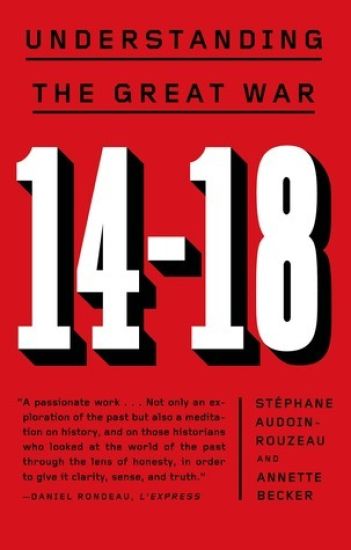
14-18: Understanding the Great War

14-18: Understanding the Great War

Stéphane Audoin-Rouzeau; Annette Becker

Hill Wang
2014
nidottu
With this brilliantly innovative book, reissued for the 100th anniversary of the beginning of World War I, St phane Audoin-Rouzeau and Annette Becker have shown that the Great War was the matrix on which all subsequent disasters of the twentieth century were formed. Three elements of the conflict, all too often neglected or denied, are identified as those that must be grasped if we are to understand the war: First, what inspired its unprecedented physical brutality, and what were the effects of tolerating such violence? Second, how did citizens of the belligerent states come to be driven by vehement nationalistic and racist impulses? Third, how did the tens of millions bereaved by the war come to terms with the agonizing pain? With its strikingly original interpretative strength and its wealth of compelling documentary evidence drawn from all sides in the conflict, 14-18: Understanding the Great War has quickly established itself as a classic in the history of modern warfare.
France and the Great War

France and the Great War

Leonard V. Smith; Stéphane Audoin-Rouzeau; Annette Becker

Cambridge University Press
2003
sidottu
France and the Great War tells the story of how the French community embarked upon, sustained, and in some ways prevailed in the Great War. In this 2003 book, Leonard Smith and his co-authors synthesize many years of scholarship, examining the origins of the war from a diplomatic and military viewpoint, before shifting their emphasis to socio-cultural and economic history when discussing the civilian and military war culture. They look at the 'total' mobilization of the French national community, as well as the military and civilian crises of 1917, and the ambiguous victory of 1918. The book concludes by revealing how traces of the Great War can still be found in the political and cultural life of the French national community. This lively, accessible and engaging book will be of enormous value to students of the Great War.